
House construction is one of the most important investments in our lives. We spend our hard-earned money and emotionally invest in the entire process. Hence, we become very particular about the look and appearance of our home. But there is one decision that we often overlook during the construction process. It is to choose the right type of bricks. One should compare the features of fly ash bricks and red bricks carefully before the construction process. Read on this blog post to understand fly ash bricks vs. red bricks and which is better for house construction.
Quick Answer
Fly ash bricks are better for modern house construction. This is because they have a uniform size and shape that ensures a smooth surface. Moreover, they offer good compressive strength to the structures. This helps you save mortar and plaster if the dimensions are consistent.
Red bricks are popular in traditional house construction. They are not only durable but also have the ability of natural thermal performance. The quality and dimensions of red bricks vary depending on the manufacturer.
Thus, fly ash bricks are suitable for homeowners who want uniformity and a clear finish. However, red bricks are an ideal choice if you want to follow traditional construction practices.
What Are Fly Ash Bricks?
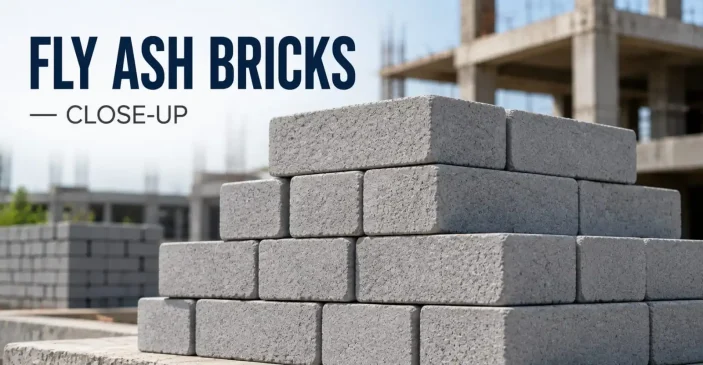
Fly ash bricks are masonry units that are manufactured through a molding and pressing process. The primary material used to manufacture fly ash bricks is fly ash. It is a fine material that is generated through coal power plants. Fly ash bricks are more consistent than many traditional red bricks.
Benefits of Fly Ash Bricks
The following are the benefits of fly ash bricks:
- Fly ash bricks provide strength to masonry construction if you perform proper quality checks.
- They reduce moisture-related problems because they have low water content.
- The workers can easily control mortar joints because the dimensions of fly ash bricks are uniform.
- Fly ash bricks offer a smooth and even surface. Thus, it makes it easy for the workers to plaster the walls.
- These bricks are lightweight. This means they are easy to handle during masonry work.
Limitations of Fly Ash Bricks
Given below are the limitations of fly ash bricks:
- The availability of fly ash bricks may vary from one locality to another.
- Transportation cost may reduce its advantage if the construction site is not near the manufacturer.
- The performance of bricks highly depends on the quality of raw materials and the curing process.
- You need professional engineers and workers for fly ash brick masonry work.
What Are Red Bricks?
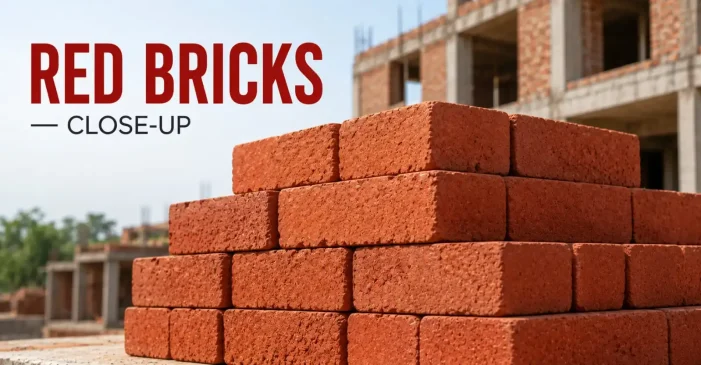
Red bricks are made from natural clay or earth. The manufacturers primarily shape the raw material into bricks. They further dry and fire the same in a kiln. Thinking about their reddish color? The red bricks get their color from the clay composition and the firing process.
Benefits of Red Bricks
Given below are the benefits of red bricks:
- Red bricks are easily available across the country. Hence, this ensures consistency in construction projects.
- Masonry workers are familiar with red brick construction practices.
- Quality red bricks offer better durability to the structures.
- Red bricks have good thermal behavior. Hence, they moderate indoor temperature to make your space feel more comfortable.
Limitations of Red Bricks
The following are the limitations of red bricks for house construction:
- Red bricks may vary in dimensions. Thus, it becomes hard to maintain uniform masonry.
- Sometimes bricks may be under-fired or over-fired. These types of bricks may lack performance.
- Porous red bricks absorb considerable amounts of water. This is why it is important to select quality bricks.
- Red brick masonry often results in wastage of materials if workers do not handle them properly.
What Is the Difference Between Fly Ash Bricks and Red Bricks?
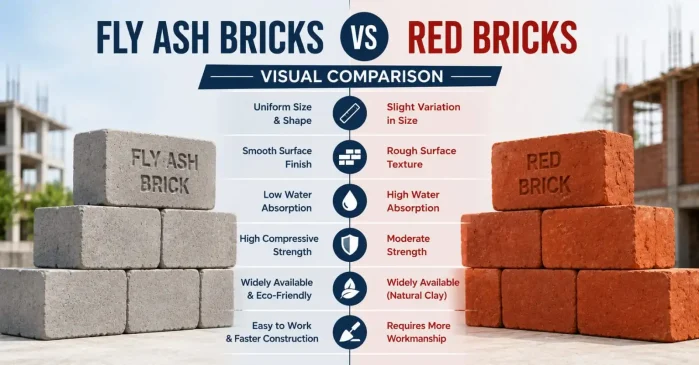
The table below highlights the difference between fly ash and red bricks:
| Parameter | Fly Ash | Red Bricks |
| Main material | It is manufactured when fly ash is mixed with other suitable ingredients. | The primary ingredient used to manufacture red bricks is clay. |
| Brick color | They appear in a grey and uniform color. | These bricks are often red or reddish-brown in color. |
| Size consistency | Fly ash bricks are consistent in size. | The size of red bricks varies depending on the manufacturer. |
| Strength | They are durable if manufactured properly. | Red bricks also offer better strength if manufactured and fired properly. |
| Water absorption | Good quality fly ash bricks absorb lower content. | Water absorption is high in quality products. |
| Availability | The availability of fly ash bricks depends on the location and the supplier. | They are easily available across the country. |
| Workmanship | It requires experts to properly handle the fly ash bricks. | Red brick masonry work is familiar to many traditional workers. |
Fly Ash Bricks vs. Red Bricks: Which Is Better For House Construction?
Fly ash bricks are ideal for modern residential projects. This is because each brick is consistent in dimension. Thus, it provides a smooth surface to the structures. Good quality red bricks are also suitable for construction if you prefer consistency with cost-effectiveness.
Some of the common factors to consider when choosing the right type of brick are as follows:
- Compressive strength
- Water absorption
- Dimensions
- Applicable Indian Standards
- Batch consistency
- Manufacturing and curing process
- Testing or quality control
Most importantly, it is advisable to hire a professional structural engineer who helps you choose the right brick as per your project requirements.
FAQs
1. Are fly ash bricks strong enough for house construction?
Yes. Good-quality fly ash bricks can provide sufficient strength for many residential masonry applications. Their suitability depends on the required compressive strength, brick quality, and structural design. Always verify test results and applicable Indian Standards before choosing bricks for your house.
2. Which brick absorbs more water, fly ash or red brick?
Water absorption depends on brick quality and manufacturing. In general, good-quality fly ash bricks tend to have lower water absorption than many traditional red bricks. However, actual performance varies, so compare tested water-absorption values before making a final choice.
3. Which brick is cheaper: fly ash or red brick?
The cheaper option depends on your location, supplier, brick quality, and transportation costs. Compare the total wall cost, not just the price per brick. Include mortar, labour, plastering, transportation, and wastage to determine which option is more economical for your project.
4. Can fly ash bricks be used for load-bearing walls?
Yes, suitable fly ash bricks can be used for load-bearing walls when their strength and other properties meet the project requirements. The required brick grade and masonry design should be confirmed by a structural engineer based on the building’s loads and design.
5. Do fly ash bricks need plastering?
Not always. Fly ash bricks have a relatively smooth, uniform surface, which can make finishing easier. Whether plastering is necessary depends on the wall design, exposure, workmanship, and desired finish. Follow the recommendations of your architect or site engineer for the application.
6. Which brick is better for hot weather?
Both fly ash and red bricks can work well in hot climates when the wall is properly designed. Indoor comfort depends on more than brick type, including wall thickness, insulation, roof design, ventilation, windows, orientation, and external finishes.
7. What should I check before buying bricks for a house?
Before buying, check compressive strength, water absorption, dimensions, consistency, visible cracks or damage, and compliance with applicable standards. Also verify the manufacturer’s quality records or test reports where available. Choosing a reliable supplier can help ensure consistent brick quality throughout construction.