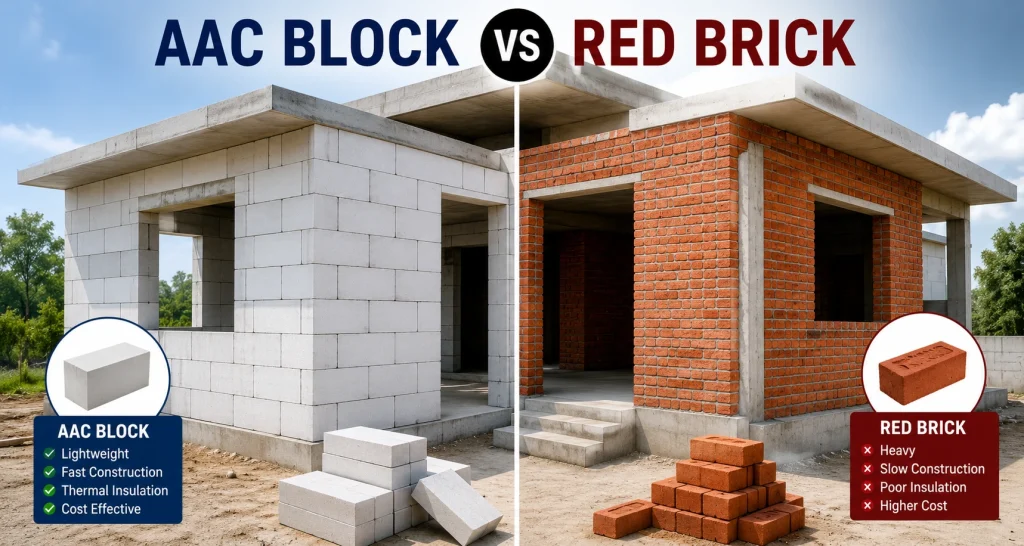
The wall material you choose affects more than appearance in home construction. It not only influences the construction speed but also the overall cost of the project. One of the popular building materials is red brick. Many homeowners also prefer AAC blocks for their home construction. So, which is better for your home? Read on this blog post to know the difference between AAC blocks and red bricks.
Quick Answer
AAC blocks are good if you want lighter walls that are easy to handle. Moreover, AAC blocks offer better thermal insulation. Red bricks are better if you need bricks in a large quantity. These bricks are also popular in areas with local masons. Both AAC blocks and red bricks are good for home construction. Engineers consider various factors like material quality and workmanship to choose the right brick for home construction.
What Are AAC Blocks?

AAC full form is autoclaved aerated concrete. These are lightweight blocks that engineers use to precast masonry units. The common materials used to manufacture AAC blocks are as follows:
- Cement
- Sand or fly ash
- Lime
- Gypsum
- Water
- Aerating agent
The manufacturers cure them under high-pressure steam. Hence, the internal air pockets make AAC blocks lighter than conventional clay bricks. The best applications of AAC blocks are residential and commercial buildings.
Key Features of AAC Blocks
Given below are the key features of AAC blocks:
- Lightweight: AAC blocks are lighter than traditional red clay bricks. Hence, they reduce the dead load on a building’s structure.
- Better Insulation: The porous structure of AAC blocks keeps interiors cool in summer. Moreover, you feel warm and cozy in winter. This helps you save on electricity bills.
- Fast construction: They are uniform in size and large in dimensions. Thus, the walls can be built up to four times more quickly than traditional bricklaying.
- Highly Durable: AAC blocks have a lifespan of 70-100 years. What’s more? They also resist fire and ensure better sound insulation.
What Are Red Bricks?

Red bricks are traditional masonry units. They are made from natural clay. The manufacturers shape the clay into bricks and fire them at high temperatures. This is why they get hard and turn into a reddish color. Red bricks in house construction have been popular for a long time. Why? This is because they are familiar to local masons. Moreover, they are easily available in many regions.
Key Features of Red Bricks
Given below are the key features of red bricks in construction:
- Eco-Friendly: Red bricks are made from natural materials. This is why they are sustainable and eco-friendly.
- Efficiency: The high thermal mass inside the red bricks also regulates indoor temperature.
- Maintenance: Red bricks are easy to maintain in homes. All you need to do is select the best quality construction materials.
- Durability: These types of bricks are highly durable. Hence, the structures stand for a longer period of time.
What Is the Difference Between AAC Blocks and Red Bricks?
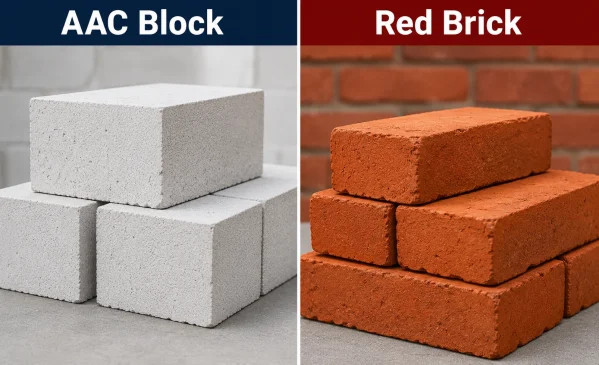 |
The table below highlights the difference between AAC blocks and red bricks:
| Parameter | AAC Blocks | Red Bricks |
| Weight | AAC blocks are lightweight. | Red bricks are often heavy. |
| Size | They are available in larger units. | They are available in smaller units. |
| Thermal insulation | Thermal insulation in AAC blocks is better than red bricks. | Thermal insulation in red bricks is often lower. |
| Handling | They are easy to handle due to their lower weight. | Red bricks are heavy. This is why more labor is required to transport them. |
| Availability | AAC blocks are available only in certain locations. | Red bricks are widely available in India. |
| Mason familiarity | It requires expert workmanship to lay AAC blocks. | Anyone with little knowledge of construction can lay red bricks. |
| Quality consistency | These blocks are manufactured under specific guidelines. | The quality may vary from one manufacturer to another. |
AAC Blocks vs. Red Brick: Which Is Better For Your Home?
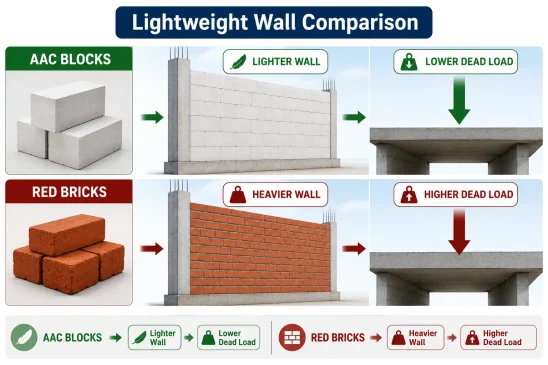
Engineers recommend both AAC blocks and red bricks for home construction. However, they may ask you the following questions before advising the right one:
- Where is the house being built?
- What does your structural engineer specify?
- Which material is consistently available in your area?
- Does your contractor have experience with AAC blocks?
- What is the total cost of a complete wall?
AAC blocks are ideal for homeowners who want better insulation in their homes. However, red bricks are more suitable for people seeking cost-efficient home construction.
The Final Words
To conclude, both AAC blocks and red bricks are good for home construction. AAC blocks are lightweight. Moreover, they offer better insulation benefits. Red bricks are commonly used because of their availability and cost-effectiveness. What’s more? It is advisable to choose AAC blocks for the construction of a new home. They not only reduce wall weight but also improve thermal performance.
FAQs
1. Are AAC blocks stronger than red bricks?
Not necessarily. AAC blocks and red bricks are available in different grades and strengths. The better choice depends on the required compressive strength and application. Always compare the specified strength of the product rather than assuming one material is stronger than the other.
2. Are AAC blocks good for house construction?
Yes, AAC blocks are suitable for house construction when the correct grade, design, detailing, and installation practices are followed. They are widely used for masonry walls because they are lightweight, easy to handle, and offer useful thermal insulation properties.
3. Which is cheaper, AAC blocks or red bricks?
The overall cost of AAC blocks vs. red bricks depends on location, material prices, and labour rates. Compare the complete wall cost, including transportation, mortar, labour, wastage, plastering, and construction time—not just the price of individual blocks or bricks.
4. Do AAC blocks reduce heat inside a house?
Yes, AAC blocks can help reduce heat transfer because their porous structure provides thermal insulation. However, indoor temperature also depends on roof insulation, windows, ventilation, building orientation, and shading. AAC blocks work best as part of an overall climate-responsive home design.
5. Can AAC blocks be used for load-bearing walls?
AAC blocks can be available in different strength grades, but their suitability for load-bearing walls depends on the structural design, specified grade, and applicable construction standards. Always consult a structural engineer before using AAC blocks for load-bearing applications in your home.
6. Why are AAC blocks bigger than red bricks?
AAC blocks are larger than red bricks so that more wall area can be covered with fewer units. This reduces the number of masonry joints and can make wall construction faster. BIS recognizes AAC block lengths of 400, 500, and 600 mm.
7. Are red bricks still good for modern homes?
Yes, red bricks are still suitable for modern homes when good-quality bricks are used correctly. Their performance depends on factors such as compressive strength, water absorption, mortar, workmanship, and proper construction practices. Their widespread availability also makes them a practical choice in many locations.