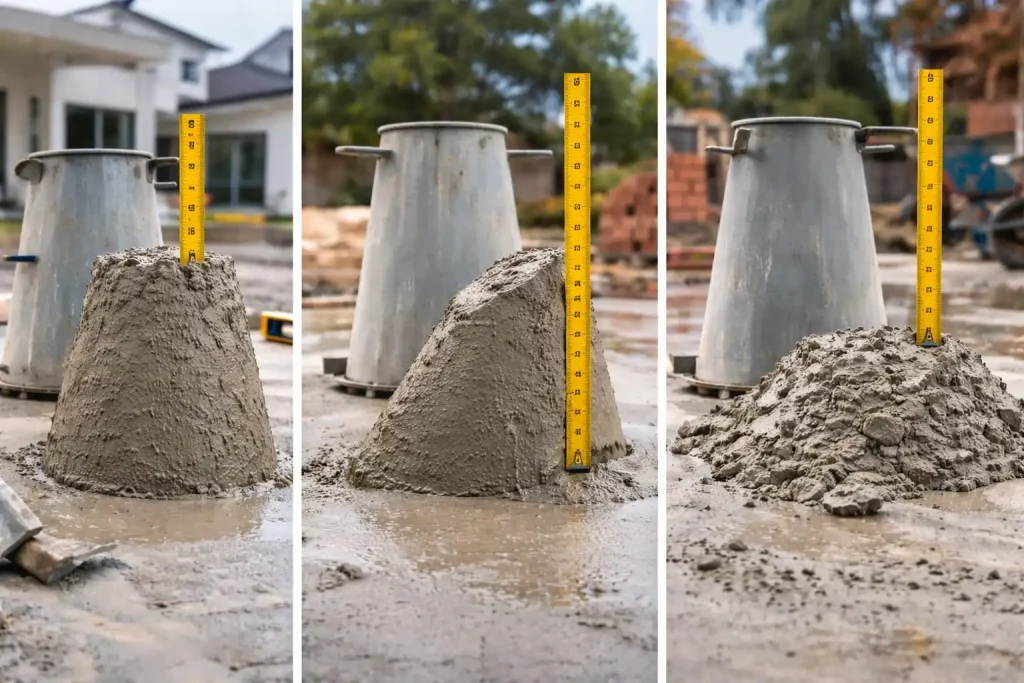

Concrete may look strong from the outside, but its real condition is not always easy to judge by simply looking at it. A building can have a clean finish while hidden problems exist inside the concrete. This is why engineers prefer non-destructive testing of concrete. It involves different test methods to understand the condition of concrete. This matters during construction and in older buildings.
A site engineer may want to check whether newly cast concrete has gained enough strength. The key point is that NDT doesn’t mean testing without breaking concrete. So, what does it exactly mean? Read on this blog post to find out!
Quick Answer
Non-destructive testing involves various methods that engineers use to assess the concrete. The best part? It helps you determine its condition, quality, and properties without damaging the structure. Given below are some of the common non-destructive testing methods for concrete:
- Rebound Hammer Test
- Ultrasonic Pulse Velocity Test
- Cover Meter Test
- Ground Penetrating Radar
- Impact Echo Test
- Half-Cell Potential Test
Engineers use these methods to study concrete strength, uniformity, cracks, voids, reinforcement location, and possible corrosion. No single NDT method can tell you everything about a concrete structure. The right approach often combines two or more tests with visual inspection and other available construction records.
Why Is Non-Destructive Testing of Concrete?
Concrete structures are expected to serve for many years. Heavy loads or exposure to rain and moisture can reduce their lifespan. Construction quality can also vary from one site to another. A problem may not become visible until the structure has already aged. NDT helps engineers investigate such concerns without causing unnecessary damage.
What Are the Different Types of Non-Destructive Testing of Concrete?

Given below are the different types of non-destructive testing:
- Rebound Hammer Test
The rebound hammer test is one of the most commonly used NDT methods for concrete. The test uses a spring-loaded hammer that strikes the concrete surface. The hammer rebounds after impact. The rebound value gives an indication of the surface hardness of the concrete.
Engineers can use this information to assess the uniformity of concrete and get an approximate idea of its compressive strength. The test is quick and requires very little preparation. It works well when an engineer wants to compare different areas of a structure.
However, surface condition can affect the result. A very smooth, rough, wet, or damaged surface may influence the reading. So, engineers should not treat the rebound value as the only proof of concrete strength.
- Ultrasonic Pulse Velocity Test

The ultrasonic pulse velocity test checks how quickly an ultrasonic pulse travels through concrete. The equipment sends a pulse through the concrete from one point to another. Engineers use the travel time to understand the quality and uniformity of the concrete. A consistent pulse indicates good-quality concrete.
However, slower movement often results in cracks or honeycombing. One of the greatest benefits of UPV is that it helps investigate concrete without damaging the member. Many engineers also use the UPV method with other tests for a more reliable assessment.
- Rebar Locator Test

Reinforcement plays a critical role in RCC construction. But once concrete covers the steel, locating the reinforcement without breaking the surface becomes difficult. A rebar locator allows engineers to assess the position and depth of reinforcement bars.
This becomes particularly useful before drilling, cutting, or carrying out repair work. It can also help engineers check whether reinforcement placement matches the available structural drawings. That can be valuable during renovation or structural assessment of older buildings.
- Penetration of Ground Radar
GPR uses electromagnetic waves to examine what lies below the concrete surface. It is especially helpful before drilling or cutting. For large structures, it can also support detailed condition surveys. The method requires trained operators because interpreting the results correctly matters as much as collecting the data.
- Half-Cell Potential Test
Corrosion of reinforcement can become a serious concern in RCC structures. The half-cell potential test helps engineers assess the likelihood of corrosion activity in reinforcement. It does not directly measure the amount of corrosion.
What Are the Uses of Non-Destructive Testing of Concrete?
Given below are the uses of non-destructive testing of concrete:
- Check concrete quality in different parts of a structure
- Assess older buildings before renovation or repair
- Find cracks and weak areas
- Locate reinforcement before drilling or cutting
- Check possible reinforcement corrosion
- Investigate bridges, dams, and industrial structures
- Support structural safety assessments
- Compare different areas of concrete
- Plan repair and maintenance work
What Are the Advantages of Non-Destructive Testing of Concrete?
The following are the advantages of non-destructive testing of concrete:
- Most NDT methods leave the structure largely intact.
- It is easy to complete various tests quickly.
- Engineers can test multiple locations across a building or infrastructure project.
- Non-destructive tests help you identify sections that need closer attention.
- Results can help engineers decide where repair or further testing may be necessary.
- NDT can reduce the need for unnecessary breaking and sampling.
The Final Words
Concrete does not always tell you what is happening inside. That is why structural assessment needs more than a quick visual inspection. Non-destructive testing gives engineers a practical way to investigate concrete while keeping the structure largely intact. From a simple rebound hammer test to more advanced radar-based investigation, each method has a role. The important part is choosing the right test for the right question.
FAQs
1. What is the main purpose of NDT in concrete?
Non-Destructive Testing (NDT) helps engineers assess concrete quality, uniformity, strength indicators, reinforcement location, and possible deterioration without significantly damaging the structure. It is useful for evaluating both new and existing concrete.
2. Which is the most common NDT method for concrete?
The rebound hammer test is one of the most commonly used NDT methods for concrete. It is quick, relatively simple, and helps assess surface hardness while providing an indication of concrete strength.
3. Can NDT accurately measure concrete strength?
NDT cannot directly measure concrete strength. It provides an estimate or strength indication based on test results. For important structural decisions, engineers may combine NDT results with other testing methods for a more reliable assessment.
4. Can NDT detect cracks inside concrete?
Yes, some NDT methods can help identify internal defects, cracks, voids, or changes within concrete. Ultrasonic pulse velocity and ground-penetrating radar are useful methods, depending on the type, depth, and location of the defect.
5. Is NDT suitable for old buildings?
Yes. NDT is particularly useful for assessing old and existing buildings because engineers can evaluate concrete condition, identify possible deterioration, and locate reinforcement while causing minimal damage to the structure.