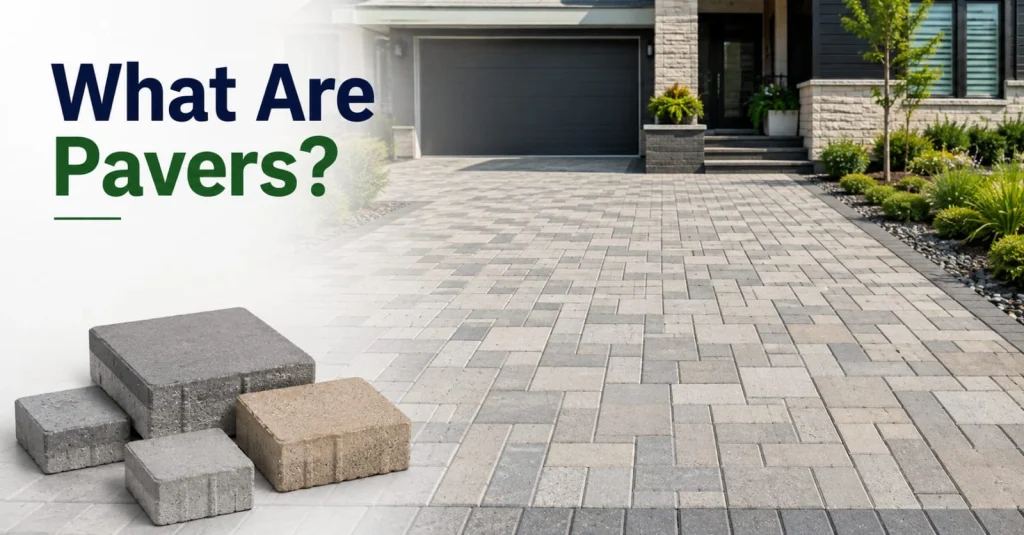
Morning walks indeed make you feel refreshed. Some people prefer to walk on a park pathway. But do you know what these pathways are made of? Many people confuse them with cement blocks. However, in reality, they are known as pavers. They are precast units that workers lay next to each other. The best part? It is easy to lift the selected blocks if you need to repair the water pipe. Read on this blog post to find out a complete guide to concrete paver blocks.
Quick Answer
Pavers are precast concrete blocks that create hard and durable surfaces. The manufacturers make them under suitable conditions and cure them properly. They are laid over sand and other aggregates carefully to prepare a base. Given below are some common applications of pavers:
- Driveways
- Footpaths
- Patios
- Parking spaces
- Pathways
- Roads
- Landscaping
But does one block carry the entire load by itself? Indeed, not! Various other processes support a paver to carry heavy loads.
What Are the Different Grades of Pavers & Their Uses?
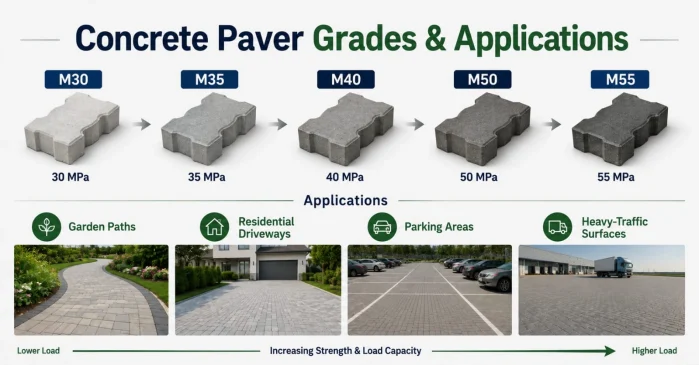
The table below shows the different grades of pavers and their common applications:
| Grade | 28-day Compressive Strength | Application Category |
| M30 | 30 Mpa | Non-traffic areas |
| M35 | 35 Mpa | Light traffic areas |
| M40 | 40 Mpa | Medium traffic areas |
| M50 | 50 Mpa | Heavy traffic areas |
| M55 | 55 Mpa | Higher demand applications |
The structural engineer selects the right grade of pavement according to the project. They may select the M55 grade for a domestic garden path. However, a low-grade block is suitable for an industrial pavement.
What Are the Benefits of Pavers in Construction?
Given below are the benefits of pavers in construction:
- Durable and Strong
Good-quality concrete pavers manage regular foot traffic and vehicle loads efficiently. However, this is only possible if you choose the right grade and pavement design.
- Easy to Repair
One of the greatest benefits of pavers is their modular design. It is easy to lift and replace a section if it gets damaged. The best part is that it does not disturb the entire surface.
- Multiple Designs and Patterns
Homeowners and designers have the flexibility to choose pavers as per their preference. This is because they are available in different shapes and laying patterns. The most intriguing part is that you can also customize the color of your pavers.
- Quick Installation
The workers can lay pavers without waiting for the concrete surface. Hence, this makes paving projects more convenient. They make the area usable at the earliest.
What Is the Process to Manufacture Concrete Pavers?
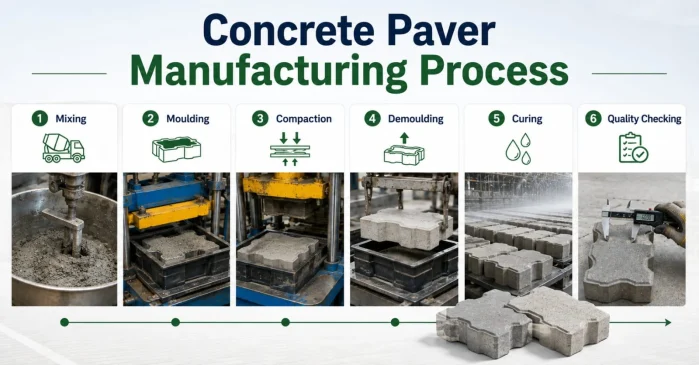
Given below is a step-by-step guide to manufacturing concrete pavers:
- Mix the Materials
The first step is to mix various building materials in controlled proportions. Thus, it will form a consistent concrete mix. It is advisable to mix the ingredients properly to ensure uniform quality and strength in the finished pavers.
- Moulding
The next step is to pour a concrete mix into specially designed molds. The final shape and size of the pavers depend on these molds. The manufacturers produce different surface designs according to the construction project. It is necessary to mold concrete accurately. This is because consistent dimensions make it easier to arrange and install them properly.
- Compaction
At this stage, the workers compact the concrete mix once it is placed inside the molds. Hence, the paver becomes more dense and uniform. This step also reduces air pockets within the material.
- Demoulding
This step involves removing pavers from their molds. The demoulding process requires extra care because it allows you to maintain a uniform surface finish. What’s more? It helps you prevent damage before the curing process.
- Curing
This is one of the most important steps in the entire process. It is necessary to cure the fresh pavers under controlled conditions. It helps the blocks achieve the required performance. Insufficient curing not only affects the quality but also influences the durability of finished pavers.
- Quality Checking and Packing
It is important to quality-check the pavers before the final packaging. The experts recommend that you check the following factors:
- Dimension
- Size
- Appearance
- Strength
Most importantly, make sure you handle the pavers properly during storage and delivery.
Which Is Better: Pavers or Concrete?
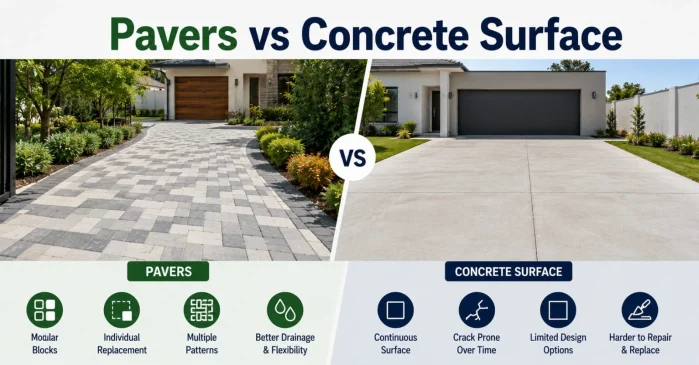
Pavers and concrete are important building construction materials. Thus, one cannot compare them with each other. However, the right choice between them depends on your project.
A concrete surface is continuous. But pavers are modular in nature. This is why pavers provide flexibility to repair and replace them easily. Concrete is a more suitable choice for various high-strength structural requirements. Given below are some common factors to consider when choosing between pavers and concrete:
- Traffic load
- Expected service conditions
- Soil quality
- Drainage
- Installation time
- Appearance
- Overall project cost
The Final Words
Pavers are popular in modern construction. This is because they are easy to replace without disturbing the whole surface. They are also made of concrete. But they provide flexibility to choose from different shapes and patterns. Moreover, you can customize the color of pavers as per your choice.
FAQs
1. What are pavers mainly used for?
Pavers are mainly used for driveways, footpaths, patios, parking areas, garden paths, courtyards, and other outdoor surfaces. The right paver grade and thickness depend on the application, expected traffic, site conditions, and overall pavement design.
2. Are concrete pavers strong?
Yes, concrete pavers can provide high strength when properly manufactured and installed. Under IS 15658:2021, concrete paving blocks are available in grades from M30 to M55, with higher grades offering higher specified compressive strength.
3. Which paver grade is best for a home driveway?
There is no single paver grade suitable for every home driveway. The choice depends on vehicle loads, soil conditions, paver thickness, drainage and pavement design. A qualified professional can recommend the appropriate grade based on the specific site requirements.
4. Can pavers withstand heavy vehicles?
Yes, properly designed paver pavements can withstand heavy vehicle loads. However, the paver grade alone is not enough. The base, sub-base, thickness, jointing, and overall pavement design must also be selected according to the expected traffic and site conditions.
5. Do pavers crack easily?
Properly selected and installed pavers can provide durable performance. However, individual blocks may be damaged by heavy impact or unsuitable loading. If cracking or settlement occurs repeatedly, the underlying pavement layers or installation may need to be checked rather than blaming the pavers alone.
6. Are pavers suitable for Indian monsoons?
Yes, pavers can be suitable for Indian monsoon conditions when installed with proper drainage and pavement preparation. Since rainwater can enter through the joints, the surface slope and underlying layers should be designed to manage water effectively and prevent prolonged water accumulation.
7. Can damaged pavers be replaced?
Yes, one major advantage of pavers is their modular design. Individual damaged blocks can often be lifted and replaced without disturbing the entire paved surface. This also makes pavers practical when underground utility repairs require temporary access to a specific section.