We often hear terms like grades of cement at a construction site. We also hear some engineers saying M20 or M25 on-site. It is easy to understand the grades of cement. However, many of us are confused about these numbers. The engineers and contractors use these numbers to determine if the concrete is suitable for a particular construction work. There are different grades of concrete in construction. Each grade has different characteristics. Read on this blog post to find out the details!
Quick Answer
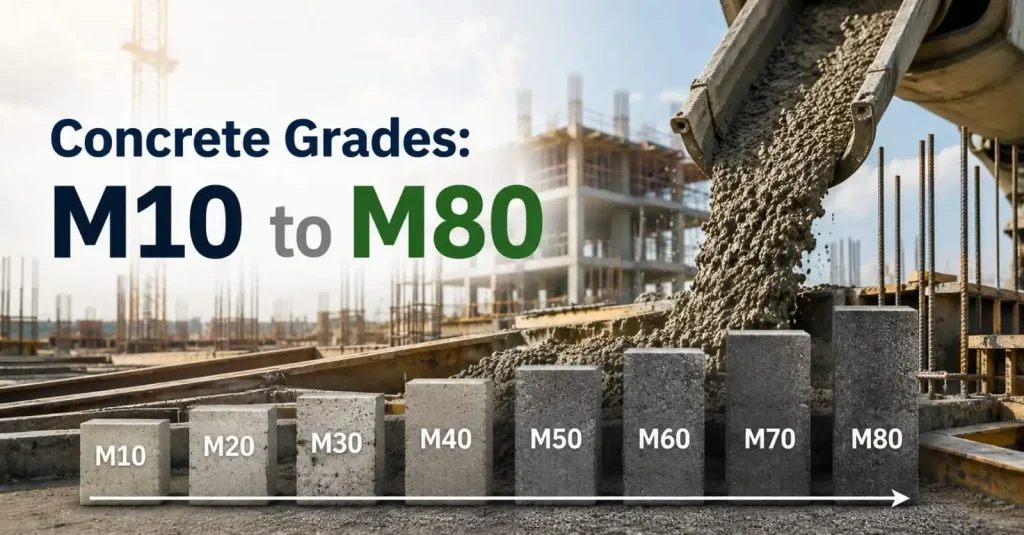
The ‘M’ in a grade of concrete refers to the mix. The numbers indicate the compressive strength in MPa at 28 days. For example, M25 represents a compressive strength of 25 MPa at 28 days. The table below highlights the grades of concrete and their uses:
| Grade of Concrete | Characteristic Compressive Strength at 28 days | Common Uses |
| M10 | 10 MPa | Lean or plain concrete |
| M15 | 15 MPa | Plain concrete and light-duty work |
| M20 | 20 MPa | General concrete applications |
| M25 | 25 MPa | Structural concrete |
| M30 | 30 MPa | Higher-strength structural work |
| M35 | 35 MPa | Demanding structural applications |
| M40 | 40 MPa | Heavy-duty structural work |
| M45-55 | 45-55 MPa | High-performance structural work |
| M60-M80 | 60-80 MPa | High-strength and specialised applications |
The number is the starting point to understand each grade of concrete.
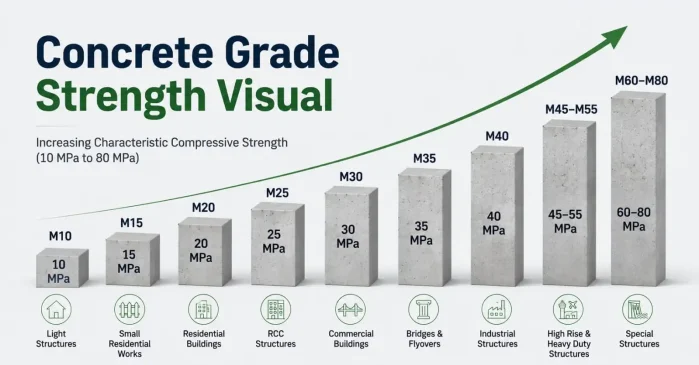
What Is the Meaning of Grade of Concrete in Construction?
Let’s understand the grade of concrete with an example: A plastic chair supports one person. However, a heavy-duty industrial chair can handle heavy loads. So, which is better? Both are ideal for different purposes.
The same principle applies to a grade of concrete. M10 grade of concrete offers lower strength. This is why it is suitable for light-weight construction projects. Many people confuse a higher number with a higher strength. However, the structural engineer selects the right grade of concrete depending on numerous factors. Some of these factors are as follows:
- Loads
- Structural Members
- Exposure conditions
- Durability
- Quality of the material
What Are the Different Types of Grades of Concrete?
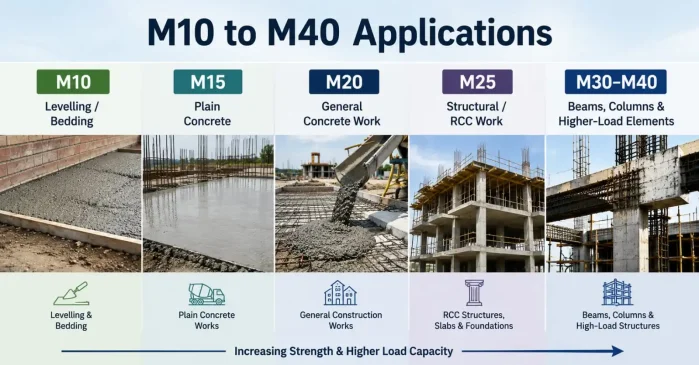
The main difference between different types of grades is their characteristic compressive strength at 28 days. Given below are some common concrete grades in construction:
It gains a strength of 10 MPa after 28 days of proper curing. It is a lower-strength concrete used for the following applications:
- Levelling courses
- Bedding
- Non-structural applications
One of the most common reasons for using M10 concrete in construction is that it creates a stable concrete base.
It is ordinary concrete that develops 15 MPa strength at 28 days. Engineers recommend using it for plain concrete work and light-duty applications. Hence, it is used in areas where moderate strength is required.
This grade of concrete gains a strength of 20 MPa after 28 days. It is also an ordinary concrete used for the construction of plain concrete applications. M20 concrete is one of the most common grades found on construction sites.
It is a standard concrete that is used for reinforced concrete work. However, the structural design specifies the need for the M25 grade of concrete. The engineers often use it for residential and structural applications that require 25 MPa characteristic strength.
Engineers use this grade of concrete for structural members that require higher strength. It is highly suitable for the construction of beams and columns. What’s more? It is a standard concrete that gains 30 MPa strength at 28 days.
It is one of the popular grades of cement for structural applications. This means that engineers use M35-grade concrete for structures that require higher compressive strength. It gains a strength of 35 MPa after proper curing for 28 days.
This grade of concrete is ideal for applications that require 40 MPa characteristic strength. The experts advise using it for heavily loaded structural elements and the most demanding construction work.
- M45-M55 Concrete
M45, M50 and M55 are the grades of concrete that offer higher strength. This is why it is used for applications with high structural loads. Some of the common applications are as follows:
- Large commercial structures
- Infrastructure projects
- Heavily loaded members
- Special construction
Tip: It is necessary to maintain quality control in a high-strength concrete mix. Choose the right building materials and mix them in the right proportions for the best performance.
- M60-M80 Concrete
All the grades of cement falling under this category offer high strength. This is why it is often used for large buildings and heavy construction projects. The most important point to remember is that higher grades of concrete need support from both production and placement processes.
What Are the Factors to Consider When Choosing the Right Grade of Cement?

Given below are the factors that influence your choice of the right grade of cement:
- Structural Load
An element with a light load requires a lower-strength concrete grade. However, a heavily loaded column may require a grade of concrete that provides higher compressive strength.
- Type of Structural Member
Different elements in the project may have different specifications. This is why it is advisable to consider the grade of concrete as per the stage and element of the structure.
- Exposure Conditions
Concrete that is exposed to moisture and other chemicals requires specific durability provisions along with strength. Moreover, you should be mindful of the cement grade for coastal regions.
- Design Requirements
The structural engineer must choose the grade of concrete according to the calculations and project conditions. One should avoid copying the concrete grade from other structures.
The Final Words
To conclude, M10 to M20 concrete grades are lower-strength cement grades. They are used for plain concrete work. M25 to M40 concrete grades cover various structural requirements. Lastly, M45 and above concrete are high-performance grades that are used for special construction projects. The engineers must consider various factors when choosing the right grade of concrete for an excellent performance.
FAQs
1. What is the grade of concrete?
The grade of concrete indicates its characteristic compressive strength at 28 days. It is written as “M” followed by a number, such as “M20,” “M25,” or “M40.” For example, M25 concrete is designed to achieve a characteristic compressive strength of 25 MPa at 28 days.
2. What does the “M” in M20, M25, or M30 mean?
The “M” stands for Mix. The number that follows it represents the characteristic compressive strength of the concrete in MPa (N/mm²) at 28 days. So, M30 means a characteristic strength of 30 MPa at 28 days.
3. Which grade of concrete is commonly used for house construction?
There is no single grade that is suitable for every house. The required grade of concrete depends on the structural design, type of member, loads, exposure conditions and applicable specifications. For RCC work, the grade should always be selected according to the structural engineer’s design rather than by choosing a grade based on general advice.
4. Is a higher grade of concrete always better?
A higher grade of concrete simply provides a higher specified compressive strength. The correct grade depends on what the structure actually requires. Using a higher grade without a design reason can increase cost and may require more careful control of the mix and construction process.
5. What is the difference between concrete grade and cement grade?
They refer to two different things. M25 or M40 describes the grade of concrete and its characteristic compressive strength. 43 Grade or 53 Grade refers to the grade of cement. So, 53-grade cement does not mean that the resulting concrete will automatically be M53. The final concrete grade depends on the complete mix design and construction process.
6. Why is concrete strength measured at 28 days?
Concrete continues to gain strength with time. However, 28 days is the standard reference age commonly used for specifying and assessing the characteristic compressive strength of concrete. That is why grades such as M20, M25 and M40 are normally expressed in terms of their 28-day strength.