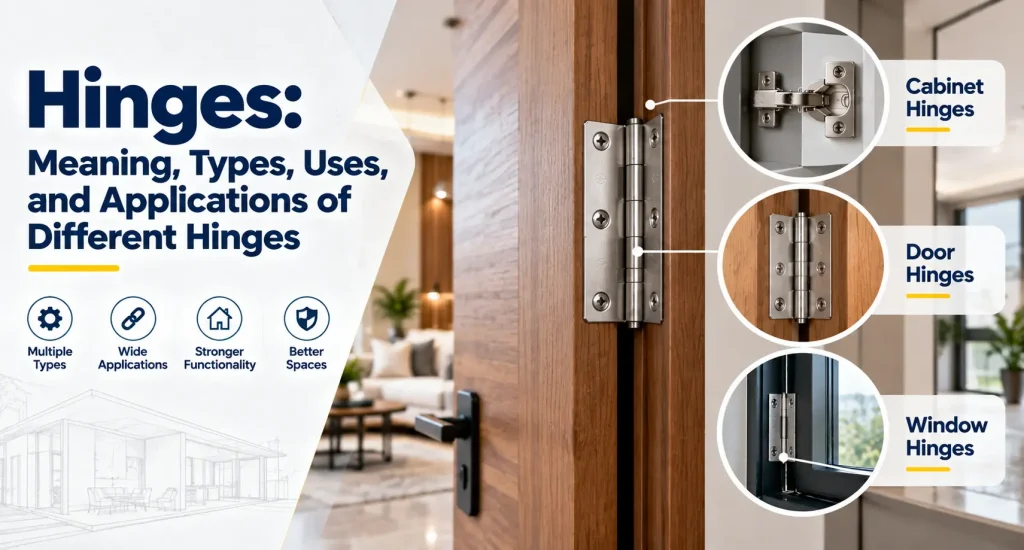
Think about the number of times you open a door in a day. Your main door. The bedroom door. The kitchen cabinet. Even a small window. Most of these everyday movements depend on one small hardware component.
The hinge. It may look simple. But it carries an important job. It connects two parts and allows one part to move around a fixed point. In building construction, hinges help doors and windows open and close smoothly. The right hinge can improve movement. So choosing a hinge should not come down to appearance alone.
Let’s understand what hinges are, the different types available, and where each type works best.
Quick Answer
A hinge connects two objects to ensure controlled rotational movement between them. Given below are different types of hinges in construction:
- Butt hinges
- Continuous or piano hinges
- Concealed hinges
- Pivot hinges
- Strap hinges
- Spring hinges
- Ball-bearing hinges
- Flag hinges
Many factors, like material, location, and more influence the choice of the right hinge.
What Is a Hinge?
A hinge allows movement between two connected surfaces. It usually has two plates or leaves joined through a central pin. One leaf attaches to the fixed frame. The other connects to the moving door, window or shutter. The pin allows the moving part to rotate.
That sounds basic. But the hinge has to handle repeated movement without losing alignment. In a house, this can mean hundreds of opening and closing cycles over time. A poorly selected hinge can create familiar problems. The door may sag. It may scrape against the floor. The frame may experience stress. The shutter may stop closing properly.
That is why hinge selection deserves attention during construction and interior work. The same principle applies to windows.
What Are the Different Types of Hinges?
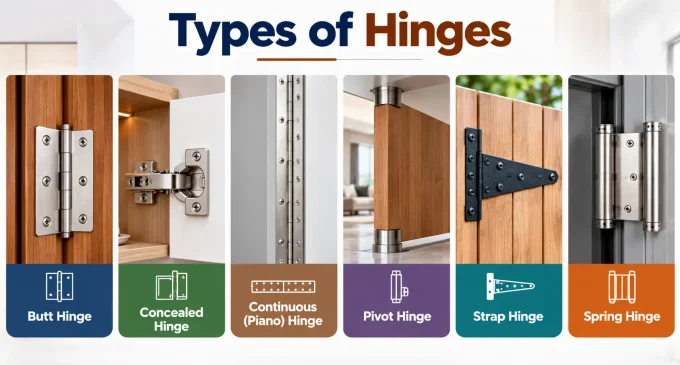
Given below are the common types of hinges:
- Butt Hinges
Butt hinges are one of the most common hinges used for doors. They have two leaves that meet closely when the door closes. The following are the common uses of butt hinges:
- Wooden doors
- Room doors
- Cupboard doors
- Small shutters
- Utility doors
Butt hinges offer a simple and reliable solution. Heavy doors may need larger or stronger hinges. The number of hinges also matters. A lightweight internal door may need fewer hinges than a heavy solid-wood entrance door.
- Concealed Hinges
Concealed hinges stay hidden when the cabinet or door remains closed. They have become common in modern interiors. The common uses of concealed hinges are as follows:
- Kitchen cabinets
- Wardrobes
- Modular furniture
- Contemporary interior doors
Their biggest advantage is appearance. The hardware does not interrupt the clean surface of the furniture. Many concealed hinges also allow adjustment. This helps installers correct small alignment issues during installation.
- Continuous or Piano Hinges
A continuous hinge runs along most or all of the length of the connected surfaces. People often call it a piano hinge because manufacturers traditionally used it on piano lids. It distributes the load across a longer area. This makes it useful where a long and continuous connection helps.
The common uses of continuous or piano hinges are as follows:
- Storage boxes
- Cabinets
- Long shutters
- Access panels
- Equipment enclosures
The long hinge also helps maintain alignment along the edge.
- Pivot Hinges
Pivot hinges work differently from conventional butt hinges. They allow a door to rotate around a pivot point. The best part? Pivot hinges provide flexibility to customise architectural designs.
Designers often recommend them for the following applications:
- Large entrance doors
- Glass doors
- Contemporary interiors
- Commercial spaces
- Feature doors
Architects often choose pivot systems when the door itself becomes part of the design.
- Strap Hinges
Strap hinges have a long visible arm that extends across the door or shutter. They often create a traditional or rustic appearance. The following are the uses of strap hinges:
- Farmhouse-style doors
- Wooden gates
- Decorative shutters
- Large timber doors
They also work well when the hardware forms part of the visual character. In such cases, the hinge does more than provide movement. It becomes a design element.
- Spring Hinges
Spring hinges contain a spring mechanism. This helps the door return towards a closed position. They can work well in spaces where people need the door to close automatically.
Some of the common applications of spring hinges are as follows:
- Light commercial doors
- Utility areas
- Certain internal doors
- Fire-door systems where approved hardware suits the application
The installer must select the correct hinge for the door weight and intended use.
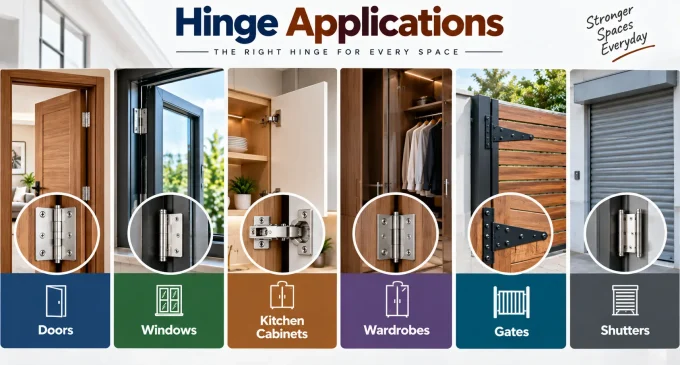
The Final Words
Hinges rarely get attention during the design stage. Most people notice them only when something goes wrong. A door starts making noise. A cabinet refuses to close. A window becomes difficult to operate. That is when the importance of good hardware becomes obvious.
The simple rule is worth remembering: Choose the hinge according to the load, movement, location and design requirement. Get that part right. The door, window or cabinet can quietly do its job for years. And in construction, that kind of quiet reliability is often the real sign of good work.
FAQs
1. What is the main purpose of a hinge?
A hinge connects two parts and allows one part to rotate around a fixed point. Hinges provide controlled movement for doors, windows, cabinets, gates, and furniture. They also help parts open and close smoothly while keeping them securely connected.
2. Which hinge is commonly used for doors?
Butt hinges are commonly used for conventional doors. They attach the door to its frame and allow smooth opening and closing. The required hinge size and number depend on the door’s weight, height, material, and usage. Heavy doors may need heavy-duty or ball-bearing hinges.
3. Which hinge is best for kitchen cabinets?
Concealed hinges are a popular choice for kitchen cabinets. They remain hidden when the cabinet door stays closed and create a clean appearance. Many concealed hinges also offer adjustment features for proper door alignment. Choose the hinge based on cabinet design, door weight, and opening angle.
4. What type of hinge works for heavy doors?
Heavy-duty butt hinges, ball-bearing hinges, and pivot hinges can support heavy doors. Ball-bearing hinges work well for frequently used doors because they reduce friction. The right hinge depends on the door’s weight, size, material, and operating frequency. Always select a hinge with a suitable load capacity.
5. Are hinges used in windows?
Yes. Window hinges allow different window styles to open and close. Casement windows often use side hinges while awning windows use top hinges. The hinge type depends on the window design, weight, and opening direction. Proper hinges also support smooth movement and secure operation.
6. How many hinges does a door need?
The number of hinges depends on the door’s size, weight, material, and hinge type. Standard doors commonly use three hinges. Taller or heavier doors may need additional hinges for better support and stability. Always follow the manufacturer’s recommendations and ensure the hinges can safely carry the door load.