Building a home is a dream come true. Isn’t it? However, it becomes painful when cracks appear on the walls after a few monsoons. Some people may blame the cement. Others may point to the poor workmanship. It is indeed true that these factors play an important role in the durability of your home.
But there is one more important factor that results in cracks after a few monsoons. Those are the bricks. They carry the entire weight of a building. Hence, weak and porous bricks may result in cracks in the building. This is why expert engineers and contractors conduct a brick test before using it for the structure.
Thinking about what it is and how it is done? Read on this blog post to find out!
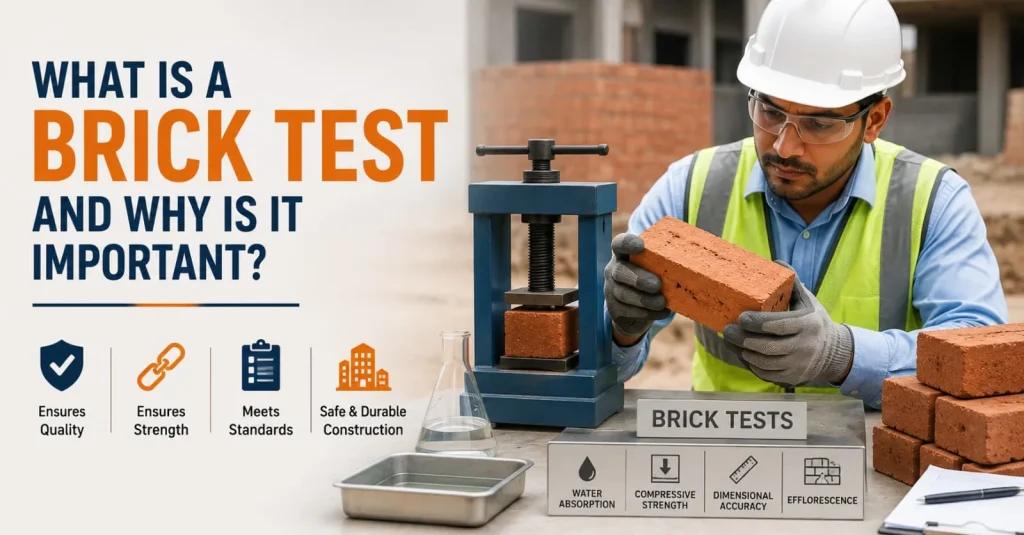
What Is a Brick Test and Why Is It Important?
A brick test is a process that engineers perform to assess the quality of bricks before construction. It helps them check the following parameters:
- Strength
- Water absorption
- Hardness
- Shape
- Resistance to salts
Some engineers may skip this process because of time constraints. However, it is one of the important steps that contractors must follow before making structures. Given below are some reasons why it is important:
- Carry structural loads safely
- Absorb limited moisture
- Resist the weather over time
- Maintain the shape and dimensions of a building
- Prevent dampness and cracks
To put it simply, brick tests not only improve a building’s life but also reduce future repair costs.
What Are the Different Types of Brick Tests?
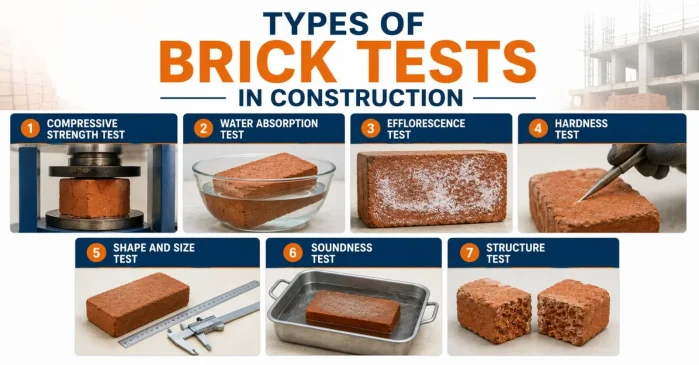
Given below are the different types of brick tests in construction:
- Compressive Strength Test
This test measures the strength of the brick. The engineers review the load that a brick can manage before it breaks. How is it done? There is a compression testing machine in which the engineer places a brick. The machine applies the pressure until it breaks. Higher compressive strength means stronger bricks. Hence, they can support the structural loads safely.
- Water Absorption Tests
The water absorption test for bricks is to determine if they can withstand monsoon rains. It allows the engineers to check the amount of water a brick absorbs after immersion.
The primary step in this type of brick test is to dry the brick in an oven and weigh it. The next step is to immerse the brick in clean water for 24 hours. You have to weigh the brick again to determine the weight percentage of the brick.
The increase in weight means that it absorbs water. However, if the weight is low, it means that the brick is dense and more durable.
Note: The water absorption limit for first-class burnt clay bricks is 20% of dry weight.
- Efflorescence Test of Brick
You must have seen white powdery patches that appear on brick walls. That’s known as efflorescence. The efflorescence test of brick is to determine if the brick contains soluble salts. These salts might migrate to the surface after water evaporates. Hence, excessive salt can result in the following:
- Damage plaster
- Peel the paint
- Affect the wall’s appearance
- Reduce durability
Bricks are classified into different categories as per the visible white salt deposits. Nil and slight efflorescence are the best categories for quality construction.
- Hardness Test
This is a simple type of brick test. The engineers use a sharp steel object or a fingernail to scratch across the brick surface. The result? The brick has good hardness if no visible scratches appear. Soft bricks scratch easily and wear out quickly during construction.
- Shape and Size Test
Uniform bricks not only make construction easy but also reduce mortar consumption. Given below is the ideal brick as per the brick test IS code:
- Sharp edges
- Rectangular shape
- Uniform dimensions
- Smooth faces
The experts place 20 bricks together in a straight line to verify the dimensional consistency of the bricks.
- Soundness Test
The sound of the brick also helps you determine the quality of the brick. A good brick produces a clear metallic ringing sound when struck against another brick. However, a dull or hollow sound means internal cracks and incomplete burning. The experts perform this quick brick test before unloading a truck of bricks.
- Structure Test
This type of brick test is done to inspect the internal structure of a brick. This is why it is broken into pieces. A good-quality brick will have the following properties:
- Uniform color
- Dense texture
- No line nodules
- No visible voids
Hence, a simple brick test helps you ensure the quality of the brick and the durability of your building’s structure.
What Is the IS Code for Brick Test?
Brick quality in India is regulated by the Bureau of Indian Standards (BIS). Given below are the primary brick test IS codes:
- IS 3495 (Parts 1 to 4): Test methods of burnt clay building bricks
- IS 1077:1992: Specification for common burnt clay building bricks
These standards define how to test the different properties of the brick. Moreover, it provides a clear picture of the acceptable quality limit of the bricks. The four major brick test methods in IS 3495 are below:
- Part 1 – Compressive Strength Test
- Part 2 – Water Absorption Test
- Part 3 – Efflorescence Test
- Part 4 – Determination of Dimensions
The prescribed brick test IS code ensures that the brick maintains quality standards for construction projects in India.
What Is the Step-by-Step Process for Brick Tests?
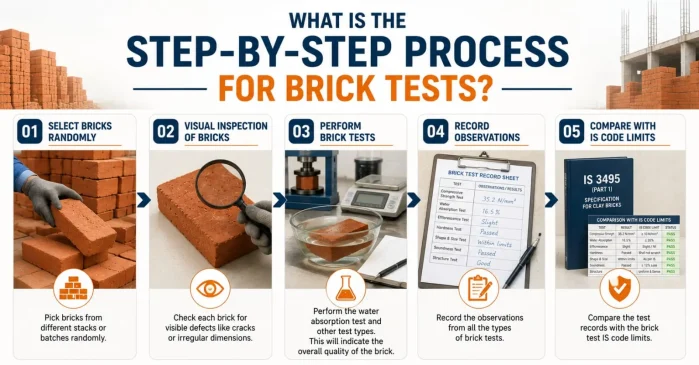
Given below are the steps to follow for testing bricks in construction:
- The first step is to pick bricks from different stacks or batches. Make sure you pick the brick randomly.
- Check each brick for visible defects like cracks or irregular dimensions.
- Perform the water absorption test and other test types. This will indicate the overall quality of the brick.
- Record the observations from all the types of brick tests.
- Compare the test records with the brick test IS code limits.
Note: The brick that passes the necessary standards is ideal for construction in India.
The Final Words
A building is reliable if the builder uses good-quality materials for the construction. Brick is also one of the most important components of masonry work. Hence, it is necessary to perform a brick test before creating the structures. This will not only ensure safety but also durability from changing weather.
FAQs
1. What is a brick test?
A brick test is a quality assessment used to evaluate a brick’s strength, water absorption, dimensions, durability, and resistance to defects. It helps determine whether bricks meet construction standards and are suitable for safe, long-lasting buildings.
2. Which IS code is used for brick testing?
The main brick test IS code is IS 3495 (Parts 1–4), which covers compressive strength, water absorption, efflorescence, and dimensional testing. IS 1077 specifies the quality requirements for common burnt clay building bricks used in construction.
3. What is the acceptable water absorption for first-class bricks?
According to the water absorption test for bricks, first-class bricks should absorb no more than 20% of their dry weight after 24 hours of immersion in water. Lower water absorption generally indicates better strength, durability, and resistance to moisture damage.
4. What is the purpose of the efflorescence test of brick?
The efflorescence test of brick identifies soluble salts that form white deposits on brick surfaces after drying. Excessive efflorescence can affect appearance, plaster adhesion, and long-term durability, making this test important for quality control.
5. What are the main types of brick test?
The most common types of brick test include compressive strength, water absorption, efflorescence, hardness, soundness, shape and size, and structure tests. Together, these tests evaluate a brick’s strength, quality, durability, and suitability for construction.
6. Can brick tests be performed on-site?
Yes, basic brick tests like hardness, soundness, appearance, and dimensional checks can be performed on-site. However, laboratory testing is required for compressive strength, water absorption test for bricks, and the efflorescence test of brick to ensure accurate results.
7. Why is brick testing important before construction?
Brick testing ensures only quality bricks are used in construction. It helps identify weak or defective bricks, reducing the risk of cracks, dampness, efflorescence, and structural failure while improving the safety, durability, and lifespan of the building.