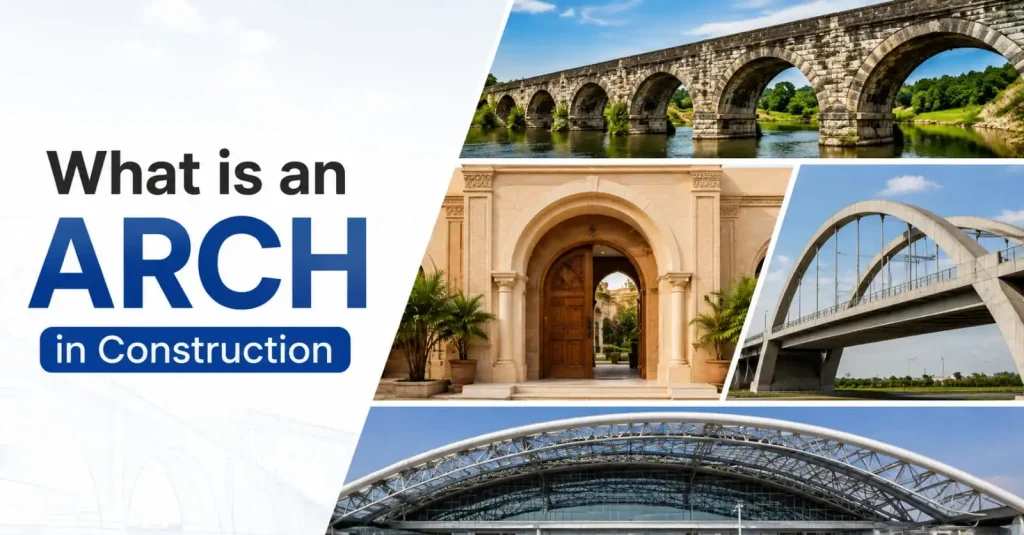
An arch is a design feature that has stood the test of time. It is found not only in a historic fort but also at the railway bridge and temple. Engineers have been using arches for a long time to build durable structures. It is one of the smartest structural solutions besides reinforcement steel and concrete. Thinking about what exactly an arch is? And which types of arches are used in modern construction? Read on this blog post to find out!
What is an Arch in Construction?
It is a curve-shaped structural element that spans an opening. The load transfers safely to the supports on either side through it. Most people confuse an arch with a flat beam. Well, it is not similar to a flat beam that bends under weight. However, it redirects the load into compression. This means the forces travel along the curve to reach the foundations.
Let’s understand it this way: Two people lean against each other and join hands overhead. They don’t fall because they push inward to support one another. This is how an arch behaves. Arches are built over the following in construction:
- Doors
- Windows
- Corridors
- Bridges
- Culverts
- Large roof spans
But what’s the history behind an arch? The concept dates back thousands of years. Historians believe early stone arches appeared in Mesopotamia, while the Romans perfected the technology. Many Roman aqueducts and bridges are still standing after nearly 2,000 years. It is proof that an arch can be effective if the engineer designs it properly.
Arches in modern construction are made using the following components:
- Stone
- Brick
- Reinforced concrete
- Steel
- Timer
Note: The engineer may add or remove the elements as per the project requirements.
How Does an Arch Work?
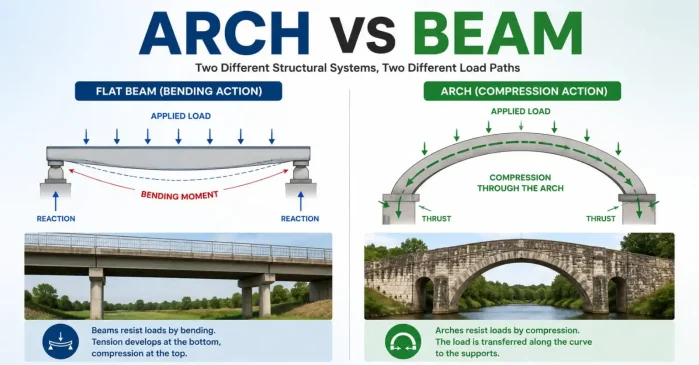
One reason engineers still rely on the arch is that it works with nature. Most construction materials, like stone or brick, perform exceptionally well under compression. However, they are relatively weak in tension. A straight beam bends when there is a load. Arch changes the direction of the force. It doesn’t bend downward and allows the load to travel along the curved path. Where exactly does it reach? It goes to the supports known as abutments.
Modern structural analysis shows that properly designed arches can carry substantial loads while using less material than an equivalent beam over long spans. That’s one reason they’re still preferred for bridges, auditoriums, airport terminals, and stadium roofs.
Of course, the strength of an arch also depends on quality materials, proper curing, accurate centering during construction, and durable concrete. A well-designed concrete mix forms the foundation of every long-lasting structural member.
What Are the Types of Arch Used in Construction?
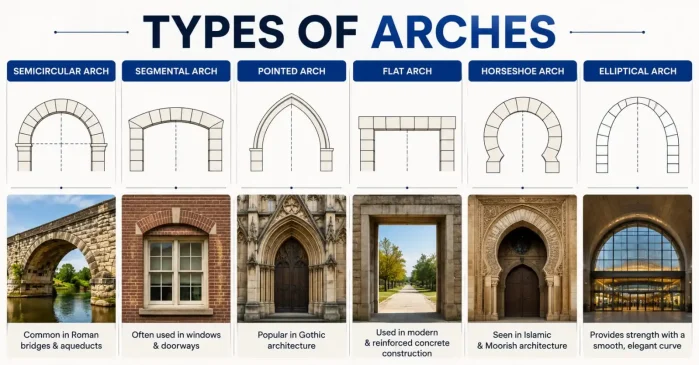
Given below are the different types of arches used in modern construction:
- Semicircular Arch
It is a classic Roman arch with a half-circle shape. The engineers mostly use it in bridges or heritage structures because it distributes loads efficiently. What’s more? It is easy to construct a semicircular arch because of its simple geometry.
- Segmental Arch
A segmental arch uses less than a half circle. It offers great headroom while maintaining structural efficiency. This is because it has a lower rise. You will mostly find the engineers using it for residential openings and bridge construction.
- Pointed Arch
This type of arch has two curved segments that meet at the top. It was most popular during the Gothic period. The best part? Its design reduces horizontal thrust, which allows you to build a tall building with large openings. The historic churches and cathedrals feature this elegant form.
- Flat Arch
Don’t confuse the feature of this arch with its name. It is called “flat” but has a slight curve that helps distribute loads. It is advisable to use it for doors and windows where you desire a straight appearance.
- Horseshoe Arch
The horseshoe arch extends beyond a semicircle. The engineers recognize it by its inward-curving profile. This architecture associates with Islamic and Moorish designs. It is one of the popular decoration materials for entrances.
What Are the Applications of Arch in Construction?
The arch has been popular for centuries because of its versatility. It not only solves structural challenges but also adds visual appeal. Given below are some common applications of an arch in construction:
- Bridges
An arch bridge transfers the weight of vehicles and pedestrians to strong supports on either side. These bridges span long distances because they transfer load through compression.
Note: Do you know which is the oldest functioning arch bridge in the world? It’s the Pont du Gard in France.
- Doors and Windows
Many homes and commercial buildings use an arch above doors and windows. Besides improving aesthetics, an arched opening distributes the load above more efficiently than a simple rectangular opening.
Note: The engineer uses flat arches in residential construction. This is because they provide structural support and a clean architectural look.
- Roofs and Large Halls
Arches are also common for the construction of airports, railway stations, and industrial warehouses. They help the engineers create wide and column-free spaces. What’s more? The architects cover large spans without filling the interior with a steel or reinforced concrete arch.
- Culverts
There is a use of arch-shaped openings in road and railway culverts as well. Why? This is because they resist soil pressure and also allow water or vehicles to pass underneath.
- Heritage and Decorative Architecture
An arch does more than carry heavy loads. It plays a significant role in architecture. From luxury homes to courtyards, temples, and mosques, arches provide a timeless and elegant appearance to the structures.
What Are the Advantages of Using Arches in Construction?
Given below are the benefits of an arch in construction:
- Excellent Load Distribution
An arch transfers loads efficiently. The forces spread evenly toward the supports rather than concentrating stress at one point. The result? It reduces bending and improves structural stability.
- High Durability
Many ancient stone arches still stand after centuries of continuous use. The construction material is evolving, but the engineering principle is the same. It is to deliver long-lasting structures with the use of quality concrete and proper workmanship.
- Attractive Appearance
Some structural elements combine engineering and architecture naturally. One of these structural elements is an arch. The engineer uses it for both a heritage bungalow and a contemporary commercial building. Why? This is because it creates visual depth and welcome character.
- Efficient Use of Materials
Loads transfer primarily through compression. This means arches achieve strength while using fewer resources. Moreover, modern reinforced concrete arches optimize material performance through careful structural design.
The Final Words
The arch is one of those rare engineering ideas that has been intact for thousands of years. It uses curves to guide forces safely into the ground. It doesn’t resist them through bending. That simple concept helps build everything, like Roman aqueducts and historic forts.
FAQs
1. What is an arch in construction?
An arch is a curved structural element that spans an opening and transfers loads to supports on both sides through compression. It is stronger than many flat beams for certain applications and is widely used in bridges, doors, windows, tunnels, and buildings for strength and durability.
2. What is the main purpose of an arch?
The main purpose of an arch is to support loads across an opening and distribute them efficiently to the foundations. This improves structural stability, reduces bending stress, and adds architectural appeal, making arches suitable for both functional and decorative construction.
3. What are the most common types of arches?
The most common types of arches are semicircular, segmental, pointed, flat, horseshoe, and elliptical arches. Each type serves different structural and architectural purposes, depending on the span, load requirements, and overall building design.
4. Why are arches stronger than beams?
Arches are stronger because they transfer loads mainly through compression instead of bending. Since materials like brick, stone, and concrete perform well under compression, arches can support heavier loads efficiently while using less material.
5. Where are arches commonly used?
Arches are commonly used in bridges, doorways, windows, tunnels, culverts, railway stations, stadiums, heritage structures, commercial buildings, and residential architecture. They provide structural strength while creating attractive and durable designs.
6. Which material is best for constructing an arch?
The best material depends on the project. Stone and brick are ideal for traditional masonry arches, while reinforced concrete and steel are preferred for modern construction because they offer greater strength, durability, longer spans, and design flexibility.
7. Are arches still used in modern construction?
Yes. Arches remain widely used in modern construction for bridges, airports, stadiums, commercial buildings, and luxury homes. They combine structural efficiency, durability, and aesthetic appeal, making them valuable in contemporary architecture.
8. What factors should be considered before choosing an arch?
Choose an arch based on span length, load capacity, building purpose, material, foundation strength, environmental conditions, budget, and maintenance needs. Selecting the right arch ensures safety, durability, cost-effectiveness, and long-term structural performance.