
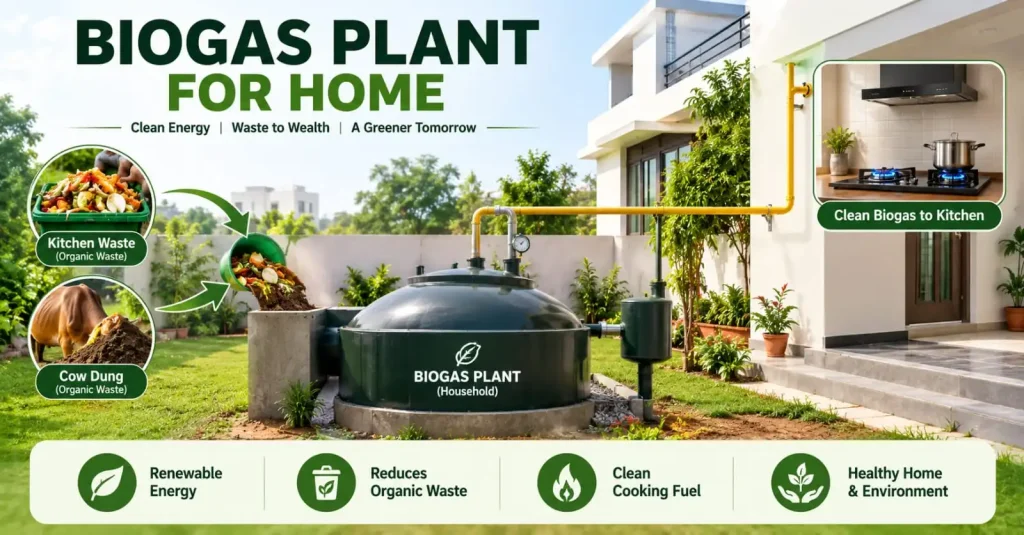
What if you could use your kitchen waste to cook your next meal? Thinking about whether it’s possible? It is indeed possible with a biogas plant for the home. A household biogas plant turns biodegradable waste into biogas and nutrient-rich slurry. In other words, it is similar to a recycling bin. But how do you install a biogas plant in a home? How much does it cost in 2026? Read on to know the answers with a biogas plant diagram.
Quick Answer
A biogas plant for the home is a system that converts organic waste into biogas. Different types of biogas plants may require different quantities of organic waste. Some of these are as follows:
- 1 m³ plant requires 25 kg of dung per day
- 2 m³ plant requires 50 kg of dung per day
A 2 m³ biogas plant for the home is ideal for a family of 4-5 people. Moreover, the average cost to install this biogas plant for the home is ₹17,000. It might change as per the following factors:
- Materials
- Labour
- Piping
- Burner
- Civil Work
- Location
Thus, the cost of a biogas plant for a home may vary as per the market conditions.
What Is a Biogas Plant for a Home?
A biogas plant for the home is a chamber where microorganisms break down organic matter. The best part? This process happens without oxygen. Hence, it is called anaerobic digestion. This forms a gas that contains methane and carbon dioxide. Methane acts like a fuel. Many people confuse a biogas plant for home as a fuel machine. However, it is a waste-to-energy cycle machine that turns your kitchen waste into useful energy.
Home Biogas Plant Diagram: What Are the Key Components?
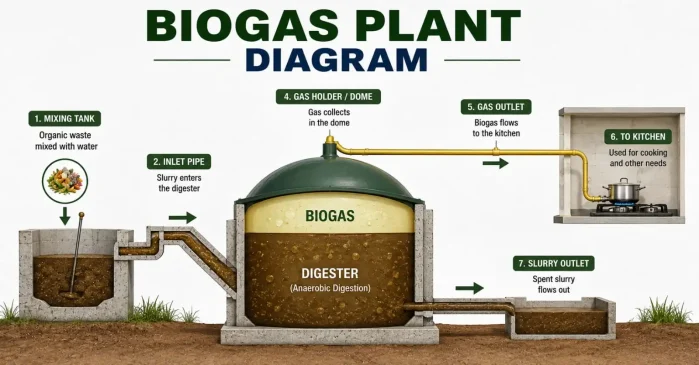
Given below are the key components in the home biogas plant diagram:
- Mixing Tank: It is a place where dung or organic waste is mixed with water. Hence, it makes a pumpable slurry.
- Inlet Pipe: The slurry travels from the mixing tank into the digester through an inlet pipe.
- Digester: It is known as the heart of the biogas plant. This is because anaerobic digestion happens in the digester.
- Gas Holder or Dome: The biogas collects in the upper portion of the plant. It may also be stored in a separate gas holder as per a specific design.
- Gas Outlet Pipe: The produced gas flows to the kitchen through this pipe.
- Slurry Outlet: An equivalent amount of digested slurry moves towards the outlet. It happens when a new slurry enters the digester.
What Are the Types of Biogas Plants for Home?
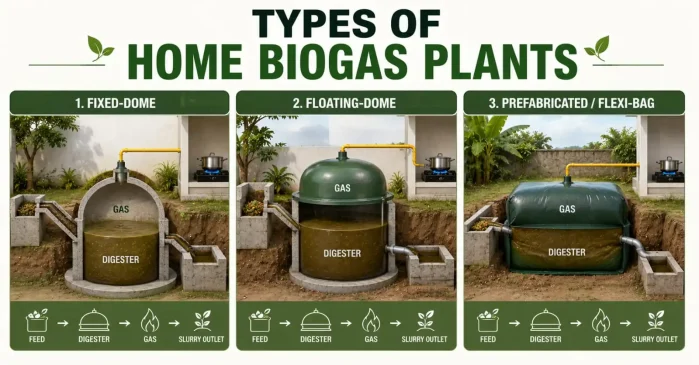
Given below are the different types of biogas plants for the home:
- Fixed-Dome Biogas Plant
The digester and gas storage structure are built on concrete structures. Hence, the Deenbandhu fixed-dome model is one of the best biogas plant models. Fewer moving parts make it ideal for permanent civil construction.
- Floating-Dome Plant
This type of biogas plant for home has a floating drum. This drum rises and falls with the changes in gas production. The Ministry of New and Renewable Energy lists the KVIC floating-dome biogas plant design as one of the best models.
- Prefabricated or Flexi-Bag Plants
Prefabricated RCC digesters are also common in a biogas plant for a home. It is ideal for homes that prefer quick installation and less maintenance.
What Is the Guide to Install a Biogas Plant at Home?
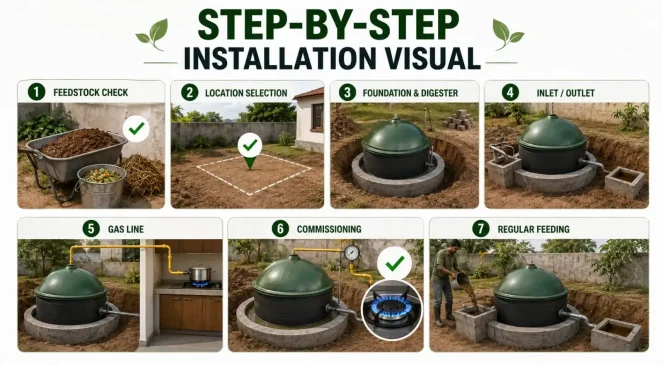
Given below is a step-by-step guide to install a biogas plant at home:
- Check Your Feedstock
The first step is to calculate the quantity of dung or organic waste you can supply each day. It is advisable to size the biogas plant on the quantity you can provide consistently.
Tip: Government guides highlight that 25 kg of cattle dung per day is required for 1 m³ of gas capacity.
- Select The Location
The area should be open and must have enough space for the digester. Moreover, it is necessary to keep the gas pipe route as short as possible. The experts also recommend choosing a location where you can easily clean or maintain the biogas plant.
- Prepare the Foundation and Digester
The experts follow the excavation and masonry work as per the chosen biogas plant design. This is where accuracy is necessary. A small construction mistake can cause leakage or poor slurry movement in the future.
- Connect the Inlet and Outlet
The inlet is a system that allows slurry to enter smoothly. However, the outlet is responsible for the seamless flow of digested slurry.
- Install the Gas Line
The gas pipe connects the plant to the kitchen stove. Hence, it is advisable to be careful and follow safety arrangements when you install the gas line.
- Commission the Plant
The starter slurry charges the biogas plant. The initial gas may not burn properly. This is because the system needs time to establish digestion. It is necessary to check the signs of gas leakage at this stage.
- Start Regular Feeding
The biogas plant is installed at your home. All you need to do is feed it regularly. The experts recommend that you avoid overloading the plant. It can upset the digestion process of the system.
The Final Words
A biogas plant for home works due to microorganisms. But their performance depends on consistency. A household biogas plant can turn waste into cooking fuel. However, it is advisable to install it only if you have enough cattle dung or organic waste. It is advisable to hire an expert and understand the components of the biogas plant diagram. This is because each component is necessary for a seamless operation of the system.
FAQs
1. Is a biogas plant suitable for every home?
Not necessarily. A biogas plant for home works best when you have a reliable daily supply of organic waste, such as cattle dung or suitable kitchen waste, along with enough space for installation. Homes without regular feedstock may not benefit from installing a biogas plant.
2. How much cow dung is required for a home biogas plant?
A home biogas plant generally requires around 25 kg of cattle dung per day for a 1 m³ plant and approximately 50 kg for a 2 m³ plant. The exact requirement can vary depending on plant design, feedstock quality and operating conditions.
3. Can kitchen waste be used in a biogas plant?
Yes, kitchen waste can be used in suitable biogas plants, provided the system is designed to handle it. Food scraps and other biodegradable waste can produce biogas through anaerobic digestion. However, plastics, metals and other non-biodegradable materials should not be added.
4. Can biogas replace LPG completely?
A biogas plant for home can reduce LPG consumption, but complete replacement depends on daily gas production, plant capacity, feedstock availability and household cooking requirements. A family with consistent organic waste may generate enough biogas for a significant portion of its regular cooking needs.
5. What comes out of a biogas plant besides gas?
Besides biogas, a home biogas plant produces digested slurry. This nutrient-rich by-product can be used as organic manure for gardens, farms and plants. Properly managed slurry helps turn household or agricultural waste into a useful resource instead of sending it to waste disposal.
6. How long does a biogas plant take to start producing gas?
A biogas plant does not produce full gas output immediately after installation. Start-up time depends on the plant design, feedstock, temperature and commissioning process. Gas production gradually increases as anaerobic microorganisms become established inside the digester.
7. Is a biogas plant safe?
Yes, a properly designed and maintained biogas plant for home can be used safely. However, biogas is flammable, so gas leaks, damaged pipes, poor ventilation and open flames near the plant should be avoided. Installation and commissioning should preferably be handled by trained professionals.