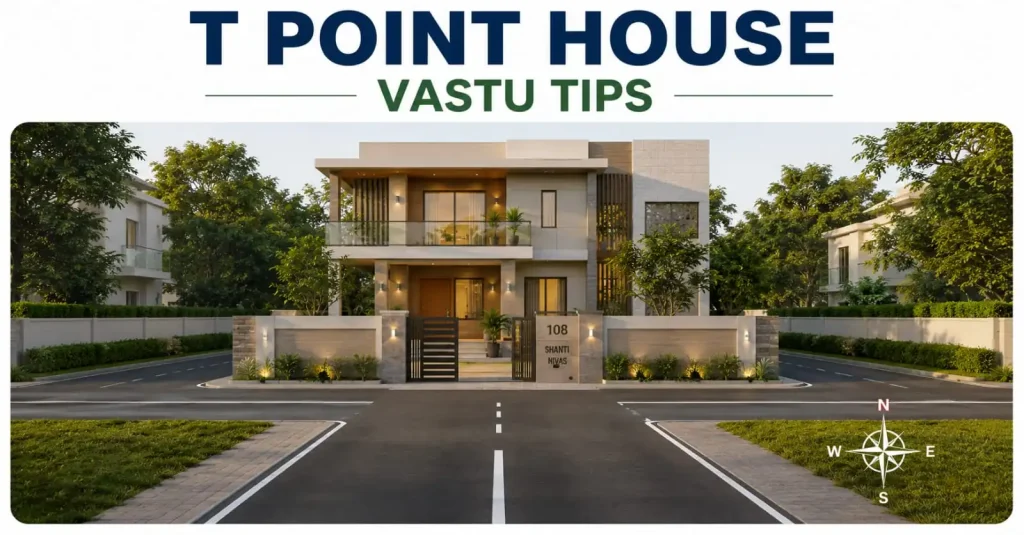
Home is a place that makes you feel comfortable. A beautiful outdoor view makes it even more beautiful. This is why homebuyers often focus on buying park-facing flats. They choose T-junction apartments. But it is important to know that a house at a T-junction can have a T-point Vastu dosh. Moreover, the road’s direction and your house’s alignment are also important in traditional Vastu Shastra. So, is it good or bad to invest in a T-point house? What are the tips to follow for positive energy near a T-point property? Read on this blog post to find out!
Quick Answer
T-point Vastu highlights that a house located directly at the end of a road is unfavorable. This is because the road directs concentrated energy towards the property. However, all T-point houses are not bad. The following factors influence the T-point house as per Vastu:
- Road direction
- Position of the main entrance
- Distance between the road and house
- Traffic movement
- Overall site layout
It is advisable to keep the above points in mind before making a final decision to buy a property.
What Is a T-Point House According to Vastu?
A T-point house is a property where one road runs directly towards another road. Moreover, the house or plot sits at the end of that approach. Let’s understand it with the letter T. The vertical line in it represents the approaching road. However, the horizontal line represents the road in front of the property. It is often known as Veethi Shoola and a road thrust in Vastu Shastra. The most common challenge in T-point Vastu is that the road movement points directly at the house. But it is important to remember that the main door should not point directly towards the road.
Is a T-Point House Good or Bad According to Vastu Shastra?
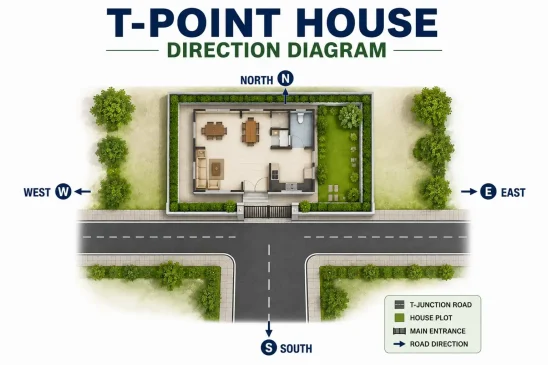
A T-point house is both good and bad according to Vastu Shastra. It depends on the direction from which the road approaches the property. Given below are some of the good and bad T-point house Vastu directions:
Favourable Directions
- North
- Northeast (Eshanya)
- East
Unfavourable Directions
- South
- Southwest
- West
- Southeast

T-Point House Vastu Dos: What Should You Do?
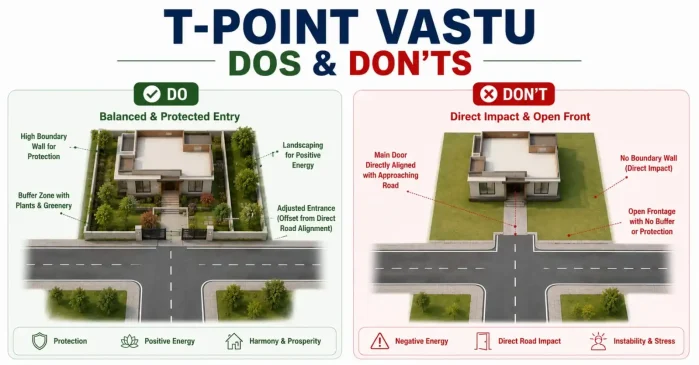
Given below are the common T-point Vastu dos for positive energy:
- Build a Buffer Zone
The best T-point Vastu approach is to create a distance between the road and the main living area. A strong compound wall acts as a physical boundary between the road and your home. What’s more? You can use dense plants or trees along the boundary to create a natural screen.
- Adjust the Main Entrance
The main entrance is one of the most important things to assess in T-point roads. If the road appears directly towards the main door, it is advisable to change the entrance position. It should not sit directly in the line of the approaching road.
- Use Convex Mirrors
Convex mirrors are a traditional remedy for a T-point Vastu concern. All you need to do is place a convex mirror outside the house. It should face the approaching road or T-junction so it redirects negative energy away from the property. However, make sure that the mirror does not create glare for others.
- Add Heavy Structures
It is advisable to place a heavy structure between the approaching road and the main residential areas. The heavy element acts as a buffer against the concentrated impact of the road.
T-Point House Vastu Don’ts: What Should You Avoid?
Given below are the things to avoid as per T-point house vastu:
- Avoid Main Door Directly Facing the Road
The main door facing the road is one of the main concerns in T-point Vastu. Thus, the road movement creates a direct flow of energy towards the front door. This is why experts recommend avoiding the main door facing the approaching road.
- Do Not Use Excessive Glass or Transparent Doors at the Front
Large glass doors provide a modern look to the home. However, excessive transparency at a road-facing entrance is not good as per T-point Vastu. This is because a transparent door provides little privacy during traffic congestion.
- Do Not Leave the Front Open
A boundary between the public road and the private home benefits a T-point property. You can either create a compound wall or place a gate for a suitable boundary element.
- Do Not Use Dark or Gloomy Colors
Traditional Vastu recommends light and calm shades for the exterior. Dark colors at a T-point main door attract heavy or stagnant energy. However, a lighter shade provides a soft visual appearance.
How to Check T-Point Before Buying a House for Positive Energy?
The table below highlights the key points to consider when you buy a house at T-point:
| Key Factor | Why It Matters |
| Direction of the road | It is important for traditional T-point vastu. |
| Road alignment | It shows the part of the property that faces the road. |
| Main entrance | It helps assess the relationship between the road and the entrance. |
| Setback from road | It creates a physical buffer to ensure privacy at home. |
| Headlight movement | It is necessary to check the headlight movement if your bedroom or living spaces face the T-point. |
| Drainage | It helps you identify monsoon-related problems. |
| Ventilation and Natural daylight | It makes your space feel more comfortable. |
The Final Words
A T-point house is a good option if you follow the above-mentioned points. It is advisable to check the road direction and alignment carefully before a final purchase. Most importantly, compare different properties and focus on the overall layout of the plot. Good-quality building material and Vastu-compliant construction ensure that your building performs well.
FAQs
1. Is a T-point house bad according to Vastu?
A T-point house is assessed based on factors such as road direction, entrance location, plot layout, and the exact point where the road faces the property.
2. Which T-point direction is considered good in Vastu?
There is no single direction that can be labelled universally good or bad without considering the entire property. Traditional Vastu assigns different significance to North, South, East, West, and the intermediate directions. Therefore, the road direction should be assessed along with the entrance and floor plan.
3. What is a T-point Vastu dosh?
A T-point Vastu dosh refers to the traditional Vastu concern associated with a road appearing to thrust directly toward a property. The interpretation can vary according to the direction, entrance, and surrounding layout.
4. Can a boundary wall help with a T-point house?
A boundary wall can create a physical and visual separation between the road and home. Traditional Vastu practitioners may recommend specific layouts depending on the property, while practically, a boundary can also improve privacy and security.
5. Should the main door face a T-point?
If you are concerned about T-point Vastu, this should be assessed carefully rather than applying a blanket rule. Check the road direction, entrance position, setback, and complete floor plan.
6. Is Vastu scientifically proven?
Vastu Shastra is a traditional Indian system of architecture and spatial planning. Its concepts around directional energy have not been established as scientific laws. Practical factors such as daylight, ventilation, drainage, safety and structural quality can be assessed through conventional architectural and engineering methods.