But the staircase? That usually gets attention much later.The irony is, a staircase affects daily life more than most design elements in a home. If it feels too steep, too narrow, or awkward to climb, you notice it every single day.
That’s one reason the dog legged staircase continues to be one of the most trusted staircase layouts in modern construction. It saves space, feels comfortable to use, and fits naturally into compact Indian homes.
Whether it’s a duplex house, apartment building, or even a school or office, a well-planned dog legged staircase design quietly makes movement easier without occupying too much floor area.
One reason dog legged stairs are still widely used is because they balance comfort and space efficiency so well.
What Is a Dog Legged Staircase?
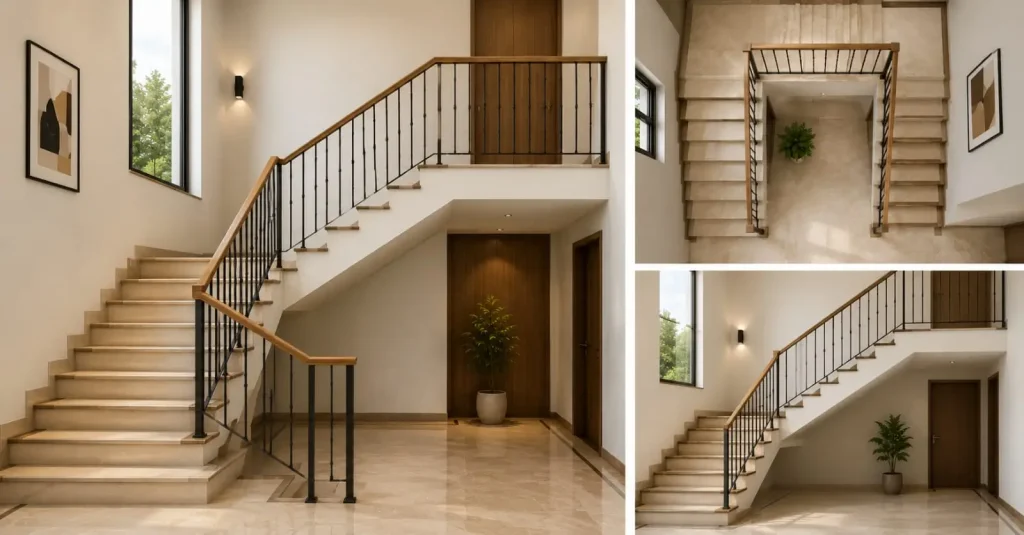
A dog legged staircase has two flights running in opposite directions and connected by a landing in the middle.
Instead of one long straight staircase stretching across the house, the staircase folds neatly into itself. That folded arrangement is exactly why dog legged stairs are considered ideal for compact layouts.
The name comes from its side profile, which resembles the bend of a dog’s hind leg.
You’ll commonly see this staircase style in:
- Duplex homes
- Apartments
- Small urban houses
- Commercial buildings
- Schools and hospitals
In cities where every square foot matters, a practical dog legged stairs plan helps save usable space without compromising comfort.
Why Dog Legged Staircases Are So Popular
In compact urban homes, dog legged stairs are often the first recommendation by architects.
It simply works.
A straight staircase may look elegant in large villas, but in most modern homes, space becomes a serious concern. That’s where a dog legged staircase design becomes practical.
Because the staircase changes direction midway, it fits into a smaller rectangular area.
Another reason dog legged stairs are preferred is safety. The landing in between creates a natural break while climbing.
Elderly people and children often find this layout easier compared to long, uninterrupted staircases.
Main Parts of a Dog Legged Staircase
Even though the design looks simple, every part of the staircase plays an important role.
Flights
A flight means a continuous set of stairs without interruption.
In a dog legged staircase, two flights move in opposite directions.
Landing
The landing is the flat platform between the flights.
It allows people to turn comfortably before continuing upward.
Treads
The tread is the horizontal part where your foot rests.
Risers
The riser is the vertical section between two steps.
Bad riser height is usually why some staircases feel tiring to climb.
Handrails
Handrails improve balance and safety, especially in homes with elderly family members.
A good dog legged stairs plan carefully balances all these components so the staircase feels natural and comfortable during everyday use.
The Right Dog Legged Stairs Plan
This is where many homeowners make mistakes.
They focus only on appearance and ignore dimensions.
A staircase may look beautiful in photos, but if the measurements are wrong, using it daily becomes frustrating.
A proper dog legged stairs plan starts with understanding the following:
- Floor height
- Available space
- Stair width
- User comfort
- Building regulations
Proper measurements matter because dog legged stairs are used every single day.
Standard Dimensions
- Riser Height: 6–7 inches
- Tread Depth: 10–11 inches
- Stair Width: 3–4 feet
- Landing Width: Equal to stair width
These dimensions are widely used because they feel comfortable for everyday movement.
If the riser becomes too high, climbing feels exhausting.
If the tread becomes too small, the staircase starts feeling unsafe.
That’s why experienced builders spend extra time finalising the dimensions of a dog legged staircase design before construction begins.
Popular Dog Legged Staircase Design Ideas
Modern homes no longer treat staircases as purely functional.
Today, staircases are part of the interior style too.
Concrete Staircase
This is still the most common option in Indian homes.
Strong, durable, and cost-effective.
Wooden Finish
Wood instantly adds warmth and softness to interiors.
Many homeowners now use wooden treads over RCC structures for a balanced look.
Marble or Granite Finish
Popular in premium homes because of the polished appearance and durability.
Steel and Glass
Minimalist homes often prefer steel railings with glass panels.
This style makes smaller spaces feel visually open.
A modern dog legged staircase design is no longer just about reaching the next floor. It also contributes to the personality of the home.
Materials Commonly Used
The overall appearance of a staircase changes completely depending on the material.
Common choices include:
- RCC (Reinforced Cement Concrete)
- Wood
- Steel
- Marble
- Granite
- Glass railings
Many homeowners today combine materials to create a more modern dog legged staircase design without making the structure overly expensive.
The Final Words
In today’s compact homes, dog legged stairs are one of the smartest solutions for comfortable movement between floors.
A staircase may not be the first thing guests notice in a home.
But the people living there use it every single day.
That’s why practical planning matters.
A properly designed dog legged staircase balances comfort, safety, movement, and space efficiency better than most staircase layouts.
In compact homes, especially, it remains one of the smartest solutions because it quietly solves a problem without demanding extra space.
Sometimes, good design is simply about making daily life easier.
FAQs
1. What is a dog legged staircase?
A dog legged staircase has two stair flights running in opposite directions connected with a landing in between.
2. Why are dog legged stairs popular in modern homes?
Because dog legged stairs are compact, space-saving, and comfortable for everyday use. Many homeowners believe dog legged stairs are easier to maintain.
3. What is the standard width of a dog legged staircase?
Most residential staircases are between 3 and 4 feet wide.
4. Is a dog legged staircase suitable for small houses?
Yes. A compact dog legged stairs plan works very well in smaller urban homes.
5. Which material is best for a dog legged staircase?
RCC is the most commonly used option because of its durability and strength.
6. Are dog legged staircases safe?
Yes. A properly planned dog legged staircase design with good lighting and handrails is very safe.
7. What are the disadvantages of dog legged staircases?
They can sometimes feel enclosed and may make moving large furniture slightly difficult.