A site-first guide to why decks fail from below — long before the boards rot
Executive Summary (for fast readers)
A deck is not decoration.
It is a structural extension exposed to weather, load, and movement.
Deck failure rarely starts on the surface.
It starts in support, drainage, and detailing.
Good-looking decks fail fast when structure is ignored.
Average-looking decks last decades when load paths are respected.
In Indian conditions, deck design matters less than deck construction logic.
This distinction is where most projects go wrong.
Deck Meaning — What a Deck Actually Is on Site
On drawings, a deck looks simple.
On site, it behaves like a small bridge attached to a building.
In construction terms, deck meaning is straightforward:
A deck is a load-bearing, exposed platform, either attached to or independent of a structure, designed to carry people, furniture, and weather — continuously.
This matters because:
- Decks carry live loads, not just finishes
- Decks face direct sun, rain, and temperature cycles
- Decks amplify construction errors faster than internal floors
Paint hides mistakes indoors.
Decks expose them outdoors.
This is why experienced site engineers treat decks as structural elements first, lifestyle features later.
Deck in Construction — Why It Is a Risk Zone
From a construction perspective, decks sit in the most unforgiving zone of a building.
They experience:
- Direct rainfall
- Thermal expansion and contraction
- Differential movement between slab, beam, and support
- Continuous moisture cycling
In Indian projects, deck failures usually appear as:
- Tile debonding
- Timber warping
- Water seepage into the slab below
- Rusting of steel supports
- Hairline cracks turning structural over time
The problem is not the deck idea.
The problem is that decks are often built like interior floors.
They are not.
Structural Logic Behind Decks (Load & Water Path in 7 Lines)
Deck slab or frame takes live load
Load transfers to beams, posts, or cantilever
Connections carry stress, not finishes
Water always finds the weakest joint
Poor slope traps moisture
Trapped moisture attacks structure
Finish fails last — structure fails first
Deck design is not about surface material.
It is about where load goes and where water exits.
RCC Decks — The Most Misunderstood Choice
Reinforced concrete decks are common in India because they feel permanent.
And structurally, they are — if done right.
On site, RCC decks work best when:
- Proper slope (minimum 1:60) is built into the slab
- Waterproofing is treated as structural protection, not paint
- Expansion joints are respected
- Parapet detailing prevents backflow
Where they fail:
- Flat slabs with no slope
- Waterproofing applied late
- Tiles fixed directly without movement allowance
Concrete is strong.
But it cracks when restrained.
Deck in construction is where concrete needs freedom, not force.
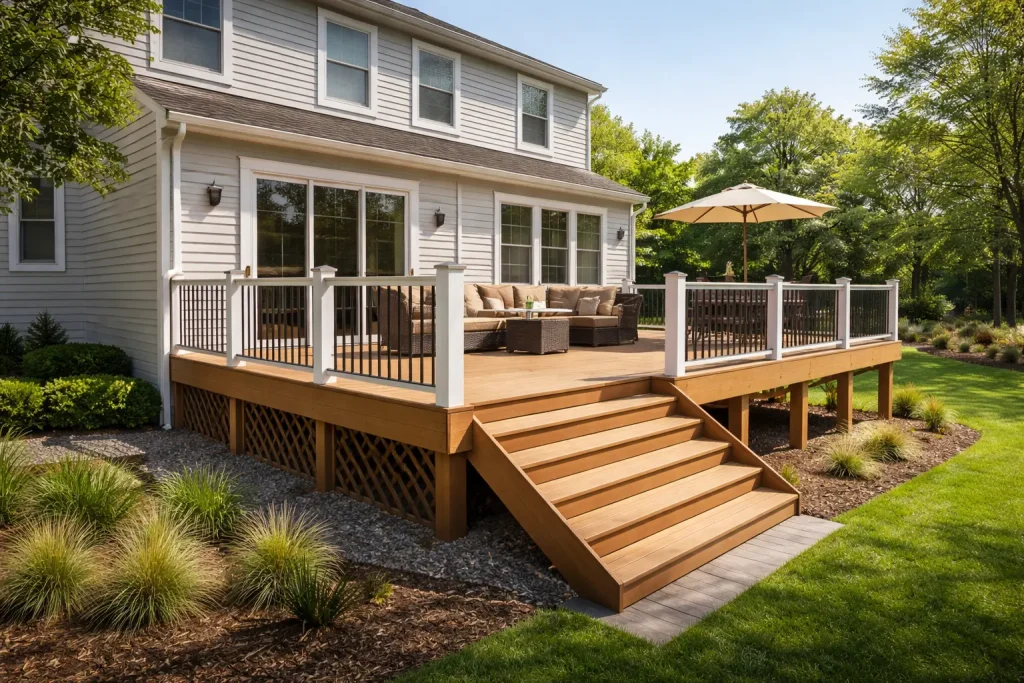
Wooden & Composite Decks — Lightweight, Not Low-Risk
Timber decks look effortless.
Structurally, they are not.
On Indian sites, wood decks fail when:
- Treated timber is skipped to save cost
- Ventilation below boards is blocked
- Fasteners rust before boards age
- Deck rests directly on slab without drainage gap
Key site truth:
Wood does not hate water.
It hates trapped water.
Composite decks solve some issues, but not all.
They still need:
- Proper joist spacing
- Thermal movement gaps
- Edge detailing
A bad substructure will destroy the best deck boards.
Deck Design — What Actually Matters
Most deck design discussions focus on:
- Board pattern
- Colour
- Railing style
On site, these matters last.
What matters first:
- Deck height relative to internal floor
- Drainage outlet location
- Connection to main structure
- Maintenance access
Good deck design quietly solves:
- Water exit
- Structural movement
- Cleaning and repair
Bad deck design looks great on day one.
And becomes a liability by year three.
Basic Deck Design Ideas That Survive Indian Conditions
These ideas are not decorative.
They are survival-tested.
1. Raised Deck with Drainage Void
Keeps water away from the slab.
Improves airflow.
Reduces seepage risk.
2. Segmented Deck Panels
Allows movement.
Prevents large-scale cracking or warping.
3. Clear Expansion Gaps
Looks untidy on drawings.
Saves the deck in reality.
4. Minimal Built-In Furniture
Less load.
Less water trapping.
Easier maintenance.
5. Shaded Deck Zones
Reduces thermal stress.
Improves material life.
A deck that ages quietly is a well-designed deck.
Why Cement Quality Still Matters in Decks
Even when decks use wood or composite finishes, cement remains critical.
Because:
- RCC slabs carry load
- Mortar beds hold tiles
- Parapets and edges stop water
In deck construction, shrinkage behaviour matters more than early strength.
Consistent cement quality — such as that from JK Cement — helps:
- Reduce micro-cracking
- Improve bond integrity
- Maintain slope accuracy
- Support long-term waterproofing performance
Deck finishes only perform as well as the concrete beneath them.
Common Deck Failures Seen on Indian Sites
These patterns repeat across cities:
- Ponding water near walls
- Cracks at slab–beam junctions
- Tile hollow sounds
- Timber blackening from below
- Rust stains at railing bases
In most cases:
The deck did not fail.
Sequencing failed.
No finish compensates for poor detailing.
When NOT to Build a Deck
| Situation | Avoid Deck When |
| RCC Deck | Slope is ignored |
| Wooden Deck | Drainage gap is missing |
| Cantilever Deck | Structural design is rushed |
| Any Deck | Waterproofing is an afterthought |
| Any Deck | Maintenance access is impossible |
This matrix saves more money than redesigns ever will.
Code & Practice Anchoring (Non-Negotiable)
Standard construction logic demands:
- Load calculations before finishes
- Waterproofing as a system, not a coat
- Movement allowance in exposed structures
Deck failures are rarely material failures.
They are design and execution failures.
Final Insight
A deck is not an outdoor floor.
It is an exposed structural platform.
Understand deck meaning as load + water + movement.
Treat deck construction as engineering, not styling.
Approach deck design as risk management, not decoration.
Because this rule does not change with budget or trend:
Decks don’t fail because of rain.
They fail because water was never given a way out.
Once a deck is built, mistakes cannot be redesigned.
They can only be patched.
And patches always fail.
Frequently Asked Questions
1. What is deck meaning in construction?
A deck is a load-bearing, exposed platform designed to carry people, furniture, and weather, either attached to or independent of a building.
2. What is the deck in construction used for?
Decks are used as outdoor extensions—terraces, balconies, sit-outs—but must be treated as structural elements.
3. Is a deck structural or decorative?
tructurally first. Decorative finishes come later.
4. Which deck type suits Indian weather best?
RCC decks with proper slope and waterproofing perform best long-term.
5. Can wooden decks be used in India?
Yes, but only with treated timber, ventilation gaps, and proper drainage.
6. Why do decks leak into rooms below?
Usually due to poor slope, failed waterproofing, or trapped water.
7. What is the biggest mistake in deck design?
Treating it like an interior floor instead of an exposed structure.