An anchor bolt is what keeps columns, machines, and heavy structures firmly tied to concrete.
In simple words, it’s a steel connector that locks a structure to its base so it doesn’t shift, tilt, or lift over time.
From factory sheds to home stair railings, anchor bolts quietly hold things in place where strength really matters.
If you’ve ever wondered how steel stays fixed on concrete, the answer is almost always an anchor fastener bolt.
On-site, anchor bolts rarely get attention. They’re small compared to columns and beams. But when they fail, everyone notices.
Sometimes, steel columns are installed perfectly, aligned to the millimetre, but still loosen later because the anchor bolt placement was rushed. At times, machines vibrate endlessly because the wrong anchor fastener bolt was used in concrete.
That’s the thing with anchor bolts. They don’t look dramatic. But they decide whether a structure stays where it’s meant to.
Understanding the meaning of anchor bolt, the different anchor bolt types, and their real-world uses helps builders, engineers, and even homeowners avoid expensive mistakes later.
What are Anchor Bolts?
An anchor bolt is a steel bolt that connects concrete to another element—usually steel, sometimes wood or equipment. It’s either cast into concrete or fixed into it later.
The simplest way to think of it is this: Concrete is strong in compression, steel handles tension, and the anchor fastener bolt makes sure the two work together.
In technical terms, an anchor bolt:
- Resists pulling forces
- Prevents sliding
- Controls vibration
That’s the basic meaning of an anchor bolt on any site, whether it’s a small house or a large industrial plant.
Types of Anchor Bolts
There are many anchor bolt types, and this is where experience matters.
Using the wrong type is one of the most common site mistakes.
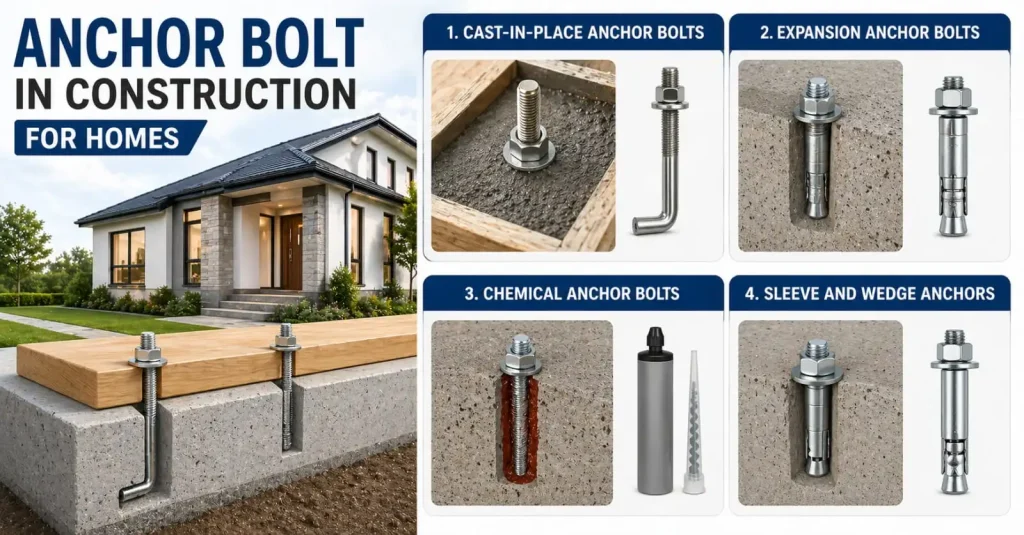
1. Cast-in-Place Anchor Bolts
You’ll usually see: L-shaped anchor bolts, J-shaped anchor bolts and straight bolts with anchor plates.
- These are placed before the concrete is poured.
- Extremely strong.
- Common in columns, sheds, and heavy foundations.
Once the concrete sets, removing it is almost impossible, which is exactly why they’re so strong.
2. Expansion Anchor Bolts
They work by expanding inside a drilled hole when tightened.
- These are installed after the concrete has hardened.
- Anchor fastener bolts are found on handrails, light steel frames, rackets and supports.
- Quick and convenient,
They are not meant for heavy loads and vibration.
3. Chemical Anchor Bolts
Chemical anchor bolts are bonded to cement with epoxy or resin.
- They are used when load requirements are high.
- Ideal for limited edge distances.
- Used when existing structures need strengthening.
On retrofit projects, chemical anchor fastener bolts are often the safest choice.
4. Sleeve and Wedge Anchors
These anchor bolt types are a preferred choice because:
- They’re easy to install and readily available.
- Suitable for medium loads where speed matters more than adjustability.
Choosing among anchor bolt types is never about price alone – it’s about load, location, and long-term behaviour.
Where are Anchor Bolts Used in Concrete?
Anchor bolts show up more often than people realise. Anywhere concrete meets another material, there’s usually an anchor bolt involved.
You’ll find anchor fastener bolts used in:
- Column base plates
- Steel sheds and warehouses
- Industrial machines and compressors
- Elevators and escalators
- Stair railings and balconies
- Solar panel structures
In reinforced concrete construction, anchor bolt placement must be accurate.
A small alignment error can delay installation or weaken the joint.
This is why anchor bolt layout is often checked twice before concrete pouring – especially in load-bearing areas.
Anchor Bolt Uses in Real Construction
The real uses of anchor bolts go beyond drawings and specifications.
- On-site, anchor bolts:
- Transfer loads from steel to concrete
- Resist uplift during wind or seismic activity.
- Control vibration in machinery
- Maintain alignment over years of use.
- In factories, anchor fastener bolts keep heavy machines stable even under continuous vibration.
- In residential buildings, anchor bolt types secure gates, railings, and staircases safely.
- During earthquakes, properly designed anchor bolts prevent structural elements from separating from their foundations.
That’s why codes treat anchor bolt design very seriously.
When combined with quality concrete and correct installation, anchor bolts perform quietly but reliably for decades. This is why JK Super Cement provides the right strength and durability.
Practical Tips from Site Experience
A few things experienced engineers never ignore with anchor bolts:
1. Positioning matters
Even a 10 mm shift can cause installation issues later.
2. Concrete quality matters
Weak concrete reduces anchor bolt capacity drastically.
3. Torque matters
Over-tightening an anchor fastener bolt can crack concrete.
4. Correct anchor bolt types matter.
One size never fits all.
This is where good material selection and proper curing play a big role. Strong concrete and accurate execution go hand in hand with anchor bolt performance. JK Super Cement is known to provide long-lasting durability.
Anchor bolts don’t look impressive. They don’t change how a building looks. But they decide how safe and stable it stays.
An anchor bolt is the link between the structure and foundation. Choosing the right anchor bolt types, installing the correct anchor fastener bolt, and planning placement properly make all the difference.
If you’re building or installing anything that meets concrete, don’t treat anchor bolts as an afterthought. Get them right early, and the structure will thank you silently for years.
FAQs
1. What is an anchor bolt used for?
An anchor bolt is used to fix structural or non-structural elements securely to concrete.
2. What is an anchor fastener bolt?
An anchor fastener bolt is a type of anchor bolt designed to fasten steel, equipment, or fixtures to concrete.
3. What are the common anchor bolt types?
Common anchor bolt types include cast-in-place, expansion anchors, chemical anchors, and wedge anchors.
4. Are anchor bolts installed before or after concreting?
Some anchor bolt types are installed before concreting, while others are fixed after the concrete has cured.
5. Are anchor bolts safe for use when vibration occurs?
Yes, as long as they are correctly installed.
6. What happens if anchor bolts are wrongly placed?
Incorrect placement can weaken connections, delay installation, or cause long-term structural issues.
7. Are anchor bolts used in residential buildings?
Yes, but mostly in stair railings, gates, balconies, solar panels, and steel structures.