Grout is what fills the gaps, locks things in place, and quietly makes construction look complete.
Most people notice tiles- very few notice grout until it cracks, turns black or starts letting water seep underneath.
On site, the meaning of grout is often a finishing touch – something done quickly once the “real work” is over. But any mason with experience will tell you this: poor grouting can ruin even the best tiles.
In simple terms, grout is a binding material used to fill joints, gaps, and cracks, making surfaces strong, stable, and long-lasting.
From bathroom tiles to heavy structural work, grout holds things together where cement alone can’t.
If tiles stay aligned, floors don’t sound hollow, and joints don’t trap dirt, grout is doing its job.
This blog provides information on the meaning of grout, the different types of grouting, and where each one fits.
What is Grouting in Construction?
Grouting in construction fills spaces – between tiles, under foundations, inside cracks, or around embedded elements. This is done either with a fluid or semi-fluid material that later hardens.
The meaning of grout goes beyond tiles. Grouting:
- Improves strength
- Prevents entry of water
- Reduces air gaps
- Makes surfaces stable and durable
- In homes, tile grout fills the joints between tiles.
- In structural work, grout fills voids under base plates, machinery, and foundations.
Different situations need different types of grouting, and choosing the wrong one can lead to cracks, leakage, or long-term damage.
Types of Grouting Material Used on Site
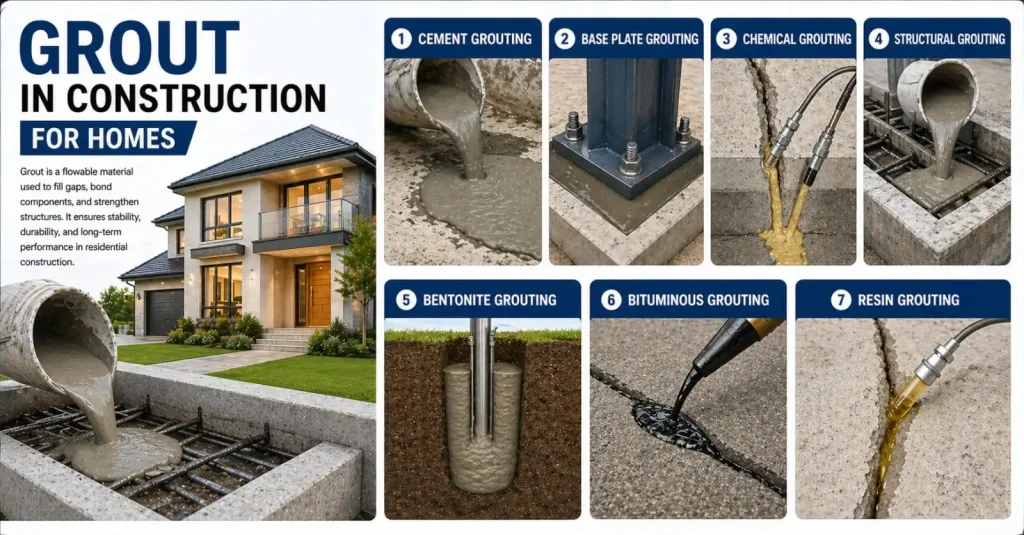
There are many types of grouting, depending on purpose, load, and exposure.
1. Cement Grouting
- It uses a mix of cement and water, sometimes with additives.
- It’s used for filling cracks
- Effective in soil stabilisation
This is the most common type of grouting.
2. Base plate grouting
- This is used for general construction repairs
- Economical and easy to use
- Not waterproof on its own.
For heavy-duty work, material quality matters a lot here.
3. Chemical Grouting
- Uses resins or chemical solutions that penetrate fine cracks.
- It’s used when cracks are very small.
- Effective in stopping water seepage.
- Strengthens the soil.
- These types of grouting are common in basements and underground structures.
4. Structural Grouting
- It is a high-strength grout that is used to transfer loads.
- Found under steel base plates, heavy machinery and precast columns
- Ensures full contact between concrete and steel.
5. Bentonite Grouting
- Bentonite grout swells when it comes in contact with water.
- It’s used for waterproofing.
- Good for sealing boreholes
- Used in underground construction
Among different types of grouting, bentonite is valued for its sealing ability.
6. Bituminous Grouting
- This type uses bitumen-based materials.
- It’s mainly used where water resistance is critical, and movement is expected.
- Bituminous grout allows slight flexibility.
7. Resin Grouting
- Uses synthetic resins
- It is strong
- Sets fast
- Used in precision work where time and strength both matter.
Resin grouting is often confused with epoxy grout.
Tile Grout and Epoxy Grout Explained Simply
Tile grout is what you see between tiles on floors and walls.
Traditional tile grout is cement-based and works well in dry areas like living rooms and bedrooms. But in wet areas, problems start.
That’s where epoxy grout comes in.
Epoxy grout is water-resistant. It doesn’t absorb stains and lasts longer. This is why in bathrooms, kitchens, and balconies, epoxy grout outperforms regular tile grout by a wide margin.
It costs more, but saves on repairs later.
Many homeowners regret skipping epoxy grout once mould and stains appear. The meaning of grout becomes very clear then.
Advantages of Grouting in Construction
Good grouting solves more problems than people realise.
Key advantages include:
1. Improved strength
Grout fills voids and distributes load evenly.
2. Water resistance
Effective grouting stops water from sneaking into joints and layers below
3. Long-lasting finishes
Protects tile edges from chipping and loosening, especially in high-traffic areas.
4. Better hygiene
When joints are properly sealed, dust and grime don’t settle in. There’s nowhere for dirt or bacteria to sit and grow.
5. Clean appearance
Neat grouting ties the whole surface together. The tiles look finished, not patchy or half-done.
Different types of grouting offer different advantages, which is why matching grout to the application is critical.
Practical Site Tips That Actually Matter
Some lessons come only from experience. Here are some tips when grouting:
- Always clean joints before applying tile grout
- Don’t over-water cement grout – it weakens the strength
- Use epoxy grout only with trained applicators
- Cure cement-based grout properly
- Never mix grouting material blindly – follow manufacturer guidelines
- Don’t rush it. Grout performance depends heavily on workmanship. Give it its due time.
To sum it up, the real meaning of grout is strength and protection. Whether it’s tile grout in a home or structural grouting under heavy loads, grout quietly keeps construction intact without asking for attention.
Understanding the types of grouting, choosing between cement grout and epoxy grout, and executing it properly can save years of maintenance trouble.
If you’re building or renovating, don’t treat grout as an afterthought. Do it right once – and you won’t have to think about it again.
FAQs
1. What is grout?
Grout is a material made from cement or chemicals that is used to fill gaps and joints in floors, walls and tiles.
2. What is the meaning of grout in construction?
In construction, grout is used to fill empty spaces and joints to improve strength, stability, and resistance to water.
3. What is the use of tile grout?
Tile grout keeps the tiles protected and firmly in place by filling the gaps between them.
4. What is epoxy grout?
Epoxy grout is a water- and stain-resistant grout commonly used in bathrooms, kitchens, and other wet areas where regular grout doesn’t last long.
5. What types of grouting are there in construction?
Six types of grouting are most common: cement, chemical, structural, bentonite, bituminous, and resin.
6. Is epoxy grout better than cement grout?
Yes, epoxy grout performs better in wet and high-use areas, though it costs more.
7. Can poor grouting cause damage?
Absolutely. Poor grouting leads to water seepage, cracks, stains, and early failure of finishes.