

Do you know what the protein for building is? It is two structural members that quietly do the heavy lifting. These structural members are beams and columns. They keep the buildings safe and manage everyday heavy loads. Most people think that beams and columns are the same. But in reality, there is a difference between beams and columns. Read on this blog post to find out the difference between columns and beams in detail.
What Is a Beam?
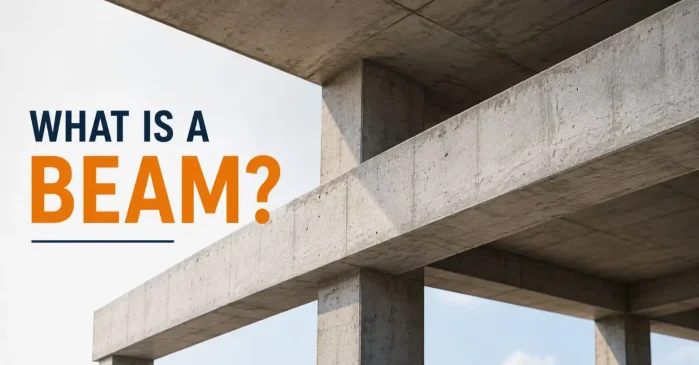
A beam is horizontal in shape and transfers loads to columns or other supporting elements. Given below are the main functions of a beam:
- Supports slabs and roofs
- Transfers loads to columns
- Prevents excessive bending and deflection
- Distribute loads evenly across the structure
Most reinforced concrete beams contain steel reinforcement. Why? This is because concrete works well under compression but is weak in tension. Concrete resists compression. However, the steel bars handle tensile forces efficiently. Some of the common applications of beams are:
- Residential buildings
- Commercial complex
- Bridges and flyovers
- Industrial sheds
- Parking structures
- Educational and healthcare institutions
Floor slabs may sag under their own weight without beams. Thus, it makes the buildings unsafe.
What Is a Column in Construction?

A column is a vertical structural member that carries loads from beams and slabs. It transfers a load safely to the foundation of a building. They are the most critical elements in any structural framework. This is because they resist compressive forces. Given below are the main functions of a column:
- Supports beams and slabs
- Transfers the load of the building to the foundation
- Provides structural stability
- Resists vertical compression
- Helps buildings manage the forces of wind and earthquake.
The reinforced concrete columns contain longitudinal steel bars tied together with stirrups. Hence, this reinforcement improves strength and ductility during seismic events. The common applications of columns are:
- Houses and apartments
- High-rise buildings
- Industrial facilities
- Stadiums
- Warehouses
- Multi-level parking structures
It is advisable to be careful when designing a column. A poor design may impact the stability of the entire building.
What Is the Difference Between Beams and Columns?
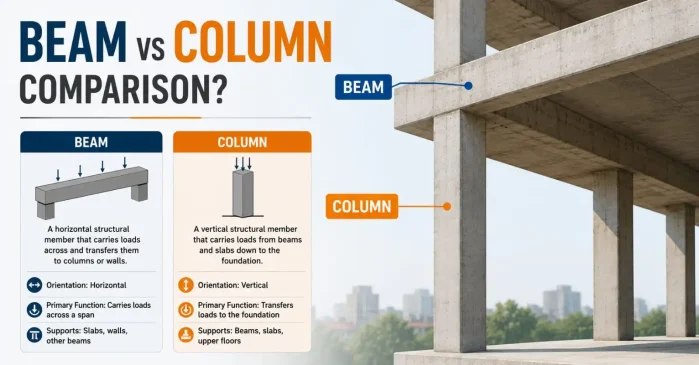
The table below highlights the difference between columns and beams.
| Parameter | Beams | Columns |
| Position | It is in a horizontal position. | It is in a vertical position. |
| Primary function | It carries loads of slabs and roofs. | It supports the beam and transfers the load to the foundation. |
| Main force | The main forces are bending and shear. | The main force is compression. |
| Load transfer | It transfers loads to columns or walls. | It transfers the load to the foundation. |
| Shape | It is usually long and horizontal in shape. | It is vertical and comparatively shorter between spaces. |
| Common location | Roofs, ceilings, and floors | Building corners and structural grid points. |
Let’s understand this beam and column difference with an example of carrying a heavy bookshelf. The shelf behaves like a beam and the side panels that hold it act like columns. They both are essential for the stable structure.
How Beams And Columns Work Together in a Building Structure?
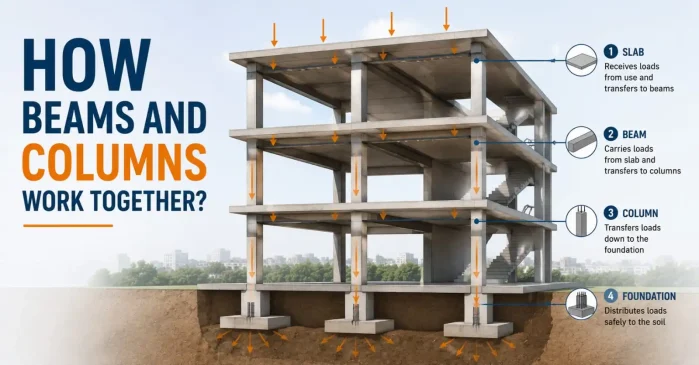
Every modern reinforced concrete building relies on both beams and columns. How exactly does it happen? Given below is the simple process:
- The slab carries furniture, people, walls, and other loads.
- These loads move into the columns.
- Beam transfers the loads to columns.
- Columns safely carry the loads down to the foundation.
- The foundation distributes the load to the soil.
This continuous load path keeps the buildings stable. It is advisable to hire skilled workers to design beams and columns. This keeps the structure safe against loads and environmental forces.
The Final Words
It is necessary to understand the difference between beams and columns. A beam carries loads from slabs and roofs before transferring them to columns. However, columns take those loads down to the foundation. The beam and column difference provides a clear picture of how every building stands strong. Hence, good structural design is more than using quality materials.
FAQs
1. What is the main difference between a beam and a column?
A beam is a horizontal structural member that supports slabs, roofs, and floors by transferring loads to columns. A column is a vertical member that carries those loads downward to the building’s foundation. Together, beams and columns form the primary load-bearing framework of a structure.
2. Which carries more load: a beam or a column?
A column typically carries more load than a beam because it supports the combined weight transferred from beams, slabs, walls, and upper floors. Columns safely channel these vertical loads to the foundation, making them one of the most critical structural elements in a building.
3. Can a building have beams without columns?
Most reinforced concrete buildings require beams and columns to work together. However, some structures use load-bearing walls, steel frames, or cantilever systems instead of traditional columns. The structural system depends on the building’s design, purpose, and engineering requirements.
4. Why are beams reinforced with steel?
Steel reinforcement allows beams to resist tensile (pulling) forces created during bending, while concrete handles compressive forces. This combination increases strength, durability, and crack resistance, enabling reinforced concrete beams to safely support heavy structural loads.
5. Why are columns important in construction?
Columns provide essential vertical support by carrying loads from beams, slabs, and roofs to the foundation. They ensure structural stability, distribute weight evenly, and help buildings withstand gravity and external forces such as wind and seismic loads.
6. What materials are commonly used for beams and columns?
The most common material for beams and columns is reinforced concrete due to its strength and durability. Depending on the project, engineers may also use structural steel, timber, precast concrete, or composite materials to meet specific load and design requirements.
7. Can beams and columns fail?
Yes. Beams and columns can fail due to poor design, inadequate reinforcement, low-quality materials, excessive loading, corrosion, or lack of maintenance. Proper structural design, quality construction, and regular inspections significantly reduce the risk of structural failure and improve safety.