A good home features more than strong walls and a solid roof. Modern construction prefers drywall to create interior walls and ceilings. Why? This is because they offer flexibility to customize the design as per preference. But what exactly is drywall? What are the types of drywall in construction? Read on this blog post to find out!
What Is Drywall in Construction?
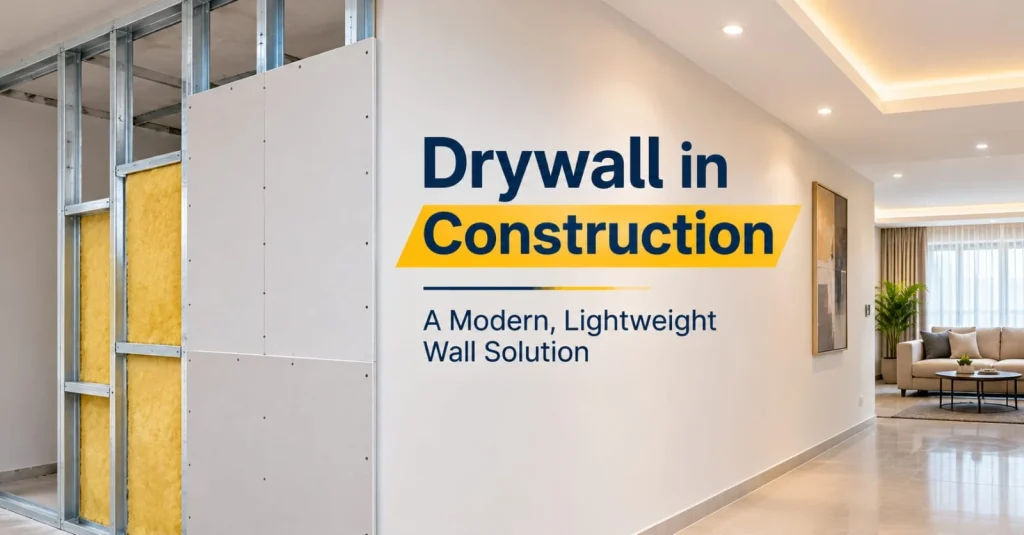
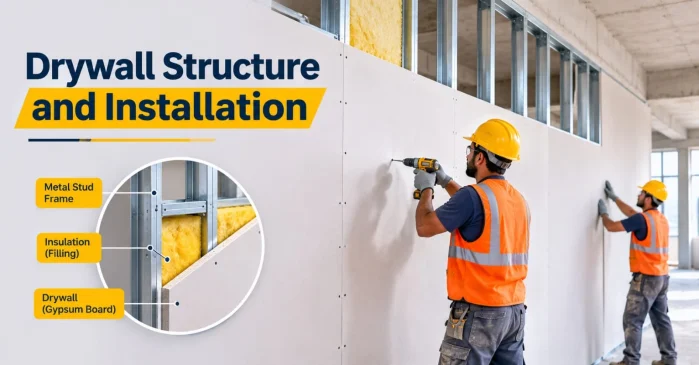
Drywall is a building material. Designers use it to create interior walls and ceilings. But what exactly does it contain? It consists of gypsum that is between sheets of paper. Sometimes it may also be enclosed in other facing materials. These boards are made of metal or timber. They are fixed to a supporting framework. What’s next? The joints are treated with jointing compound and tape. This provides a smooth surface for painting.
What Are the Types of Drywall in Construction?

Given below are different types of drywall in construction:
- Standard Drywall
This type of drywall is popular in dry areas. Why? This is because it provides a smooth surface to paint or decorate as per interior design.
Common uses:
- Bedroom and living room partitions
- Interior walls in residential buildings
- Office partitions
- General ceiling applications
It is often a good choice when homeowners don’t need moisture or fire resistance.
- Moisture-Resistant Drywall
It is best for humid and moisture-prone areas. The designer may add additives based on the product. Some common uses of moisture-resistant drywall are as follows:
- Residential kitchens
- Utility areas
- Certain bathroom wall applications
- Interior spaces with higher humidity
However, moisture-resistant drywall is not waterproof. It is a substitute for a suitable waterproofing system in showers or other areas exposed to regular direct water contact.
- Fire-Resistant Drywall
Fire-resistant drywall is designed to contribute to a fire-rated wall or ceiling assembly. It may contain glass fibers or other reinforcing materials that improve its performance under high temperatures. The common uses of this type of drywall are as follows:
- Commercial buildings
- Apartment corridors
- Service shafts
- Areas requiring specified fire-rated partitions
The fire resistance of a wall depends on the complete tested assembly. Some of the members are the board layers, framework, insulation, joints, and fixings. Thus, a fire-resistant board does not automatically make a wall fire-rated.
- Sound-Reducing Drywall
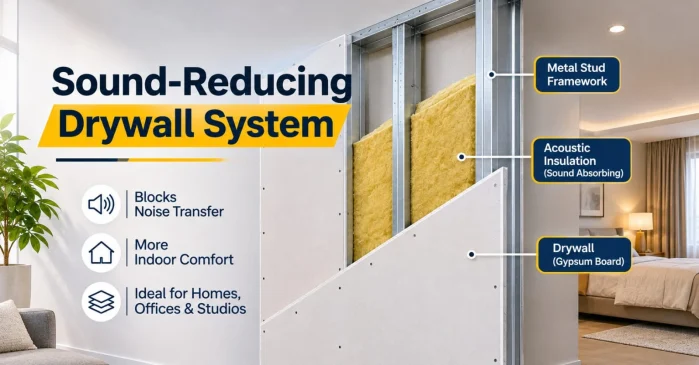
If you are looking for the solution to remove unnecessary noise, sound-reducing drywall is the best choice. It limits the transmission of noise between rooms. This is why they are found in the following areas:
- Meeting rooms
- Home theaters
- Offices
- Bedrooms adjoining noisy spaces
The final acoustic performance depends on the entire wall construction, not just the board itself.
- Impact-Resistant Drywall
The areas with frequent knocks or physical contact require impact-resistant drywall. It usually uses a reinforced core or a stronger facing to resist everyday wear. The following are the common uses of impact-resistant drywall:
- Schools
- Hospitals
- Corridors
- Busy commercial interiors
The best part of impact-resistant drywall is that it helps reduce surface damage in high-traffic areas.
What Are the Common Applications of Drywall in Construction?
Given below are the common uses of drywall in construction:
- Interior Partitions
Drywall divides a large room into separate functional areas. The most intriguing part is that it doesn’t require a conventional brick partition.
The designers also use drywall boards below the structural ceiling. Why? This is because it creates a finished ceiling surface and provides better lighting.

- Office Interiors
Businesses can use drywall partitions to create office interiors. Some systems may also be dismantled or modified when layouts change.
- Wall Finishing
Interiors play an important role in aesthetics. Drywall provides a smooth surface for different types of interior finishes.
- Renovation Projects
Drywall helps create new interior spaces with less demolition. This is especially useful where the existing structure and site conditions permit.
The Final Words
Drywall is more convenient than traditional interior construction. It provides flexibility to create functional spaces. However, it is necessary to choose the right board and pay attention to details. Before the construction of drywall, it is also advisable to consider moisture protection. The best results come when you match the system to the job.
FAQs
1. What is drywall made of?
Most conventional drywall consists of a gypsum core enclosed in paper or another suitable facing material. The boards are fixed to a metal or timber framework, and the joints are finished with tape and jointing compound. This creates a smooth surface ready for painting or other compatible finishes.
2. Is drywall suitable for Indian homes?
Yes, drywall can be a practical choice for Indian homes, particularly for interior partitions, false ceilings, and renovation projects. The key is to select the right board and installation system for the space. Local climate, humidity, potential water leaks, and the intended use should all be considered before installation.
3. Is drywall better than a brick wall?
Neither drywall nor brickwork is always the better option. Drywall is generally lighter and can be quicker to install for interior partitions, with less wet work involved. Brick walls may be preferable for certain applications requiring masonry construction or greater impact resistance. The right choice depends on design, budget, and performance requirements.
4. Can drywall be used in bathrooms?
Yes, certain moisture-resistant drywall systems can be used in selected bathroom areas when installed according to the manufacturer’s recommendations. However, moisture-resistant does not mean waterproof. Shower areas and surfaces exposed to regular direct water contact require a suitable waterproofing system and compatible finishes to help prevent moisture damage.
5. Does drywall reduce noise?
Yes, a properly designed drywall system can help reduce noise travelling between rooms. Its performance depends on factors such as board thickness, multiple board layers, insulation, framework, and joint sealing. Standard drywall alone does not guarantee soundproofing. For bedrooms, offices, or home theaters, the complete wall system should be selected according to acoustic requirements.
6. Can heavy items be mounted on drywall?
Yes, heavy items such as cabinets, televisions, and shelves can be mounted on drywall if the fixing method and supporting structure are suitable for the load. Appropriate anchors may work for lighter items, while heavier fixtures may require reinforcement or direct fixing to the framework. Plan the support before installation whenever possible.