If you’ve ever wondered how a slab stays in place before concrete hardens, the answer is centring work.
In simple words, centring work in construction is the temporary support system that holds concrete in shape until it becomes strong enough to support itself.
Without proper centring in construction, slabs can sag, beams can crack, and site safety can be compromised. That’s why centring isn’t just “temporary work” — it’s a critical stage that decides the quality of the final structure.
On most construction sites, centring work happens quietly.
But ask any site engineer what keeps them awake during slab casting, and they’ll say one thing – centering.
Think of centering work like the hands that hold wet clay while a potter shapes it. Concrete behaves the same way. Until it sets, it needs support from below and sides. Centering work in construction provides that support during the most vulnerable stage of a structure.
Many slab issues — cracks, uneven levels, deflection — don’t start with bad concrete. They start with weak or careless centering in construction.
What Is Centering in Construction?
Centering in construction is the backbone that supports fresh cement until it hardens and gains enough strength to hold the structure.
- Centering supports wet concrete and reinforcement.
- It gives shape to slabs, beams, staircases, and arches.
- It safely transfers the load to the ground.
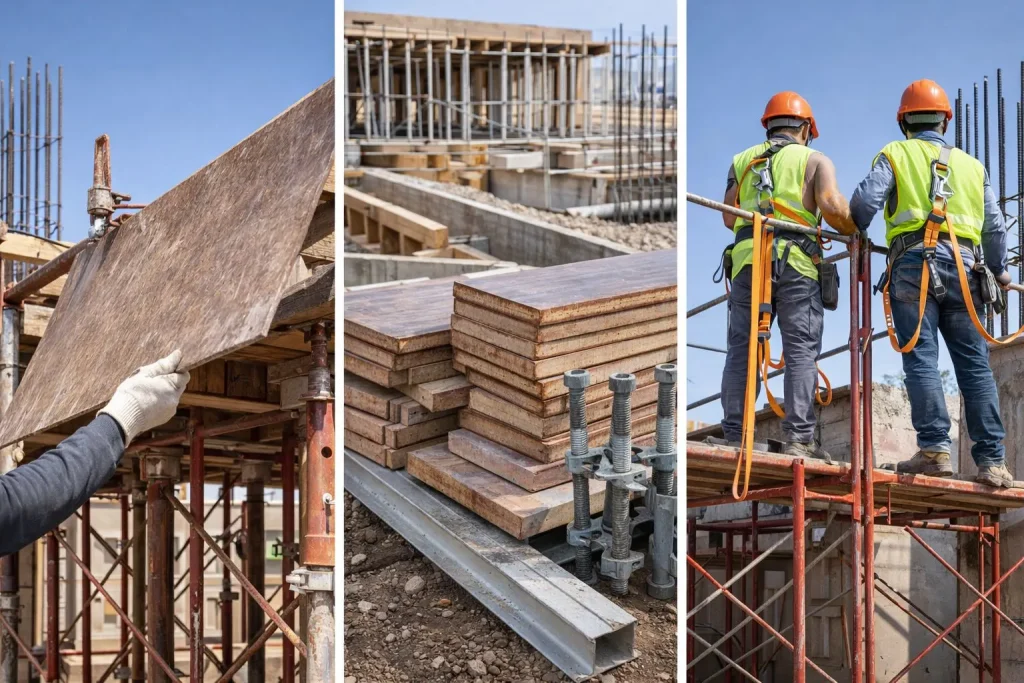
On-site, centering includes:
- Vertical supports (props, pipes, ballies)
- Horizontal members (joists and runners)
- Shuttering plates or plywood
- Centering work in construction is crucial for slab casting.
Importance of Centering in Construction
People often ask why so much effort is spent on something that will be removed later. The reason is simple – failure during centring means permanent damage.
Here’s why centring work is crucial:
1. Structural safety
Centering takes the enitre load of the concrete and steel during the casting process.
2. Correct levels and thickness
Good centering in construction ensures slabs don’t dip or slope.
3. Surface finish
Proper centering work results in smoother soffits and fewer repairs later.
4. Construction safety
Weak centering is one of the biggest causes of site accidents.
5. Shaping Concrete
Once concrete hardens, it remembers the shape it was given. That shape depends entirely on centering work in construction.
Types of Centering in Construction
Different projects use different types of centring. The choice depends on scale, budget, and repetition.
1. Timber Centering
- Still common in small residential projects.
- Uses wooden ballies and planks
- Easy to assemble
- Needs careful checking for cracks and bending
This type of centering work demands experienced carpenters.
2. Steel Centering
- Very popular on large and repetitive projects.
- Steel props and pipes
- Adjustable height
- High load-carrying capacity
Steel-based centering in construction is safer and more durable.
3. Plate and Girder System
- Used in commercial buildings.
- Steel plates for shuttering
- Girders distribute loads evenly
- Excellent finish quality
This is premium centring work in construction, often reused many times.
4. Modular/Formwork Systems
- Used in high-rise and fast-track projects.
- Aluminium or system formwork
- Fast installation and removal
- High precision
These systems reduce dependency on manual labour in centering work.
How Centering Work Is Done on Site
Good centering work in construction always follows a sequence.
1. Level marking
Slab bottom and beam levels are marked accurately.
2. Erecting vertical supports
Props are placed at calculated spacing based on load.
3. Adjusting horizontal members
They distribute the load across multiple supports.
4. Placing shuttering plates
Boards or plates are fixed tightly with no gaps.
5. Final checking
Alignment, tightness, and stability are checked before concreting.
Skipping even one step weakens centering in construction.
Formwork, Shuttering & Centering: Differences
These terms are often used interchangeably, but they are not the same.
Shuttering
The surface that comes in direct contact with concrete.
Formwork
The complete mould that gives shape to concrete.
Centering
The supporting system that holds formwork in place.
So technically, centering work in construction supports formwork, and shuttering is part of that formwork.
Understanding this difference helps avoid confusion on-site.
Safety Tips for Centering Work
Most centering-related accidents happen due to overconfidence or shortcuts. Essential safety practices in centring work are:
- Never overload centering platforms
- Ensure props are perfectly vertical
- Use base plates on loose soil
- Avoid stacking loose bricks or wooden blocks
- Never remove centering without the engineer’s approval
Good centering in construction protects workers first, structure second.
Real-World Site Insight
On Indian sites, centering failures usually happen because of:
- Reused bent props
- Uneven ground support
- Rushed slab casting
- Early de-shuttering
Even the best concrete mix can’t compensate for poor centering work in construction. This is why experienced contractors treat centering as a structural activity, not a temporary formality.
Quality materials matter too. Good quality concrete gains strength uniformly. This makes centering removal predictable and safe. For the best performance, use JK Super Cement– a trusted legacy brand with a range of cement that specialises in quality, consistency and durability.
Centering doesn’t stay in the building, but its effect does. Strong slabs, straight beams, and crack-free ceilings all begin with proper centering work. Poor centring leaves behind problems that no paint or plaster can hide.
If there’s one lesson every site should remember, it’s this:
Centering work in construction is temporary, but its impact is permanent. If you’re building or supervising a project, give centering the attention it deserves. It’s the silent support that decides how strong your structure really becomes.
FAQs
1. What is centering in construction?
Centering in construction is the temporary support system that holds concrete until it hardens.
2. Why is centering work important?
Centering is crucial to keep the structure in place during casting. It ensures correct levels, a smooth finish and slab strength and safety.
3. What materials are used in centring work?
Steel props, wooden supports, shuttering plywood, and steel plates are commonly used.
4. How long should centering be kept?
Usually 7–28 days, depending on slab type and design.
5. Can centering materials be reused?
Yes, but only if they are straight, undamaged, and safe.
6. What happens if centering fails?
It can cause slab collapse, cracks, uneven surfaces, and serious site accidents.
7. Who is responsible for centering safety on-site?
The contractor and site engineer are responsible for proper centering in construction.