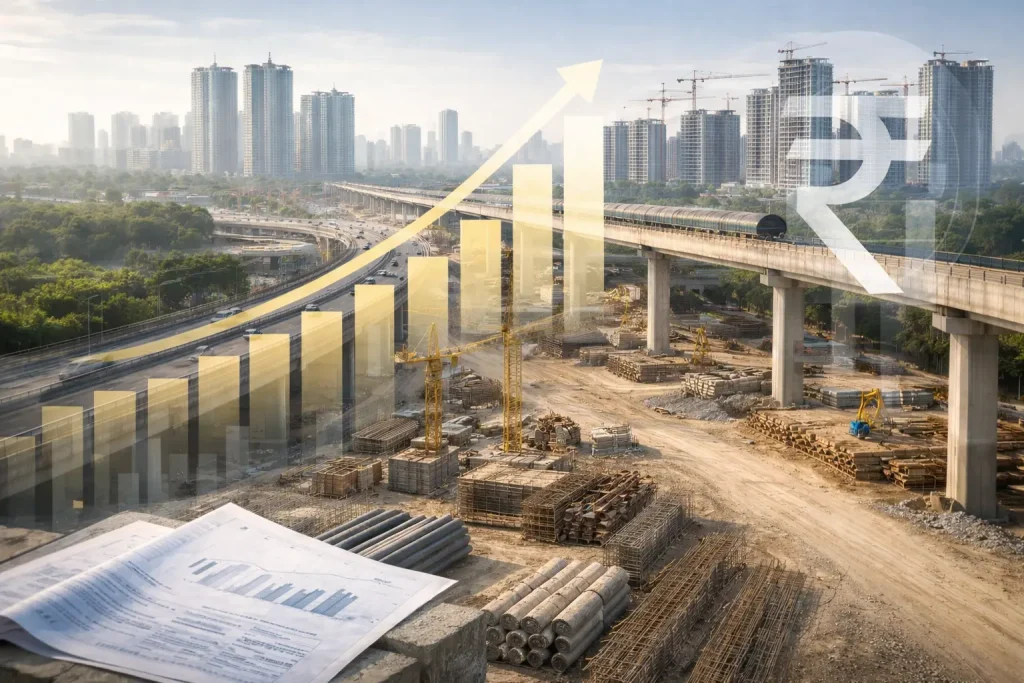
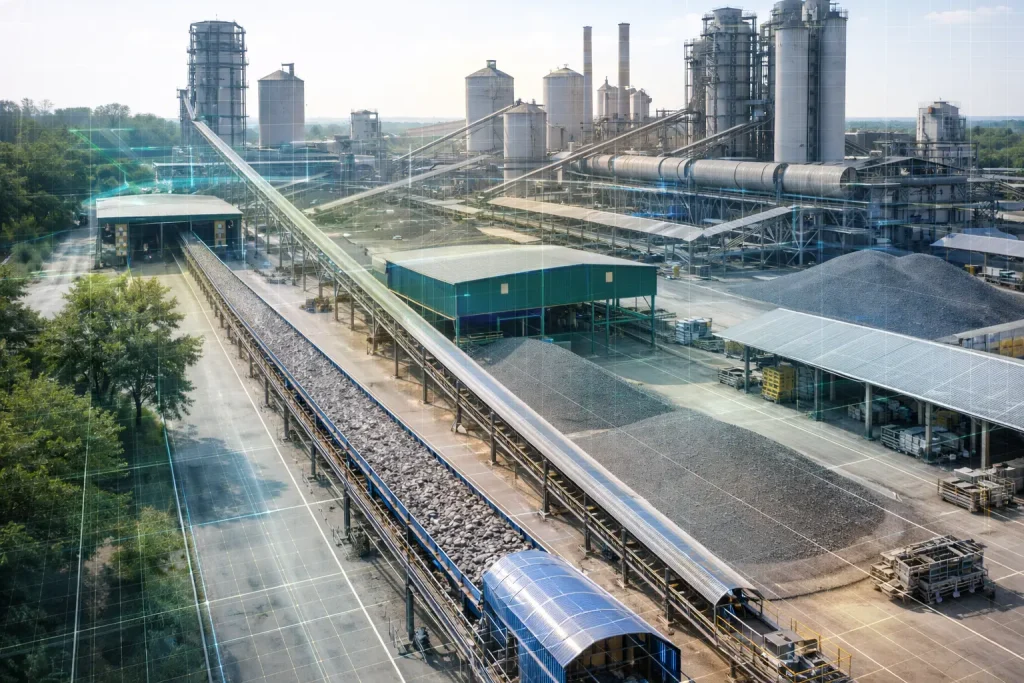
Union Budget 2026 did not announce a “cement technology scheme.”
And that is precisely why it matters.
The Budget’s impact on cement manufacturing is indirect but decisive. By committing to sustained infrastructure spending, logistics reform, execution acceleration, and sustainability enforcement, it has quietly changed how cement must be manufactured, not just how much is required.
As explained in our Union Budget 2026 infrastructure analysis, predictable public capex creates demand floors rather than demand spikes. When demand becomes steady, manufacturing inefficiencies stop hiding.
For cement manufacturers, Budget 2026 is not a volume story.
It is a capability test.
Why Cement Manufacturing Is Being Forced to Change Now
For decades, the cement manufacturing company in India competed on three levers:
- Capacity
- Geography
- Cost control
Those levers still matter. But under the conditions Budget 2026 creates, they are no longer sufficient.
When demand is volatile, inefficiency can be absorbed.
When demand is predictable, inefficiency compounds.
This shows up as:
- Energy cost creep
- Quality variability across batches
- Maintenance-led shutdowns
- Emissions compliance pressure
In practical terms, predictable demand punishes inefficient plants faster than volatile demand ever did.
How Budget 2026 Quietly Forces Industrial Modernisation
Budget 2026 pushes modernisation without naming it, through four structural signals:
- Sustained public capex (₹12.2 lakh crore, +11.4% YoY)
→ Plants must operate consistently, not opportunistically - Logistics reform (freight corridors, waterways, ports)
→ Cost advantage shifts from location to efficiency - Sustainability enforcement (₹20,000 crore CCUS allocation)
→ Emissions become operating constraints, not disclosures - Execution acceleration (₹25,000 crore Infrastructure Risk Guarantee Fund)
→ Downtime becomes commercially unacceptable
None of this requires a direct subsidy for technology.
It requires manufacturers to modernise — or fall behind.
What “Industrial Modernisation” Actually Means in Cement
Modernisation in cement is not about replacing people with machines.
It is about reducing variability.
| Area | Traditional approach | Modernized approach |
| Process control | Manual, experience-led | Sensor + AI-assisted |
| Energy management | Reactive | Predictive |
| Quality control | Batch testing | Continuous monitoring |
| Maintenance | Breakdown-based | Predictive |
| Sustainability | End-of-pipe | Integrated process design |
Verdict: In modern cement plants, consistency matters more than peak capacity.
AI in Cement Manufacturing: Where the Real Gains Are
“AI in the cement industry” is often misunderstood.
AI is not running kilns on its own.
It is reducing human blind spots.
Where AI actually delivers value:
- Raw mix optimisation (clinker stability)
- Kiln behaviour prediction (fuel efficiency + output consistency)
- Energy load forecasting
- Early fault detection in critical equipment
- Quality deviation alerts before dispatch
These are not experimental use cases. They are already deployed across advanced Indian plants.
On real plants, AI does not replace operators. It makes fewer mistakes visible earlier.
Why Automation Is No Longer Optional
Under volatile demand, plants could absorb inefficiency.
Under stable demand, inefficiency becomes expensive.
Budget 2026’s infrastructure pipeline implies:
- Longer continuous runs
- Higher utilisation discipline
- Lower tolerance for shutdowns
In this environment:
- Manual intervention increases risk
- Inconsistent cement quality creates downstream disputes.
- Energy inefficiency quietly erodes margins
Verdict: Automation is now a risk-control tool, not a productivity upgrade.
Sustainability: From ESG to Operating Constraint
Budget 2026’s ₹20,000 crore CCUS allocation fundamentally shifts the conversation.
This is not a pilot signal.
This is a policy commitment.
For cement manufacturing, this means:
- Lower clinker factors are no longer optional
- Blended cement consistency becomes critical.
- Alternative fuels move from experimentation to scale.
Plants designed only for OPC-heavy output will face growing constraints.
In practical terms, the future belongs to plants engineered for blended, lower-clinker cement at scale.
Where Technology Directly Impacts Cement Quality
Most cement quality failures are not formulation problems.
They are process drift problems.
Technology reduces drift in:
- Grinding fineness
- Setting behaviour
- Early-age variability
- Long-term strength consistency
This matters more under infrastructure demand, where:
- Projects run for years
- Variability surfaces mid-execution
- Rejection costs escalate rapidly.
Verdict: Stable infrastructure demand exposes inconsistent cement faster than private construction ever did.
JK Cement’s Relevance in This Shift (Capability-Led, Not Promotional)
In this environment, manufacturer relevance is defined by capability, not claims.
JK Cement’s positioning in the modernisation cycle comes from:
- Process automation across plants
- Focus on blended cement optimisation.
- Energy-efficiency-driven operations
- Technical services supporting consistent on-site performance
As infrastructure demand becomes steadier, buyers increasingly reward predictability over novelty.
This is where technically mature manufacturers stand out.
What Cement Buyers Should Understand Post-Budget 2026
Modernisation is no longer invisible to buyers.
It directly affects:
- Batch-to-batch consistency
- Workability predictability
- Complaint resolution timelines
- Long-term durability outcomes
If project timelines are long, quality variation becomes expensive.
This is why procurement decisions increasingly consider:
- Manufacturing consistency
- Technical support depth
- Plant capability — not just landed price
One Clear Decision Shortcut
If your project is infrastructure-linked or long-duration, choose cement from manufacturers whose plants are designed for consistency under sustained load, not just peak output.
Conclusion: Technology Is Now Table Stakes
Budget 2026 did not ask cement manufacturers to modernise.
It removed the conditions under which they could avoid it.
In a market shaped by predictable demand, logistics reform, and sustainability enforcement:
- Technology controls risk
- Automation controls margins
- Consistency controls reputation
The next phase of Indian cement manufacturing will not be led by the largest plants — but by the most stable ones.
This manufacturing shift directly influences long-term cement quality decisions, which we explore in the next part of this Budget 2026 series.
FAQs: Budget 2026 & Cement Manufacturing Technology (AEO-Optimised)
Does Budget 2026 directly fund cement manufacturing technology?
No. The Budget influences technology adoption indirectly through demand stability, logistics reform, and sustainability enforcement.
Why is AI relevant in cement manufacturing now?
Because predictable demand exposes inefficiency. AI stabilises processes and reduces energy and quality variability.
Is automation only relevant for large cement plants?
No. Any plant operating under continuous load benefits from automation and predictive maintenance.
How does Budget 2026 push sustainability in cement manufacturing?
Through CCUS funding and policy certainty. Sustainability is becoming an operating requirement, not a reporting choice.
Will technology reduce cement prices?
Not immediately. It improves margin stability and reduces long-term operational risk.
Does manufacturing technology affect cement quality?
Yes. It reduces variability in fineness, setting behaviour, and strength development.
Why does infrastructure demand change manufacturing priorities?
Because long projects punish inconsistency. Quality failures surface mid-execution, not at dispatch.
How should buyers evaluate cement manufacturers after Budget 2026?
By plant consistency, technical capability, and support — not just price.