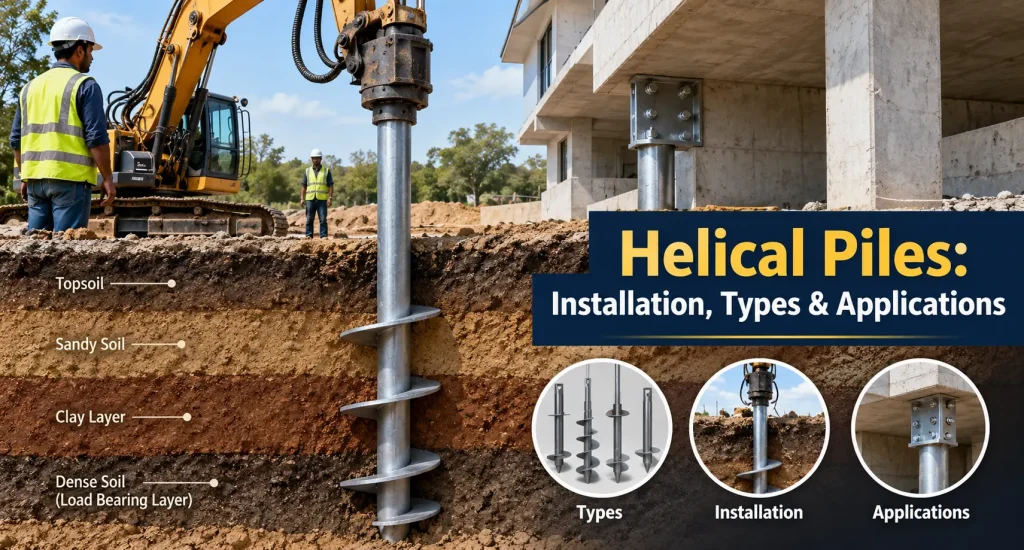
Foundation work often decides how well a building performs over the years. A weak foundation can lead to settlement. What’s more? Cracks may appear in your structures. Conventional foundations need deep excavation in difficult soil conditions. This is why helical piles are useful in construction. They are installed into the ground by rotating the pile. The best part? Helical piles transfer structural loads into suitable soil layers. Read on this blog post to know more about the types and process of helical piles.
Quick Answer
Helical piles are steel foundation elements with one or more helical plates. The pile in the ground is rotated by a hydraulic motor. The plates then move through the soil as the piles go deep. Piles transfer the building loads using shafts and helical plates.
Modern construction often relies on helical piles because they support compression loads. They also resist uplift forces. They are highly useful if conventional foundations face problems with weak soil. The most interesting part is that helical piles allow engineers to install them quickly with less disturbance.
What Are the Types of Helical Piles?
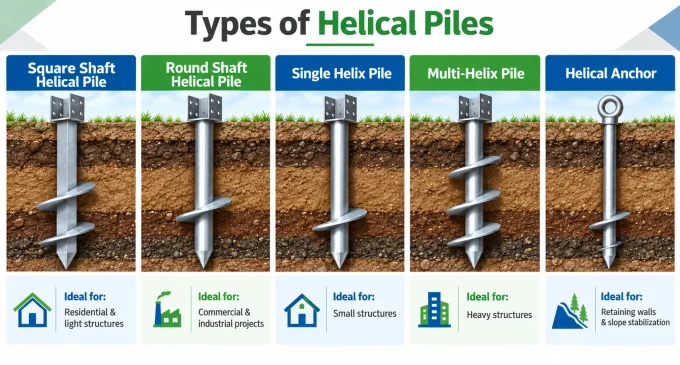
The following are the different types of helical piles in construction:
- Square Shaft Helical Piles
Square shaft piles use a solid square steel shaft. They work well for light and medium loads. Engineers mostly use these piles for residential projects. This is because they offer good resistance in certain soil conditions.
- Round Shaft Helical Piles
Round shaft piles use a tubular steel shaft. They are suitable for projects that require higher structural capacity. This is why they are used for the construction of larger buildings. The shaft diameter and wall thickness depend on the structural design.
- Single Helix Piles
A single helix pile has one helical plate. The plate helps the pile move into the soil during installation. It also helps you transfer load to the surrounding soil.
- Multi-Helix Piles
Multi-helix piles have two or more helical plates. The plates sit at different positions along the shaft. Hence, the load capacity of the pile may increase due to this arrangement.
- Helical Anchors
The main job of helical anchors is to resist uplift or tension. Engineers recommend using this type of helical pile to retain systems and structures that face uplift forces.
What Is the Process to Install Helical Piles in Construction?
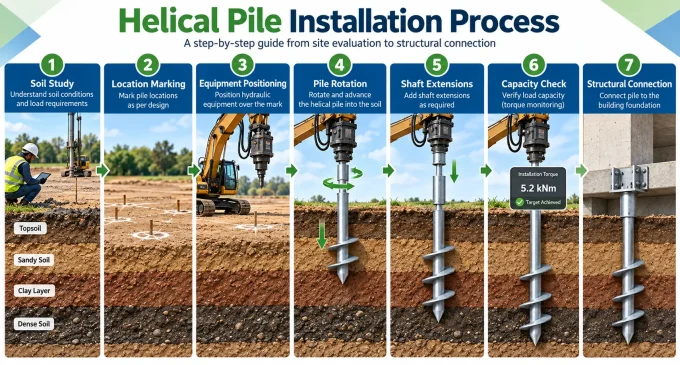
Given below is the process to install helical piles in construction:
- Study the Soil
The first step is to check the ground conditions. This is because it helps engineers identify soil layers and groundwater conditions. They further select the suitable pile as per the structural needs.
- Mark the Pile Locations
The next step is to mark the position for each pile according to the foundation drawing. Remember that it is necessary to mark the pile locations accurately. The load path may suffer if a pile sits outside its planned location.
- Position the Installation Equipment
Engineers install a hydraulic machine on the site to connect it to the pile shaft. Small equipment is often used in tight spaces. However, it is ideal to use larger equipment to handle bigger piles.
- Rotate the Pile Into the Ground
The machine applies downward pressure and rotation. The helical plates pull the pile into the soil. The crew continues the installation until the pile reaches the required depth and installation torque. Torque gives the engineer useful information about the soil resistance.
- Add Extensions if Needed
Many projects need greater pile depth. This is why engineers may add shaft extensions during installation. It is highly useful for the pile to reach stronger soil layers.
- Reach the Required Capacity
The workers check the required torque and depth. The engineer uses the installation data to ensure that the pile aligns with the design needs.
- Connect the Pile to the Structure
The final stage involves cutting the pile to the required level. Engineers link a pile cap to the building or structure. Remember that the exact connection depends on the foundation design.
What Are the Common Applications of Helical Piles in Construction?
Given below are the common applications of helical piles:
- Residential buildings
- Extensions and additions
- Decks and platforms
- Industrial structures
- Solar panel foundations
- Walkways
- Utility structures
- Retaining systems
- Temporary structures
- Foundation underpinning
- Signboards and similar structures
What Are the Advantages of Helical Piles in Construction?
The following are the advantages of helical piles in construction:
- Faster Installation
The installation process can move quickly. Workers do not need large-scale excavation for each pile. This can help projects maintain tighter schedules.
- Less Soil Disturbance
The pile enters the soil through rotation. The process creates much less spoil than traditional excavation. That can keep the site cleaner.
- Useful in Tight Spaces
Some construction sites have very little working room. Urban plots can have buildings close to the foundation area. Compact installation equipment can make helical piles useful in such conditions.
- Lower Construction Noise
Helical pile installation can create less noise than some traditional piling methods. That can matter near homes and occupied buildings.
- Easy to Install in Different Weather Conditions
The method does not depend on curing time for the pile itself. This can help reduce delays after installation. The site team must still account for local ground conditions and weather risks.
The Final Words
Foundation technology keeps changing as construction sites become more complex. Space constraints are common in cities. Project timelines are also getting tighter. Helical piles can answer some of these challenges with a fast and relatively clean installation method.
They can support new construction. They can also help with repairs and foundation upgrades. But no foundation system works on a one-size-fits-all basis. Good soil data and sound structural design should always come first. When those two pieces are right, helical piles can become a practical foundation solution for the right project.
FAQs
1. How deep do helical piles go?
There is no fixed depth for every project. The required depth depends on the soil profile and design load. The installation team also checks factors such as installation torque.
2. Are helical piles suitable for houses?
Yes. Engineers can use them for selected residential projects. The soil conditions and building loads must support the choice.
3. Do helical piles need concrete?
The steel pile itself does not need a cast-in-place concrete shaft. The structure may still need concrete pile caps or other connection elements.
4. Can helical piles work in weak soil?
They can work in many difficult soil conditions. Engineers choose the pile size and installation depth based on the soil profile. They may extend the pile until it reaches a suitable bearing layer.
5. Are helical piles permanent?
Yes, engineers can design helical piles for permanent foundations. The project team should consider steel durability and corrosion protection for the expected service life.
6. Can workers install helical piles near an existing building?
Yes, helical piles can work well in some restricted spaces. Their installation creates less excavation than many conventional foundation methods. The team must still check access and structural risks before installation.