Walk through any growing neighborhood in India right now, and you’ll notice something interesting. More homes are being built with concrete blocks instead of traditional red bricks. And honestly, there’s a reason for that.
Concrete blocks were mostly seen in factories, boundary walls, or commercial projects. But now even individual homeowners in different cities are asking contractors about concrete block sizes, strength, thermal comfort, and even the latest concrete block price trends before starting construction. Of course, blocks are not magic.
Choosing the wrong block type or ignoring site conditions can still create problems later. So before choosing blocks for your home, ensure that you know what they are, how they’re used, their sizes, costs, and more.
Let’s break it down simply.
What Are Concrete Blocks?
In simple words, concrete blocks are large masonry units made using cement, sand, aggregates, and water. Think of them as bigger, more engineered versions of traditional bricks.
They are manufactured in molds under controlled conditions, which gives them a consistent shape and strength. That consistency is one reason contractors prefer them today.
Unlike hand-made clay bricks that can vary from piece to piece, concrete blocks are usually uniform.
That means:
- Faster alignment
- Cleaner wall finishing
- Less mortar consumption
- Reduced plaster thickness
Most homeowners also notice that rooms built with good-quality concrete blocks feel quieter and slightly cooler.
Another thing many people overlook is how blocks work together with RCC elements. During slab and column work, proper concrete cover block placement helps maintain reinforcement cover and prevents steel corrosion later.
That small detail matters more than most people think. Today, you’ll find different concrete block sizes for load-bearing walls, partitions, compound walls, and even decorative applications. And because manufacturing has improved across India, the price of concrete blocks has become competitive enough for regular residential construction too.
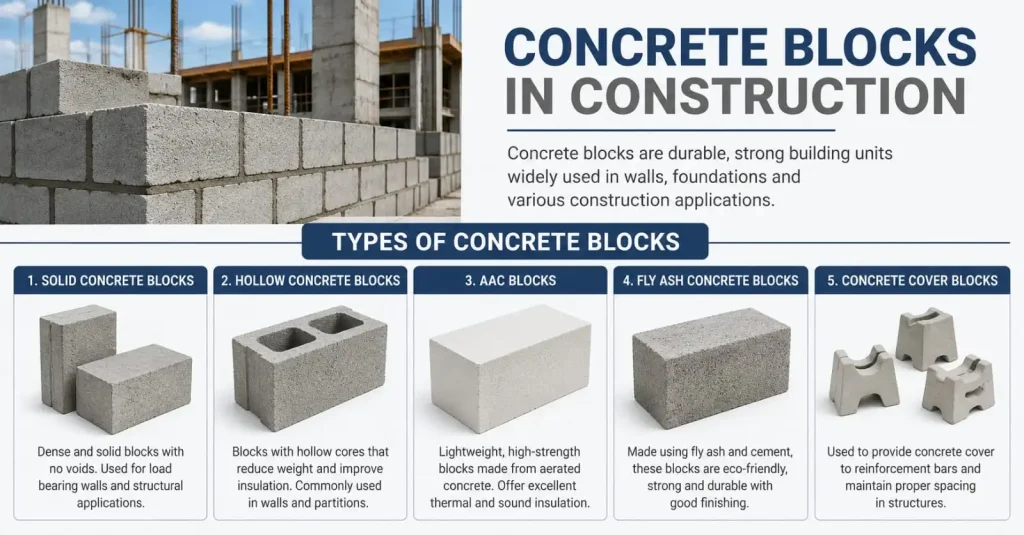
What Are the Different Types of Concrete Blocks Used in Construction?
Not all concrete blocks are the same. Choosing the right type depends on where the block will be used.
- Solid Concrete Blocks
These are dense and heavy blocks commonly used for load-bearing walls. They offer strong structural support and are often used in foundations and external walls. A lot of commercial buildings still prefer solid blocks because of durability.
- Hollow Concrete Blocks
Probably the most common option in modern homes. These blocks have hollow cavities inside, making them lighter and improving thermal insulation. They also reduce dead load on the structure. Most residential contractors today recommend hollow Concrete Blocks for regular wall construction.
- AAC Blocks
Autoclaved aerated concrete blocks are lightweight and known for insulation. They cut down heat transfer significantly. But AAC blocks require proper adhesive application and skilled installation. Poor workmanship can create cracks later.
- Fly Ash Concrete Blocks
Made using fly ash and cement, these are more eco-friendly. They provide smooth finishing and decent strength. They’re increasingly popular in urban projects focused on sustainability.
- Concrete Cover Blocks
These are smaller blocks used inside RCC elements. A concrete cover block helps maintain the correct distance between reinforcement steel and outer concrete surfaces. Without proper cover blocks, steel bars can corrode over time due to moisture exposure. And once rust starts inside the RCC, repairs become painful and expensive.
What Are the Standard Concrete Block Sizes and Dimensions?
One of the biggest advantages of Concrete Blocks is size consistency. Standardisation improves speed and reduces material wastage on-site. Common concrete block sizes in India include:
| Type | Common Sizes |
| Solid Block | 400 x 200 x 200 mm |
| Hollow Block | 400 x 200 x 100 mm |
| Partition Block | 400 x 200 x 150 mm |
| AAC Block | Varies by manufacturer |
| Concrete Cover Block | 25 mm, 40 mm, 50 mm |
The larger size of Concrete Blocks compared to clay bricks means fewer joints. Fewer joints usually mean:
- Faster construction
- Lower mortar use
- Better wall alignment
Contractors especially appreciate this during tight project timelines. Anyone who has handled labour shortages during festive seasons knows how much construction speed matters now.
What Are the Concrete Block Prices in India?
This is usually the first question homeowners ask. “What’s the actual concrete block price?” And honestly, prices vary depending on:
- City
- Transport distance
- Block type
- Density
- Manufacturer quality
Now here’s the interesting part. Even if the initial concrete blocks price sometimes looks slightly higher than that of clay bricks, the overall project cost may be reduced because:
- Less mortar is needed
- Faster labour execution
- Reduced plaster thickness
- Lower wastage
That’s where many homeowners actually save money.
What Are the Key Benefits of Using Concrete Blocks in Construction?
There’s a reason concrete blocks became mainstream in modern construction.
- Faster Construction: Because of larger concrete block sizes, masons can complete walls much faster. This becomes critical during monsoon delays or labor shortages.
- Better Strength: Good-quality concrete blocks offer solid compressive strength and structural stability.
- Reduced Heat Transfer: Hollow blocks and AAC blocks help keep interiors cooler. In Indian summers, that difference is noticeable.
- Cleaner Finishing: Uniform blocks create straighter walls and smoother plaster finishes.
- Lower Water Absorption: Compared to poor-quality clay bricks, concrete blocks generally absorb less water. That reduces seepage risks.
- Eco-Friendly Options: Fly ash blocks reduce dependence on clay soil excavation. And proper concrete cover block use improves RCC durability, reducing long-term repairs.
What Is the Difference Between Concrete Blocks vs. Traditional Blocks?
This debate happens on almost every site. Bricks or Concrete Blocks? The truth is that both have their place. But modern construction is slowly shifting toward blocks for practical reasons.
| Feature | Concrete Blocks | Traditional Blocks |
| Size | Larger | Smaller |
| Construction speed | Faster | Slower |
| Uniformity | High | Varies |
| Mortar Consumption | Lower | Higher |
| Heat Insulation | Better | Moderate |
| Wastage | Lower | Higher |
Still, local conditions matter. In some villages where brick kilns are nearby, bricks may remain economical. But in urban and semi-urban projects, Concrete Blocks are becoming the preferred choice.
What Are the Common Applications for Concrete Blocks?
Today, concrete blocks are used almost everywhere.
- Residential Homes: Internal and external walls.
- Apartment Projects: Partition walls and load-bearing applications.
- Compound Walls: Solid blocks work extremely well here.
- Commercial Buildings: Fast execution makes blocks attractive for commercial projects.
- Basements and Utility Areas: Their durability helps in moisture-prone spaces.
- RCC Work: Proper concrete cover block use is essential in beams, slabs, and columns.
It’s a small component that protects the building’s structural life.
What Are the Things to Consider Before Choosing Concrete Blocks?
Not every block available in the market is of good quality. And this is where many homeowners make mistakes.
- Check Strength: Always verify compressive strength. Weak blocks crack easily.
- Inspect Water Absorption: Excessive absorption can lead to dampness.
- Buy Consistent Sizes: Uneven concrete block sizes create alignment problems.
- Compare Total Cost: Don’t compare only the basic concrete block price. The factors you should consider are labor, mortar savings, finishing costs, and transport.
- Use Proper Cover Blocks: Poor-quality concrete cover block placement in RCC can expose steel reinforcement. That becomes dangerous over time.
What Are the Tips for Proper Concrete Block Construction?
Even the best blocks fail if workmanship is poor. A few practical tips make a huge difference.
- Cure masonry properly
- Maintain straight alignment
- Avoid overly thick mortar joints
- Use quality cement and sand
- Store blocks away from standing water
- Use proper concrete cover block spacing during RCC work
Are Concrete Blocks Better For Modern Construction?
Yes, concrete blocks are better for many modern construction projects. Especially where speed, consistency, insulation, and reduced structural load matter. Concrete blocks fit modern construction styles well because
- They support faster timelines
- Reduce site mess
- Improve thermal performance
- Works better with RCC-framed structures
They also align nicely with current sustainable building practices. And as manufacturing quality improves across India, the gap between traditional materials and engineered blocks is becoming even wider. Still, smart construction is never about blindly following trends.
The right material always depends on:
- Climate
- Soil condition
- Structural design
- Budget
- Workmanship quality
That balance matters more than marketing claims.
The Final Words
Home construction today is no longer just about stacking walls and pouring concrete. People want homes that perform well for decades. That’s why materials like concrete blocks have gained trust across residential and commercial construction alike. And when paired with proper RCC detailing and quality concrete cover block placement, they contribute to a stronger and more durable structure overall.
FAQs
1. Are concrete blocks stronger than bricks?
Good-quality concrete blocks generally provide higher strength and better uniformity compared to regular clay bricks.
2. What are the standard concrete block sizes used in homes?
Common concrete block sizes include 400 x 200 x 100 mm and 400 x 200 x 200 mm, depending on wall type and usage.
3. What is the average price of concrete blocks in India?
The average concrete block price ranges from ₹35 to ₹90 per piece, depending on type, density, and location.
4. Why is a concrete cover block important?
A concrete cover block maintains proper spacing between reinforcement steel and the concrete surface, protecting steel from corrosion.
5. Are AAC blocks better than regular concrete blocks?
AAC blocks are lighter and provide better insulation, but they require skilled installation and proper adhesive application.
6. Do concrete blocks reduce construction time?
Yes. Larger block sizes reduce the number of joints and speed up masonry work significantly.
7. Can concrete blocks reduce heat inside homes?
Hollow and AAC concrete blocks help reduce heat transfer, making interiors more comfortable during hot weather.