You step indoors after standing outside in peak May heat.
Shirt sticking. Head buzzing.
And suddenly—relief.
No blast of cold air.
No chill either.
Just air that feels normal.
Most of us never pause to think about it. But that everyday comfort comes from HVAC.
So when people ask what is HVAC, the simplest answer is this:
It’s the reason your home doesn’t feel like the weather outside.
Once you understand the real HVAC meaning, you’ll start noticing it everywhere—from bedrooms and staircases to malls, hospitals, and office buildings that never seem to feel “off”.
HVAC Meaning and HVAC Full Form (No Technical Drama)
Let’s clear the basics first.
The HVAC full form is Heating, Ventilation, and Air Conditioning.
Nothing fancy.
No hidden science.
The HVAC meaning is simply about control—
controlling heat, cold, air movement, and freshness inside a building.
A working HVAC system does three things quietly:
- Keeps you warm when winter nights dip
- Keeps you cool when summers peak
- Keeps air moving so rooms don’t feel heavy or damp
When HVAC is done right, you don’t notice it.
When it’s done badly, everyone complains.
What Is HVAC Actually Doing Inside a Building?
To explain what HVAC is without diagrams, think of a building like a living body.
Heating is body warmth.
Cooling is sweating.
Ventilation is breathing.
Block one, and everything feels wrong.
In homes, the HVAC system works silently—cooling bedrooms while you sleep, pulling heat out of kitchens, managing moisture during monsoons. In large buildings, HVAC becomes even more critical. Offices, hospitals, malls, and hotels rely on properly designed HVAC systems just to function normally.
That’s why HVAC planning starts early in construction—not as an afterthought.
Common HVAC Systems You’ll Find in Homes
Not every home needs the same HVAC system. Climate, layout, and budget all matter.
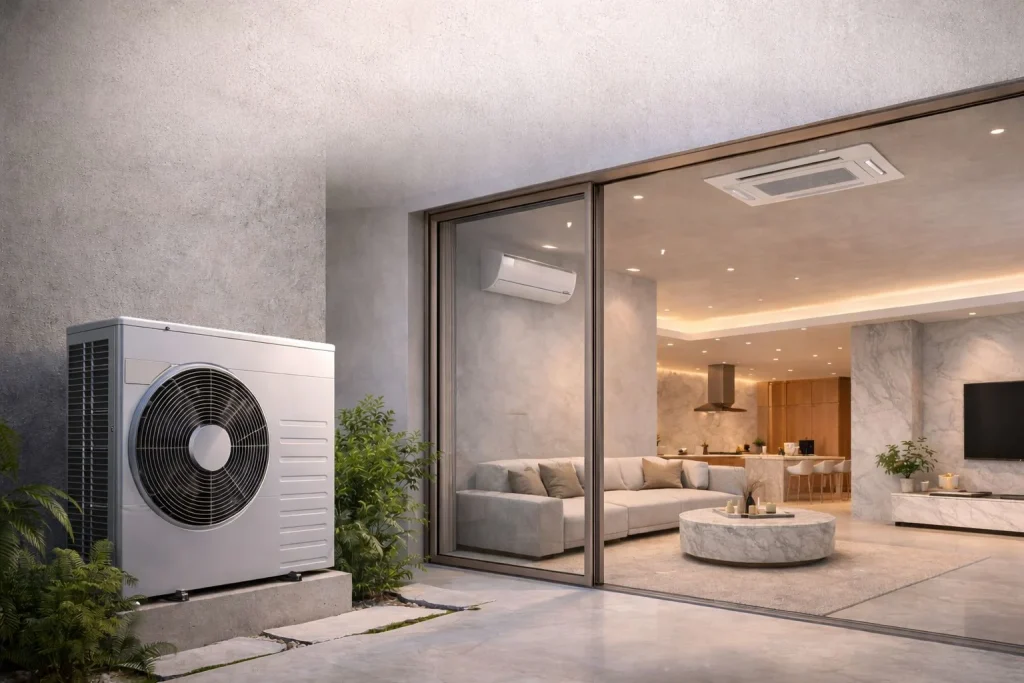
Split HVAC Systems
This is what most Indian homes use today.
One unit inside the room.
One unit outside on the balcony or ledge.
They’re popular because they’re efficient, fairly affordable, and easy to service. When someone asks what is HVAC in a flat or independent house, this is usually what they’re pointing at.
Window Units
Old-school, yes.
But still very much around.
Everything—cooling, ventilation, exhaust—comes packed into one unit. It’s a basic form of HVAC, best suited for smaller rooms or older buildings where split systems weren’t planned originally.
Ductless Mini-Split Systems
These are gaining popularity in larger homes.
Each room has its own indoor unit, but they’re all connected to a common outdoor unit.
This kind of HVAC system gives more control. One room can stay cool without freezing the rest of the house.
HVAC Systems in Offices and Commercial Buildings
Once buildings get bigger, HVAC steps up its game.
Central HVAC Systems
You’ll see these in malls, airports, hotels, and corporate offices.
Cooling or heating happens at a central plant. Air is then pushed through ducts hidden above ceilings and behind walls. The benefit? Even temperature and controlled air quality across large spaces.
If you’ve ever wondered what HVAC is doing above those false ceilings—this is it.
Packaged HVAC Units
These are common in schools, showrooms, and mid-sized commercial buildings.
All components are packed into a single unit, usually placed on the terrace. Installation is simpler, maintenance is easier, and performance is reliable if designed correctly.
Ventilation: The Quiet Hero of HVAC
Cooling gets all the attention.
Ventilation does the heavy lifting.
Good ventilation—an essential part of the HVAC meaning—keeps air fresh and breathable.
It:
- Pushes out stale air
- Controls humidity
- Reduces dampness and odours
In homes, poor ventilation shows up as peeling paint and musty smells. In offices, it causes tiredness and headaches. A balanced HVAC system handles airflow as carefully as temperature—especially in Indian cities where dust and humidity are constant challenges.
HVAC Depends More on Construction Than People Think
Here’s a reality most homeowners realise too late.
HVAC doesn’t work alone.
Walls, roofs, plaster quality, and concrete strength directly affect how well an HVAC system performs. Poor insulation or damp surfaces force systems to run longer and harder—raising power bills and shortening equipment life.
That’s why experienced engineers don’t treat HVAC like a gadget. They see it as part of the building’s health.
Understanding what is HVAC also means understanding how buildings hold heat, release moisture, and age over time.
Choosing the Right HVAC System (No Shortcuts Here)
There’s no universal answer.
The right HVAC system depends on:
- Climate
- Size of the building
- Number of people using it
- How the space is actually lived in
A home in Jaipur needs something different from an office in Bengaluru. Knowing the HVAC meaning helps people make sensible choices instead of copying trends or overspending on unnecessary capacity.
HVAC Today: Quiet, Efficient, and Expected
Modern HVAC systems are smarter and more efficient than ever. Many adjust automatically. Some run silently enough that you forget they’re on.
But the goal hasn’t changed.
Comfort.
Consistency.
Reliability.
Once you really understand what HVAC is, you realise it’s not about machines. It’s about how a space feels—every single day.
A Real-World Conclusion (With Context)
Comfort inside a building isn’t luck.
It’s built.
A properly designed HVAC system manages heat, airflow, and moisture through brutal summers, sticky monsoons, and cold winter mornings. But even the best HVAC setup struggles if the building itself doesn’t support it. Solid walls, reliable concrete, and good finishing reduce heat gain and moisture—allowing the system to work smoothly instead of constantly fighting the structure.
That’s where fundamentals matter. From the concrete that forms the skeleton to the surfaces that protect it year after year, construction choices shape long-term comfort. Brands like JK Cement, known for consistency and dependable performance, fit naturally into this equation—supporting buildings that age well, feel stable, and stay comfortable without constant fixes.
Because in the long run, good construction isn’t just about strength.
It’s about how a space feels—day after day, season after season.
FAQs
1. What is HVAC in simple words?
HVAC controls heating, cooling, and airflow inside a building so people stay comfortable.
2. What is the HVAC full form?
Heating, Ventilation, and Air Conditioning.
3. Is HVAC only about air conditioning?
No. Heating and ventilation are just as important.
4. Which HVAC system works best for homes?
Split systems and ductless mini-splits are most common, depending on layout and budget.
5. Why is ventilation important in HVAC systems?
It removes stale air, controls humidity, and improves indoor air quality.
6. Do small buildings really need HVAC?
Yes—especially in extreme weather or crowded indoor spaces.
7. Does building quality affect HVAC performance?
Absolutely. Better construction means better efficiency and lower running costs.