If you’ve ever stood under an AC and wondered why one room feels cool while another stays stuffy, chances are the issue isn’t the machine.
It’s the duct.
So let’s clear the basics straight away.
A duct is the pathway that carries cooled or heated air from the AC unit to different rooms.
In air conditioning, especially central systems, the AC duct decides how evenly air flows, how comfortable a space feels, and how much electricity you finally pay. In simple words, if the AC is the heart, the duct is the set of veins. Get the duct wrong, and even the best AC struggles.
On most sites, ducts are treated like an afterthought. That’s where problems start.
People focus on tonnage and brands, but forget that the AC duct is what actually delivers comfort. Understanding how ducts work, how to define duct properly, and knowing the right type of duct for your space can save money, energy, and a lot of frustration later.
What Is a Duct in Construction?
To define duct in construction terms:
A duct is a hollow passage used to move air from one point to another. In air conditioning systems, ducts distribute cooled or heated air from the unit to different rooms and then return it for reconditioning.
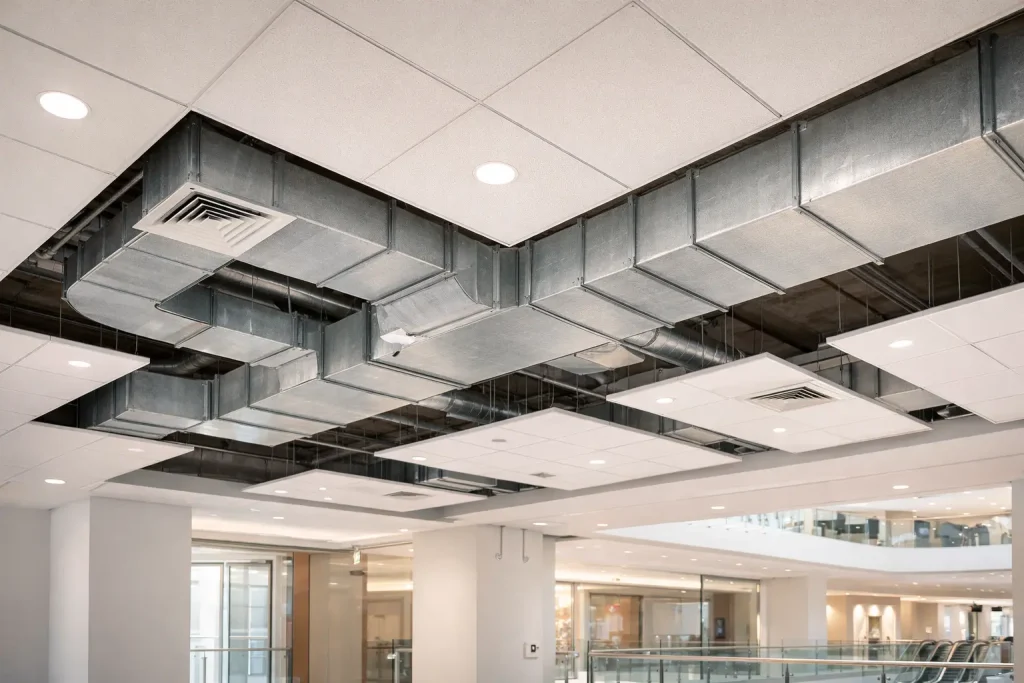
A duct is usually hidden inside false ceilings, walls, or shafts, which is why people ignore it. But invisibility doesn’t mean unimportance.
In an AC duct system, the duct size, shape, insulation, and layout decide:
- How fast the air reaches a room.
- How much of the cooling is lost on the way.
- How noisy the system becomes.
Expensive air conditioners are installed perfectly, but poor duct planning turns them into noisy, inefficient machines. Uneven cooling, whistling sounds, and water dripping – these issues almost always trace back to the duct design.
Types of Ducts Used in Air Conditioning
Not every building uses the same type of duct. Choice depends on space, budget, and cooling load.
1. Sheet Metal Duct
This is the most common duct used in commercial buildings such as malls, offices, and hospitals. They are strong, durable, and long-lasting.
Pros:
- Long-lasting.
- Smooth airflow.
Cons:
- Inefficient without proper insulation.
- It can get noisy if poorly installed.
2. Flexible Duct
It is not normally seen in residential structures, but it is easily installed and is flexible – it bends around tight corners.
Pros:
- Installation is easy and quick.
- Works well in renovations.
Cons:
- If bent too much, it can result in airflow loss.
- Not as long-lasting as a sheet metal duct.
3. Fibreglass Duct
It works extremely efficiently in controlled environments such as hospitals, labs, pharmaceutical units and research facilities where moisture, dust and air quality are in check. Its built-in insulation system helps keep the temperature controlled.
Pros:
Good thermal insulation.
Cons:
Its efficiency can be severely affected if moisture enters. It is not ideal for humid environments.
4. Pre-Insulated Duct
This is a very popular choice today due to its lightweight panels that have insulation already attached.
Pros:
- Faster installation.
- Better energy efficiency.
Choosing the right type of duct is not about what’s cheapest – it’s about what fits the building.
How AC Duct Systems Actually Work
Many people think cold air “pushes” itself into rooms. It doesn’t. An AC duct system works on pressure balance.
- The AC unit cools the air.
- Air travels through the duct network.
- Supply ducts send air into rooms
- Return ducts pull air back
If duct sizes are mismatched, rooms at the end suffer. That’s why one bedroom freezes while the living room feels warm.
This is where understanding how to define duct layout becomes critical. Duct length, bends, and height differences all affect performance.
Reasons Why Proper Duct Planning Is Necessary
This part is often ignored and later regretted. Good duct planning is important as it:
- Ensures uniform cooling
- Reduces electricity bills
- Lowers AC load
- Minimises noise
- Prevents condensation and leakage
Bad duct planning results in:
- Hot and cold spots
- AC running longer than needed
- High maintenance costs
On sites, many times, ducts are squeezed above false ceilings without space for insulation. That leads to cooling loss and ceiling dampness. A well-planned AC duct system avoids all this.
Ducts and Coordination with Civil Work
Here’s something homeowners don’t hear enough. Ducting is not just an AC contractor’s job. It needs coordination with civil, electrical, and ceiling work.
Once slabs are cast and ceilings fixed, changing a duct route becomes messy and expensive.
That’s why experienced engineers insist duct drawings be finalised early, right along with structural and finishing plans. The same planning-first approach you see recommended across practical construction guidance, including on the JK Cement blog, applies here too. Systems work best when the groundwork is thought through.
Common Duct Mistakes on Sites
Watch out for these red flags:
- Undersized ducts.
- Too many sharp bends.
- Poor insulation.
- No access panels for maintenance.
- The flexible duct stretched too long.
A properly designed AC duct system runs quietly and efficiently. You don’t notice it, and that’s exactly how it should be.
So, what should you remember?
Choosing the right type of duct, planning its layout early, and installing it properly makes the difference between a space that feels comfortable and one that never cools evenly.
If you’re planning air conditioning, don’t ask only about tonnage or brand – ask about the duct. That’s where real comfort begins.
FAQs
1. What is a duct in air conditioning?
A duct is a passage that carries cooled or heated air from the AC unit to different rooms.
2. Which type of duct is best for homes?
Flexible or pre-insulated ducts are commonly used in residential buildings.
3. Can poor ducting increase electricity bills?
Yes. Poor duct design causes air loss, making the AC work harder.
4. Is duct insulation really necessary?
Absolutely. Without insulation, cooling is lost, and condensation can form.
5. When should duct planning be done in construction?
Ideally, before the false ceiling and electrical work begin.