But here’s the truth most suppliers won’t say:
- Used correctly → they quietly last 12–15 years.
- Used blindly → they fail within two monsoons.
This guide breaks PVC panels down properly — where they work, where they fail, pricing reality, installation logic, and what most contractors get wrong.
Quick Answer
PVC wall panels are lightweight plastic-based wall cladding boards used to protect and finish interior walls.
They are:
- Moisture-resistant
- Termite-proof
- Quick to install
- Low maintenance
They are not structural materials.
They cannot hold heavy loads unless anchored into the wall behind.
PVC protects surfaces. It does not strengthen them.
Why PVC Wall Panels Are Growing in 2026
Indian homes today face predictable problems:
- Damp interior walls
- Fast renovation expectations
- Skilled labour shortages
- Dust-heavy site conditions
- Short repaint cycles
PVC panels respond to these because:
- No curing time
- No sanding
- No repeated putty work
- Minimal dust
- Faster handover
In apartments under 1,500 sq ft, PVC can reduce renovation timelines by 40–60% compared to plaster and repaint cycles.
Speed matters now.
Where PVC Wall Panels Actually Make Sense
Best Use Areas
- Bedroom feature walls
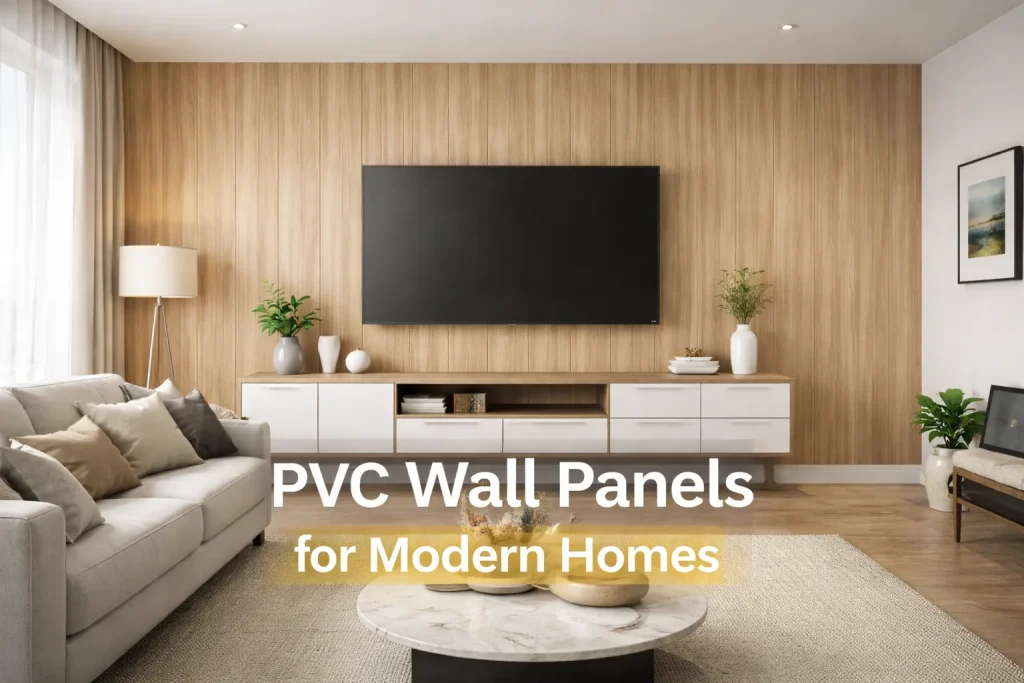
- TV backdrops
- Kitchen dry backsplashes
- Bathroom ceilings
- Utility areas
- Corridors with scuff damage
Avoid In
- Exterior-facing sun-exposed walls
- Structural crack zones
- Heavy mounting areas without backing support
- Active water leakage areas
PVC hides dampness visually.
It does not solve structural moisture.
Fix the source first. Always.
Types of PVC Wall Panels
Not all PVC panels are equal.
1. Hollow PVC Panels (5–8mm)
Lightweight and budget-friendly.
Used for ceilings and low-contact walls.
Risk: They dent easily and are not suitable behind TV units.
2. Solid PVC Panels (8–10mm)
Denser and more impact resistant.
Good for feature walls.
Higher cost than hollow panels but more durable.
3. WPC-PVC Composite (8–12mm)
Best overall performance.
Why it works:
- Higher density
- Better screw-holding capacity
- More stable in humidity
For most Indian homes, this is the safest long-term option.
4. 3D PVC Panels
Raised textures and pattern-heavy surfaces.
Good for accent areas only.
Warning: Dust accumulation increases if pattern depth is too high.
5. Laminated PVC (Marble / Stone Look)
Printed surface film over a PVC base.
Looks premium initially.
Risk: Film peeling after years if the quality is poor.
PVC Wall Panel Design Trends in 2026
Gloss is fading.
Matte and texture-led finishes dominate.
Popular finishes now include:
- Vertical fluted wood grain
- Soft concrete grey
- Linen-texture neutrals
- Warm smoked oak
- Subtle matte marble
Over-shiny PVC looks temporary.
Matte finishes age better.
What Actually Goes Wrong on Indian Sites
Most PVC failures are installation failures.
Common mistakes include:
- Fixing panels over damp plaster
- Adhesive-only installation
- No expansion gap at edges
- Over-tight screws
- No air circulation behind panels
- Using hollow panels in impact zones
Failure timeline:
- Looks perfect at installation
- Warping begins after the monsoon
- Odour appears due to trapped moisture
- Panels detach slowly
The wall behind matters more than the panel in front.
Installation Logic (Non-Negotiable Rules)
- Check wall moisture (below 12%)
- Use batten grid or framing support
- Combine adhesive and mechanical fixing
- Leave a 3–5mm expansion gap
- Seal joints in semi-wet zones
- Allow minimal ventilation
If glued directly on a damp wall, it will fail.
No brand can save bad substrate preparation.
PVC Wall Panel Price in India (2026)
Material pricing varies widely by thickness and finish.
| Type | Material Price | Installed Price |
|---|---|---|
| Hollow PVC | ₹55 – ₹120 per sq ft | ₹90 – ₹180 per sq ft |
| Solid PVC | ₹120 – ₹250 per sq ft | ₹180 – ₹350 per sq ft |
| WPC-PVC Composite | ₹180 – ₹400 per sq ft | ₹250 – ₹500 per sq ft |
| Designer / 3D Panels | ₹300 – ₹650 per sq ft | ₹350 – ₹750 per sq ft |
Installation labour usually ranges between ₹40 and ₹80 per sq ft.
For a standard 12×10 ft bedroom feature wall, the total cost may range between ₹18,000 and ₹45,000 depending on quality.
PVC vs Paint vs Wallpaper
Moisture resistance: PVC wins clearly.
Lifespan comparison:
- PVC: 10–15 years
- Paint: 3–5 years
- Wallpaper: 2–4 years
Repair flexibility:
- Paint: Easiest
- PVC: Moderate
- Wallpaper: Difficult
PVC is ideal where dampness repeats.
It is not necessary where walls are dry and stable.
Bedroom PVC Wall Panels: Smart Application
Best approach:
- Use fluted WPC panels behind the headboard
- Combine panel and paint (split wall treatment)
- Integrate warm cove lighting
- Avoid cladding all four walls
PVC works best as an accent.
Overuse reduces visual value.
Maintenance Reality
PVC is low maintenance, not zero maintenance.
- Wipe with a microfiber cloth
- Use mild soap solution
- Avoid harsh solvents
- Inspect joints yearly
- Check ventilation in humid rooms
If moisture builds behind panels, smell will reveal it.
Clear Decision Shortcut
If this were my home:
- WPC-PVC for bedroom feature wall
- Standard PVC for kitchen dry zone
- No hollow panels in impact areas
- Mechanical fixing always
- Moisture source treated first
PVC panels are problem-solving materials.
Not fashion statements.
FAQs
Are PVC wall panels waterproof?
They are water-resistant, but they do not replace proper waterproofing. Moisture behind panels can still cause fungal growth if untreated.
Can PVC panels hide damp walls?
They can visually hide stains, but the moisture source must be resolved to avoid odour and long-term wall damage.
What is the average PVC wall panel price per sq ft in India?
Installed cost ranges between ₹90 and ₹500 per sq ft depending on thickness and type.
Are PVC panels suitable for bedrooms?
Yes, especially WPC composite panels for headboard or feature walls.
How long do PVC wall panels last?
10–15 years indoors when properly installed.
Can I mount a TV on PVC panels?
Yes, but brackets must anchor into the wall behind, not the panel surface.
Are PVC panels termite-proof?
Yes. PVC is not digestible by termites.
Do PVC panels trap heat?
Indoors, no major heat retention occurs. Avoid direct sun-facing external walls.
Are PVC panels fire-safe?
Most certified panels are flame-retardant (FR grade), not fireproof. Always confirm certification.
Is WPC better than standard PVC?
Yes. WPC is denser, stronger, and holds screws better.
Final Thought
PVC wall panels are not luxury materials.
They are controlled-response materials.
Used where moisture repeatedly damages paint, they are excellent.
Used everywhere blindly, they dilute design quality.
Choose based on environment.
Install with discipline.
Avoid shortcuts.
That’s how PVC panels last beyond a trend cycle and don’t become another quick renovation regret.