(Most people notice it only when it looks good. Or when it’s missing.)
The quick answer
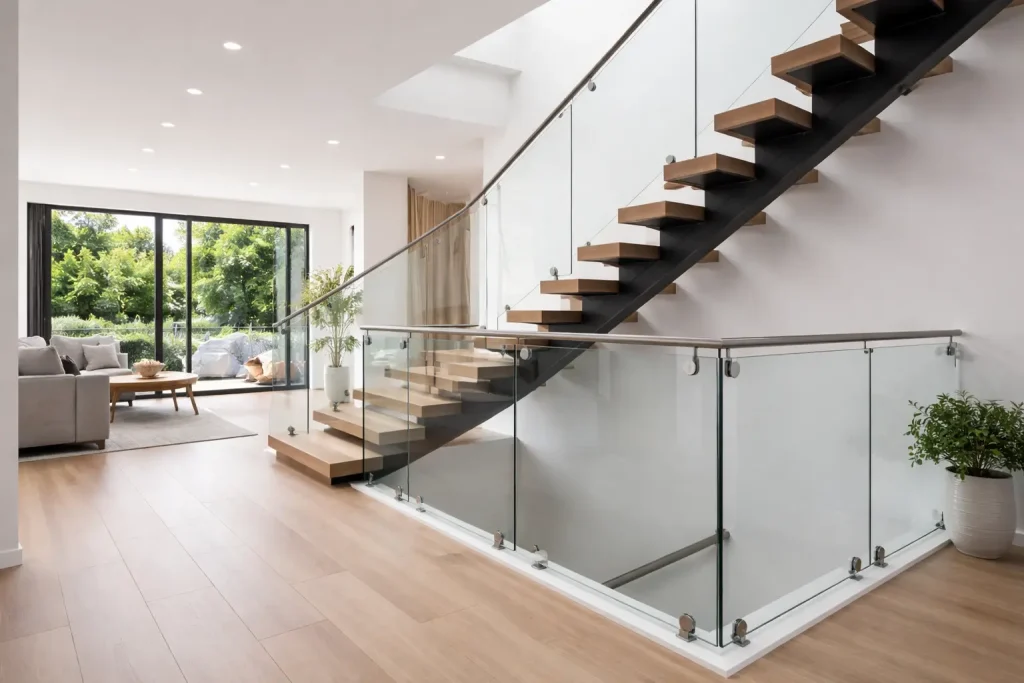
A balustrade is the protective barrier you see along edges — stairs, balconies, terraces — made of vertical elements (bars, panels, or glass) and a top rail.
It stops people from falling.
And quietly shapes how the space feels.
What it actually is on site
On drawings, you’ll hear “balustrade.”
On site, most people just say “railing.”
But there’s a difference.
A balustrade is the full system:
• Vertical supports (balusters, panels, glass, cables)
• Top rail (the part you hold)
• Sometimes a bottom rail or base
It’s not just a line of metal pipes. It’s a safety element.
Why it matters more than it looks
It’s easy to treat this as a finishing item.
But it’s doing three jobs at once:
Safety first
Edges are risky.
Stairs, balconies, terraces — one wrong step and there’s a fall.
The balustrade is what prevents that.
Support while moving
On stairs especially, the top rail acts as a guide.
You don’t think about it — until it’s not there.
Visual framing
This is where design comes in.
A heavy concrete balustrade makes a space feel solid and traditional.
Glass makes it feel open.
Metal can go either way — minimal or decorative.
Same structure. A completely different feeling.
Types of balustrades — what you actually see in real projects
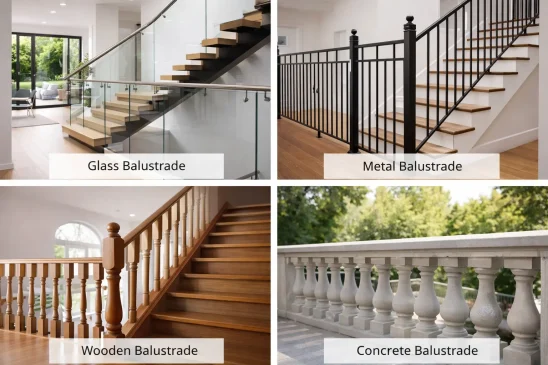
Classic baluster style
The traditional one.
Repeated vertical members with a top rail.
Seen in older homes, villas, and some premium projects even now.
Glass panel balustrade
One continuous glass panel instead of vertical bars.
Used where view matters — terraces, balconies, pool edges.
Looks clean. Feels open.
Metal balustrade
Steel, aluminium, wrought iron.
Most common in apartments.
Can be simple horizontal bars or detailed patterns.
Cable (wire) balustrade
Thin steel cables stretched between posts.
Minimal visual obstruction.
But needs proper tensioning — otherwise it sags over time.
Mixed systems
Very common now.
Concrete base + glass above
Metal posts + wooden handrail
You get strength where needed and lightness where visible.
Materials — what actually works where
Glass
Best for views.
Used in balconies, terraces, decks.
But you’ll clean it more often than you expect.
Metal
Strong, flexible, widely used.
Works almost everywhere.
Needs proper coating — otherwise rust starts showing up.
Wood
Warm, classic feel.
Mostly indoors or covered areas.
Maintenance is the trade-off.
Cement / concrete
Heavy. Solid. Long-lasting.
You’ll see this in older structures, bungalows, or projects aiming for a classical look.
Works very well outdoors.
But it adds weight — so the structure below must handle it.
Composite / uPVC
Low maintenance alternatives.
Used where people want the look without constant upkeep.
Where balustrades are actually critical
Staircases
Both sides ideally.
Height and spacing matter — not just design.
Balconies and terraces
This is non-negotiable.
Especially in apartments.
Roof edges
Often ignored.
Then later someone adds a temporary railing — usually not safe.
Ramps and walkways
Long runs need continuous support.
Not just visual barriers.
What usually goes wrong
Not design.
Execution.
• Weak fixing into concrete
• Rusting anchors
• Glass not installed properly
• Gaps too wide
• Height compromised for design
And then over time:
• Wobbling rails
• Loose panels
• Safety risk
This is one place where “looks fine” is not enough.
Small details that actually matter
• Proper anchoring into slab or beam
• Corrosion-resistant fasteners
• Correct height (around 1–1.1 m for balconies typically)
• No large gaps (especially for kids)
• Waterproofing around fixing points
That last one gets ignored often.
Water enters through anchors → corrosion → concrete damage.
If this was my own house
I wouldn’t just choose based on design.
I’d look at:
• Location (indoor vs outdoor)
• Maintenance effort
• Safety and fixing details
For example:
• Balcony → glass or metal, depending on exposure
• Stairs → metal or wood for grip
• Terrace edge → something solid and well-anchored
Because this isn’t just a design element.
It’s something people lean on.
FAQs — how people actually think about it
What exactly is a balustrade?
It’s the barrier along edges like stairs or balconies that prevents falls and often includes a handrail.
Is it the same as a railing?
Not exactly. Railing is a general term. Balustrade is the full system — posts, panels, and top rail.
Which type is best for a home?
Depends on use. Glass for views, metal for durability, concrete for a solid outdoor feel.
Are glass balustrades safe?
Yes, if proper safety glass and fixing systems are used.
What is a cement balustrade?
A balustrade made from concrete elements, usually precast, often seen in classical designs.
Which one needs the least maintenance?
Concrete and coated metal. Glass needs cleaning. Wood needs regular upkeep.
Can I install it on an existing balcony?
Yes, but fixing strength and waterproofing need to be checked properly.
What height should it be?
Usually around 1–1.1 meters for balconies, but it depends on local rules.
Do gaps matter?
Yes. Large gaps are unsafe, especially for children.
What fails most often?
Not the material — the fixing. Loose anchors cause most problems.
Final thought
A balustrade looks like a finishing detail.
But it behaves like a structural safety element.
You lean on it without thinking.
That’s the point.
If it’s done right, you never notice it.
If it’s done wrong, you feel it immediately.