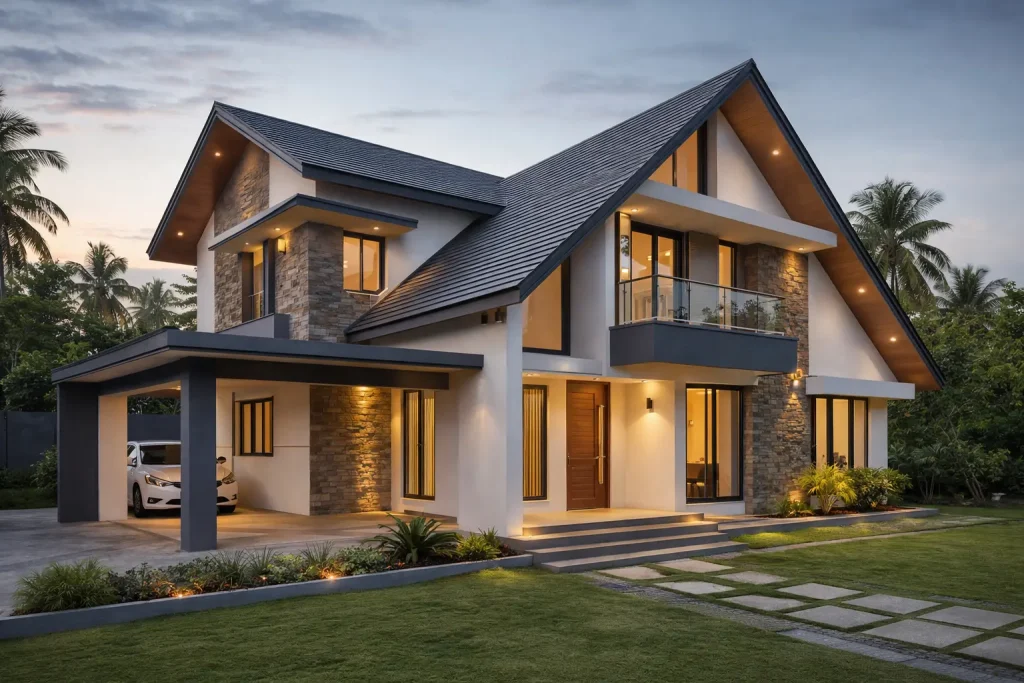
Sloping roof design is no longer an aesthetic upgrade.
It is a performance correction for Indian homes.
In a country where:
- Monsoons are aggressive
- Heat retention is rising
- Waterproofing failures are common
Flat roofs don’t fail immediately.
They fail slowly — through seepage, heat gain, and maintenance cycles.
Sloping roofs solve these problems at the source.
Not by resisting water.
But by removing it.
Quick Answer
A sloping roof (pitched roof) is a roof inclined at an angle to allow rapid drainage of rainwater, reduce heat absorption, and improve long-term structural durability.
For Indian homes:
- 25°–35° slope → ideal for tile roofs
- 10°–20° slope → suitable for metal sheets
- Gable / Hip roofs → best for heavy rainfall zones
A well-designed sloping roof can last 40–60 years, compared to repeated waterproofing cycles in flat RCC slabs.
Why Sloping Roofs Are Making a Comeback in India
For decades, RCC flat roofs dominated urban construction.
But on real sites, three failures keep repeating:
Water Stagnation
Flat roofs develop micro-slope errors over time.
Water starts collecting → seepage begins → waterproofing fails.
Heat Retention
Concrete absorbs heat all day and releases it at night.
Result:
- Hot interiors even after sunset
- Increased AC usage
- Thermal discomfort
Waterproofing Fatigue
Liquid waterproofing systems:
- Crack due to expansion
- Require reapplication every 3–5 years
This is not a one-time solution.
It is a recurring cost cycle.
Structural Logic: Why Sloping Roofs Work
Gravity Does the Work
Water does not stay.
It flows.
That single principle eliminates 80% of roof leakage risks.
Thermal Buffer Creation
Sloping roofs create an air gap (attic space).
This acts as insulation, reducing direct heat transfer into living spaces.
Load Distribution
Instead of a flat load, weight is transferred along slopes to walls.
This reduces stress concentration.
Cement & Structural Base (Critical but Ignored)
A sloping roof performs only as well as the structure supporting it.
The RCC ring beam or slab beneath must:
- Resist cracking
- Handle load transfer
- Maintain dimensional stability
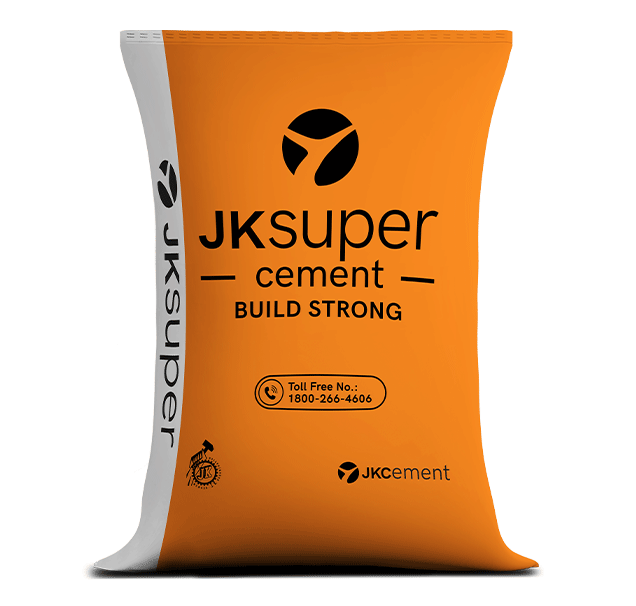
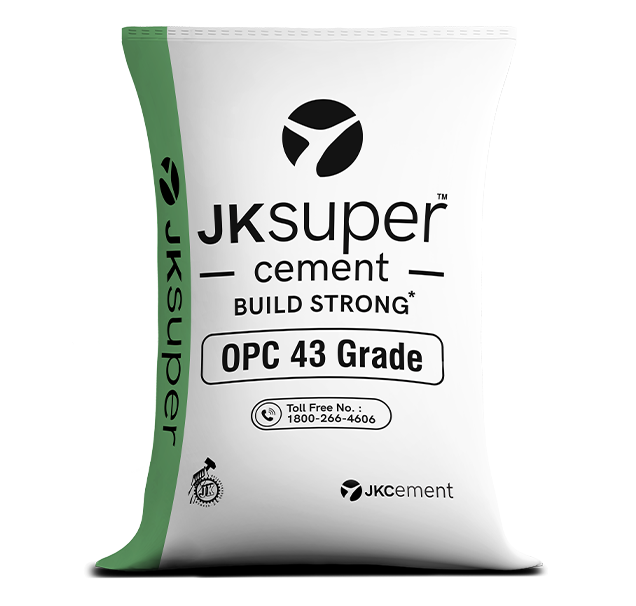
Using high-performance cement such as JK Super Cement improves:
- Crack resistance
- Density of concrete
- Long-term durability
A good roof system is not just the top layer.
It is: Roof + Structure + Material quality working together.
10 Sloping Roof Design Ideas for Indian Homes
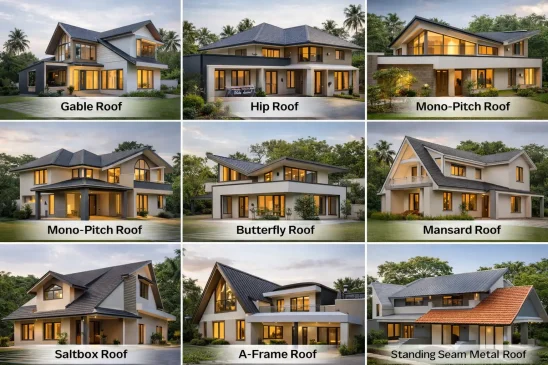
1. Gable Roof (Most Practical)
Two slopes meeting at a ridge.
- Simple
- Cost-effective
- Excellent drainage
Best for: Kerala, Karnataka, Northeast India
2. Hip Roof (Wind-Resistant)
Four-sided slope.
- Stable
- Aerodynamic
- Better load distribution
Best for: Coastal regions
3. Mono-Pitch Roof (Modern Urban)
Single sloping plane.
- Minimalist
- Solar-friendly
- Easy drainage
Best for: Row houses, extensions
4. Butterfly Roof (High-Risk Design)
Inverted slope toward center.
- Visually striking
- Requires precision drainage
Risk: Drain failure = internal leakage
5. Mansard Roof (Space Maximizer)
Steep lower slope, flatter top.
- Creates attic space
- Complex construction
6. Saltbox Roof (Asymmetrical Protection)
Unequal slopes.
- Better wind resistance
- Unique aesthetics
7. A-Frame Roof (Extreme Climate Performer)
Steep triangular form.
- Excellent drainage
- Limited usable wall space
8. Hybrid Roof (Flat + Slope)
Combination system.
- Terrace + protection
- Highly practical for cities
9. Standing Seam Metal Roof
Interlocking metal panels.
- No visible fasteners
- Lightweight
- Leak-resistant
10. Terracotta Tile Roof (Thermal Champion)
Traditional clay tiles.
- Best cooling performance
- Long lifespan
- Sustainable
Cost of Sloping Roof in India (2026)
Component-wise Cost
| Component | Cost (₹/sq ft) |
| Structure (Steel / LGSF) | 180 – 400 |
| Roofing Material | 100 – 450 |
| Insulation & Installation | 70 – 200 |
Total Cost
👉 ₹350 – ₹1,050 per sq ft
Cost Logic (Important)
Higher upfront cost ≠ expensive
Flat roofs require:
- Waterproofing every few years
- Repairs
- Heat management
Sloping roofs reduce these recurring costs.
What Actually Goes Wrong on Indian Sites
The “Oven Effect”
Metal roof without insulation:
- Indoor temps cross 40°C
- Noise during rain becomes unbearable
Poor Tile Fixing
Tiles not mechanically fixed → wind uplift → displacement
Bad Gutter Design
Undersized gutters overflow during heavy rain.
Weak Structural Base
Cracked RCC base → misalignment → long-term failure
Execution Checklist (Non-Negotiable)
- Pitch: Minimum 25° for tiles
- Gutter size: Minimum 6 inches
- Insulation: Mandatory for metal roofs
- Ventilation gap: Required below roofing layer
- Tile fixing: Mechanical or proper bedding
- Flashing: At all wall junctions
If This Were My Own House
I would:
- Use a hybrid roof system
- Gable roof with terracotta tiles for living spaces
- Flat RCC section for terrace utility
- Ensure proper insulation and ventilation
- Use high-quality cement (like JK Super Cement) for structural base
Because:
Roof failures are expensive.
And often irreversible.
FAQs
Which sloping roof is best for heavy rain in India?
A steep gable or hip roof is best for heavy rain in India. These designs allow rapid water runoff, preventing stagnation and leakage.
Is a sloping roof better than a flat roof?
Yes, a sloping roof is better for durability and maintenance. It eliminates water stagnation and reduces waterproofing failures.
What is the cost of a sloping roof in India?
The cost ranges between ₹350 to ₹1,050 per sq ft depending on materials, structure, and insulation requirements.
Which material is best for a cool roof?
Terracotta clay tiles are best for cooling as they naturally reduce heat transfer and improve indoor comfort.
Can solar panels be installed on sloping roofs?
Yes, sloping roofs are ideal for solar panels because they allow better orientation and efficiency.
How long does a sloping roof last?
A well-constructed sloping roof lasts 40–60 years with minimal maintenance.
Do sloping roofs require waterproofing?
The main surface does not, but junctions and flashings must be properly sealed.
Is metal roofing noisy during rain?
Yes, without insulation. Proper insulation reduces noise significantly.
Can I convert a flat roof into a sloping roof?
Yes, using lightweight steel structures, especially in high rainfall areas.
Does a sloping roof increase house height?
Yes, and local building regulations must be checked before construction.
Final Thought
A roof is not just a cover.
It is a long-term performance system.
Flat roofs try to resist water.
Sloping roofs remove it.
Flat roofs absorb heat.
Sloping roofs deflect it.
If you choose wrong, you will keep fixing it.
If you choose right, you will forget about it.
And in construction —
the best systems are the ones you never have to think about again.