Walk into any under-construction home in India, and you will notice one thing almost immediately. The windows aren’t just openings anymore. They are decisions. Many homeowners are particular about choosing the windows. They not only care about inches but also about light, airflow, and how the house will feel at 4 pm in May. That’s where casement windows quietly win.
Simple design. Full opening. Maximum ventilation. But here’s the catch: most people choose the design and completely ignore the size. And that’s where things go wrong. Too small, and your room feels boxed in. Too large, and you struggle with structural strength or cost.
So in this guide, you’ll learn the casement window sizes in India, the meaning of casement, what actually works in real homes, and what doesn’t.
What Is a Casement Window?
Let’s keep this simple. The meaning of “casement” is basically a window that is hinged on one side and opens outward or inward like a door. That’s it. No tracks. No sliding. Just a clean swing. That’s why casement windows are still the most common choice in Indian homes. They open fully.
Which means:
- Better cross ventilation
- More natural light
- Easy cleaning
We’ve all seen kitchens where smell just doesn’t leave. A well-sized casement fixes that instantly. Same with bathrooms: during monsoon, airflow matters. And because the casement design seals tightly when closed, it also helps keep dust and noise in check. It is something every city homeowner struggles with today.
What is the Standard Casement Window Sizes in India for Different Rooms?
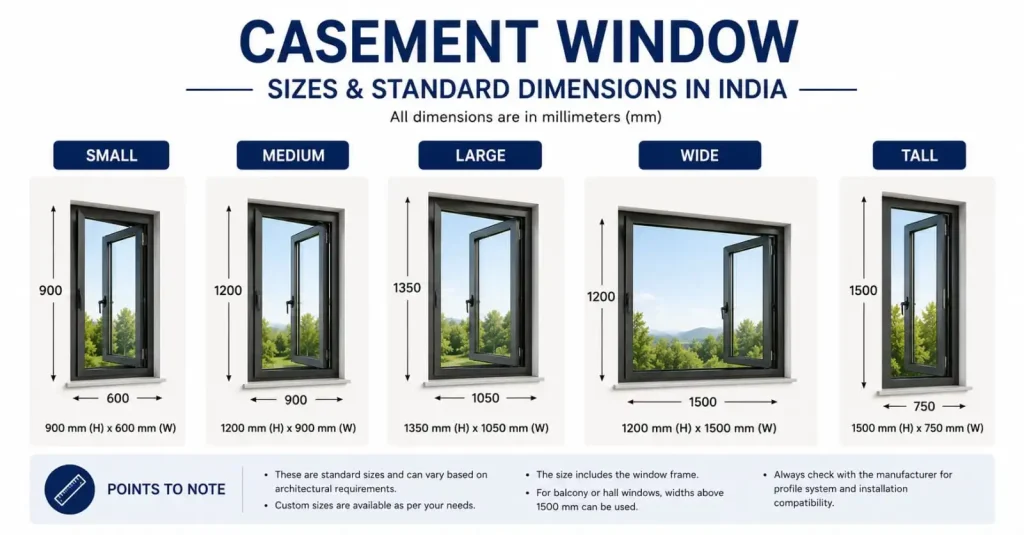
Size is something most people actually search for. There’s no single fixed number for casement windows, but over the years, some standard sizes have become common across Indian construction. These sizes are practical, cost-effective, and easy to execute on-site.
- Living Room: This is where you want openness. Hence, larger and wider casements work well for living rooms facing a garden or balcony.
- Kitchen: This is where casement windows really shine. They are usually placed above the counter or near the cooking zone in kitchens.
- Bathroom: Although small casement windows are used in bathrooms, they make a huge difference in moisture control.
What Are the Factors that Affect Casement Window Size?
This is where theory meets reality. You can’t just pick a size and apply it blindly. Every casement window size depends on a few real-world factors.
- Room Size
The simple logic is that the bigger room needs the bigger casement windows. For example, a 12×15 ft living room needs larger openings compared to a 10×10 bedroom.
- Direction of the House
South and west-facing walls get harsh sunlight. So, instead of oversized casement windows, it is advisable to sometimes reduce their size or add shading. East-facing? Go bigger to enjoy that morning light.
- Ventilation Needs
Kitchens and bathrooms need more airflow. That’s why even a small casement window is placed strategically across the areas of the home.
- Structural Limitations
This one gets ignored a lot. Too wide a casement window can weaken the wall if not properly supported. That’s where lintels and good-quality materials matter. Cracks may appear in the “bigger window view.”
- Budget
Larger casement windows mean more glass and more hardware. This results in additional cost. Sometimes, splitting into two smaller casements works better than one large panel.
What Are Standard Window Dimensions as per Indian Building Guidelines?
In India, window sizes aren’t just about design. There are basic guidelines (as per IS codes like IS 4021) that most engineers follow. They’re not always strictly enforced in homes, but they exist for a reason.
For casement windows, these are the general principles:
- Window area should be at least 10% of floor area for proper ventilation
- Sill height usually stays around 3 feet from floor level
- Lintel height is commonly around 7 feet
So if your room is 100 sq ft, your total window area (including casement windows) should ideally be around 10 sq ft or more. This provides enough daylight and natural airflow inside the home. What’s more? It reduces the dependency on artificial light.
Common Mistakes to Avoid When Choosing the Casement Window
This is where most people slip. Not in choosing the casement design but in how they size and place it. Here are common mistakes one should avoid when selecting casement windows for a home:
- Going Too Small
Trying to save money? You end up with poor ventilation. And then spend more on fans, exhausts, and lighting. Instead, choose the ideal size of the casement window depending on the space and area in the room.
- Ignoring Sun Direction
A large west-facing casement window without shading results in unbearable heat. So, avoid placing the casement windows at home in the direction of the sun.
- Poor Placement
A casement window placed too high or too low reduces its effectiveness. Hence, placement also matters a lot when it comes to proper ventilation. Make sure that the placement is right for better airflow.
- Not Considering Furniture Layout
You install a beautiful casement window and then realize your wardrobe blocks it. Doesn’t sound feasible, huh? So, it is advisable to plan window placement with furniture in mind.
- Using Weak Materials
Big windows need strong frames and good masonry. This is where quality materials matter. At JK Cement, we’ve seen how proper cement and plastering support long-lasting window installations, especially in larger openings.
- Overdesigning
Too many small casement windows instead of one well-sized unit creates clutter. The simple design will do wonders when it comes to an aesthetic and durable window placement.
The Final Words
To conclude, casement windows are not complicated. But choosing the right size? That’s where experience shows. You don’t need perfect numbers.
You need practical thinking. Ask yourself the following questions:
- How much light do I want?
- How much air do I need?
- What does my wall allow?
Because a well-sized casement window doesn’t just sit there. It changes how your home feels.
FAQs
1 What is the standard size of casement windows in India?
There is no universal standard size for casement windows in India. The dimensions depend on room type and building design. Usually, smaller windows suit bathrooms or kitchens, while larger ones are preferred for living rooms and bedrooms for better light and ventilation.
2. What is the meaning of casement in windows?
The meaning of “casement” in windows refers to a design where the window is attached to its frame with hinges on one side. It opens outward or inward like a door and ensures full ventilation. This simple mechanism makes it practical, efficient, and widely used in modern as well as traditional homes.
3. Are casement windows good for Indian homes?
Yes, casement windows work very well in Indian homes because they provide excellent airflow. This is essential in warm and hot climates. They also seal tightly when closed, which prevents dust and rain. Their easy operation and compatibility with different materials make them a reliable and practical window choice.
4. Which rooms are best suited for casement windows?
Casement windows are especially suitable for kitchens, bedrooms, and bathrooms where proper ventilation is important. Their wide opening design ensures these spaces stay airy and comfortable throughout the day.
5. How do I choose the right casement window size?
Choosing the right size depends on multiple factors like room dimensions, wall space, sunlight direction, and ventilation requirements. Larger rooms can accommodate bigger windows, while smaller spaces need compact sizes.
6. Are larger casement windows better?
Larger casement windows can bring in more natural light and improve ventilation, but they are not always the best choice. Bigger sizes may lead to increased heat gain, higher costs, and structural limitations.