Today? You’ll find it in stylish apartments, compact studios, cafés, and even modern Indian kitchens where people want something practical without spending a fortune.That shift happened for one simple reason. People got tired of flooring that looked good for six months and then started demanding attention like a high-maintenance guest.Marble stains. Wood swells during the monsoon. Tiles crack when something heavy falls.
And replacing flooring once the house is fully set up? That’s the kind of headache nobody wants.
This is where PVC flooring quietly entered the conversation.
It’s affordable. Easy to install. Comfortable underfoot.
Some modern PVC flooring resembles wood so closely that most visitors cannot tell the difference unless they touch it.
But like every material, PVC flooring has strengths and weak spots.
So before you choose it for your home, it helps to understand what it actually is, where it performs best, and where it may disappoint later.
What is PVC Flooring?
PVC stands for Polyvinyl Chloride.
Sounds technical. But in simple words, PVC flooring is a synthetic flooring material made using layers of plastic compounds designed to create a durable and water-resistant surface.
Think of it like the smartphone cover of flooring materials.
It protects. It’s flexible. It handles rough use better than expected. And it comes in hundreds of styles.
The multiple layers offered by PVC flooring sheets are as follows:
- A protective wear layer
- Printed design layer
- PVC core layer
- Backing layer for grip and stability
This layered structure is what gives PVC flooring its durability and soft feel underfoot.
Unlike cold ceramic tiles, PVC flooring feels slightly warmer and softer while walking barefoot.
That matters more than people think.
Modern PVC flooring tiles are also designed to imitate:
- Wooden planks
- Marble textures
- Stone finishes
- Concrete surfaces
- Patterned carpets
And because they’re lightweight, they’re easier to transport and install compared to traditional flooring.
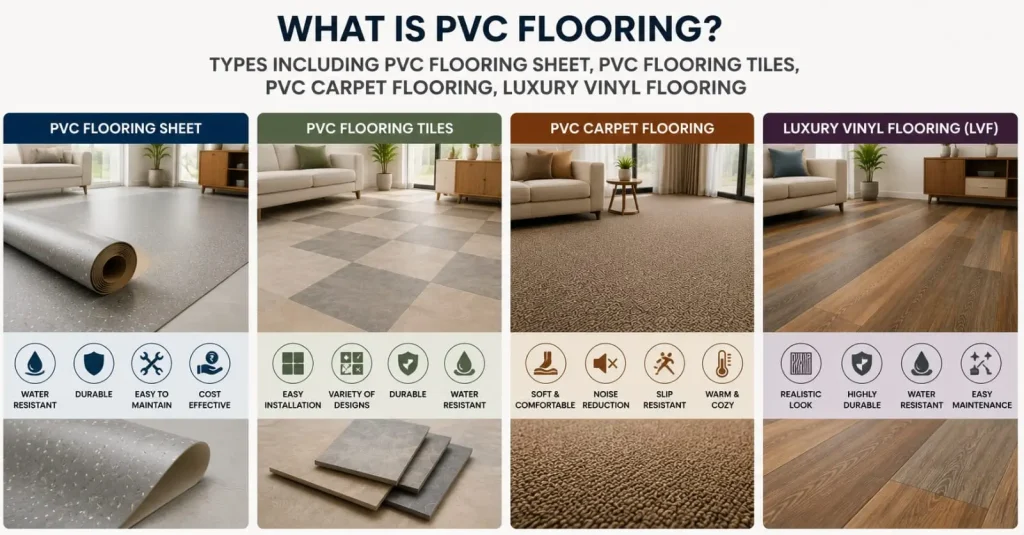
What Are the Different Types of PVC Flooring?
Not all PVC flooring is the same.
People often assume every PVC floor comes in rolls. That’s outdated now.
There are several types available depending on your budget and usage.
PVC Flooring Sheet
This is the most common format.
A PVC flooring sheet comes in large continuous rolls and is usually installed in bigger areas like offices, hospitals, classrooms, or rental apartments.
Its biggest advantage? Very few joints.
That means less chance of water seepage and easier cleaning.
You’ll often see this type used in spaces where maintenance needs to stay simple.
Especially in Indian homes where daily mopping is non-negotiable.
PVC Flooring Tiles
These are individual tile-like pieces installed section by section.
PVC flooring tiles are popular because damaged sections can be replaced individually without disturbing the entire floor.
That’s useful in homes with heavy furniture movement or children who somehow manage to damage the exact center of the room.
They’re available in:
- Wood-look designs
- Stone textures
- Matte finishes
- Geometric patterns
Some even come with click-lock systems for faster installation.
PVC Carpet Flooring
This combines the appearance of carpets with the practicality of PVC.
PVC carpet flooring is commonly used in commercial spaces, showrooms, and offices where people want a softer visual look without actual carpet maintenance.
Real carpets trap dust. PVC carpet flooring doesn’t.
That’s one reason many businesses prefer it.
Especially in cities where dust settles faster than you can clean it.
Luxury Vinyl Flooring
This is the premium version of PVC flooring.
Thicker. More realistic textures. Better durability.
And visually much closer to natural wood or stone.
Luxury vinyl flooring is becoming increasingly common in modern Indian apartments where homeowners want a luxury appearance without luxury maintenance costs.
What Are the Advantages of PVC Flooring in Modern Homes?
Water Resistance
One of the biggest strengths of PVC flooring is its resistance to moisture.
That makes it useful in:
- Kitchens
- Bathrooms
- Utility areas
- Basements
We’ve all seen how monsoon humidity affects wooden flooring.
PVC handles it much better.
Budget-Friendly
Compared to marble, hardwood, or premium tiles, PVC flooring sheet installation costs are significantly lower.
That matters during home renovation because flooring usually covers large areas and costs add up quickly.
Easy Installation
Most PVC flooring tiles can be installed relatively quickly.
Some even come with peel-and-stick systems.
That reduces labor time and disruption inside the home.
In many renovations, families continue living in the house while PVC flooring work happens room by room.
Try doing that with marble replacement.
Comfortable Underfoot
PVC flooring feels softer than tiles.
Less strain while standing. Less cold during winters.
And if something falls, there’s a slightly better chance it survives.
Sometimes.
Design Variety
This is probably the biggest reason younger homeowners choose PVC flooring today.
You get endless design options:
- Rustic wood
- Scandinavian finishes
- Concrete textures
- Vintage tile looks
- Chevron patterns
Modern PVC carpet flooring designs also work well in home offices and study rooms.
Low Maintenance
Daily cleaning is simple:
- Sweeping
- Vacuuming
- Damp mopping
No polishing. No sealing. No expensive maintenance cycles.
What Are the Disadvantages of PVC Flooring in Modern Homes?
Can Dent Under Heavy Furniture
Heavy sofas or cupboards may leave marks over time.
Especially with thinner PVC flooring sheet products.
Furniture pads help reduce this issue.
Not Ideal for Direct Sunlight
Constant harsh sunlight may cause fading in cheaper variants.
This is common near balconies or large windows.
Good curtains help. Better-quality PVC helps more.
Difficult to Repair Invisibly
While PVC flooring tiles can be replaced individually, matching old designs after years can become difficult.
Sometimes the replaced tile stands out slightly.
Lower Resale Perception
Some homeowners still associate PVC flooring with temporary or low-cost interiors.
That perception is slowly changing.
But in luxury real estate, natural materials still carry more prestige.
Environmental Concerns
Since PVC is plastic-based, sustainability concerns exist.
That’s why choosing quality manufacturers and certified products matters.
PVC Flooring vs. Tiles: Which Is Better?
| Parameter | PVC Flooring | Tiles |
|---|---|---|
| Material | Synthetic polyvinyl chloride plastic | Natural clay, porcelain, or stone |
| Cost | Low to moderate (budget-friendly) | High (expensive materials and labor) |
| Installation | Easy to install | Hard to install |
| Durability | Moderate. It can dent or scratch under heavy load. | High. It lasts for decades. |
| Water Resistance | High. Waterproof, but seams can lift if flooded. | Excellent. Perfect for wet areas. |
| Comfort | Soft, warm, and quiet underfoot | Hard, cold, and loud underfoot |
| Best Used In | Bedrooms, living rooms, rental properties | Bathrooms, kitchens |
What is the Difference Between PVC Flooring and Wooden Flooring?
| Parameter | PVC Flooring | Wooden Flooring |
|---|---|---|
| Material | Synthetic polyvinyl chloride plastic | 100% natural wood or composite timber |
| Cost | Low to moderate (budget-friendly) | High (expensive materials and specialist labor) |
| Water Resistance | Excellent. 100% waterproof. | Less. Prone to warping, swelling, and mold. |
| Durability | Moderate. Durable but cannot be repaired if torn. | High. It can be sanded and refinished multiple times. |
| Maintenance | Very low. Easy to sweep and wet-mop. | High. Requires special cleaners and sealing. |
What Are the Best Places to Use PVC Flooring?
- Bedrooms: Comfortable and warm underfoot. Wood-finish PVC flooring sheet works beautifully here.
- Kitchens: Moisture resistance makes PVC practical for Indian kitchens where spills are common.
- Children’s Rooms: Softer surface. Easy cleaning. Lower injury risk during falls.
- Home Offices: Modern PVC carpet flooring creates a quieter, more professional feel.
- Rental Apartments: Affordable upgrades matter here. PVC flooring improves appearance quickly without major civil work.
What Are the Latest PVC Flooring Design Trends?
Natural Wood Finishes
Oak textures, walnut shades, and ash-grey planks dominate modern PVC flooring tile designs.
Matte Surfaces
Glossy floors are slowly fading out.
Matte finishes feel more contemporary and hide dust better, which is useful in Indian cities.
Concrete-Look Flooring
Industrial-style interiors are growing.
Concrete-look PVC flooring sheet designs work especially well in minimalist apartments.
Herringbone Patterns
Classic European-style layouts are now available in PVC too.
Earlier this required expensive woodwork. Now it’s much more affordable.
Stone-Inspired Textures
Marble-look PVC flooring is becoming popular in compact homes where real marble feels too expensive or high-maintenance.
What is the PVC Flooring Installation Process?
Surface Preparation
The floor must be clean, dry, and level.
Uneven surfaces create problems later.
Measuring and Cutting
The PVC flooring sheet or tiles are cut according to room dimensions.
Precision matters around corners and door frames.
Adhesive Application
Depending on the product type, adhesive may be applied.
Some modern systems are glue-free.
Placement
Sheet or PVC flooring tiles are carefully placed and aligned.
Air bubbles are removed using rollers.
Finishing
Edges are trimmed.
Skirting may be added for a cleaner look.
Many PVC flooring installations finish within a day or two.
How to Clean and Maintain PVC Flooring?
Daily Cleaning
Use a soft broom, vacuum cleaner, and damp mop.
Avoid soaking the floor with excess water.
Avoid Harsh Chemicals
Strong acidic cleaners can damage the protective layer.
Mild floor cleaners work better.
Protect from Scratches
Furniture pads help, especially under dining chairs.
Clean Spills Quickly
Even though PVC flooring is water-resistant, long-term stains can still happen.
Especially with oils or strong dyes.
Avoid Dragging Furniture
Lift whenever possible.
Dragging heavy furniture can damage the surface layer.
What Are the Tips for Choosing the Best PVC Flooring?
Think About Daily Use
A retired couple needs different flooring compared to a family with toddlers.
Consider Maintenance
Some people genuinely enjoy maintaining natural materials.
Others just want something stress-free.
Choose honestly.
Don’t Ignore Climate
Indian weather matters.
Humidity-heavy cities need moisture-resistant flooring.
PVC performs well here.
Buy Slightly Better Quality
Ultra-cheap PVC flooring sheet options often fade or peel quickly.
Spending slightly more usually pays off later.
Match Flooring With Interior Style
Minimal interiors work better with subtle textures.
Traditional homes may suit warmer tones.
The Final Words
PVC flooring became popular because it solved real problems.
Not because it was trendy.
It gave homeowners a flooring option that looked good, cost less, handled moisture better, and didn’t demand constant maintenance.
And in busy Indian homes, that practicality matters. A lot.
Whether you choose a modern PVC flooring sheet, textured PVC flooring tiles, or stylish PVC carpet flooring, the key is choosing the right product for the right space.
Not the most expensive one. Not the trendiest one.
The one that quietly fits into your daily life without creating extra work.
Good flooring should do exactly that.
You shouldn’t have to think about it every day.
FAQs
- 1. Is PVC flooring waterproof?
- Most PVC flooring products are highly water-resistant, making them suitable for kitchens, bathrooms, and utility areas.
- 2. How long does PVC flooring last?
- Good-quality PVC flooring sheets or tiles can last anywhere between 10–20 years depending on usage and maintenance.
- 3. Can PVC flooring be installed over existing tiles?
- Yes, in many cases, PVC flooring tiles can be installed over existing flooring if the surface is level and stable.
- 4. Does PVC flooring look cheap?
- Older designs often did. But modern PVC flooring now comes in premium wood, stone, and matte finishes that look quite sophisticated.
- 5. Is PVC flooring good for Indian weather?
- Yes. PVC flooring handles moisture and humidity better than many natural materials, which makes it suitable for Indian conditions.
- 6. Which is better: a PVC flooring sheet or PVC flooring tiles?
- A PVC flooring sheet works well for seamless large areas, while PVC flooring tiles are easier to replace individually if damaged.
- 7. Is PVC flooring safe for homes with children and pets?
- Yes, good-quality PVC flooring is generally safe, easy to clean, and softer underfoot compared to traditional tiles.