Deep ruts. Potholes. Road Sinks. These are common when we drive on a rural road after heavy rains. We often end up thinking that the problem is the road. Agreed? But the problem is not only the road. Well, there are broader problems like weak soil or moisture-prone soil.
This is where modern ground solutions save you. One of the best and most common technologies is the geocell. Engineers use geocells for construction for various reasons. Thinking, what exactly are those reasons?
Read on this blog post to find out what a geocell is and why it has become an important part of modern road engineering.
What is a Geocell in Construction?
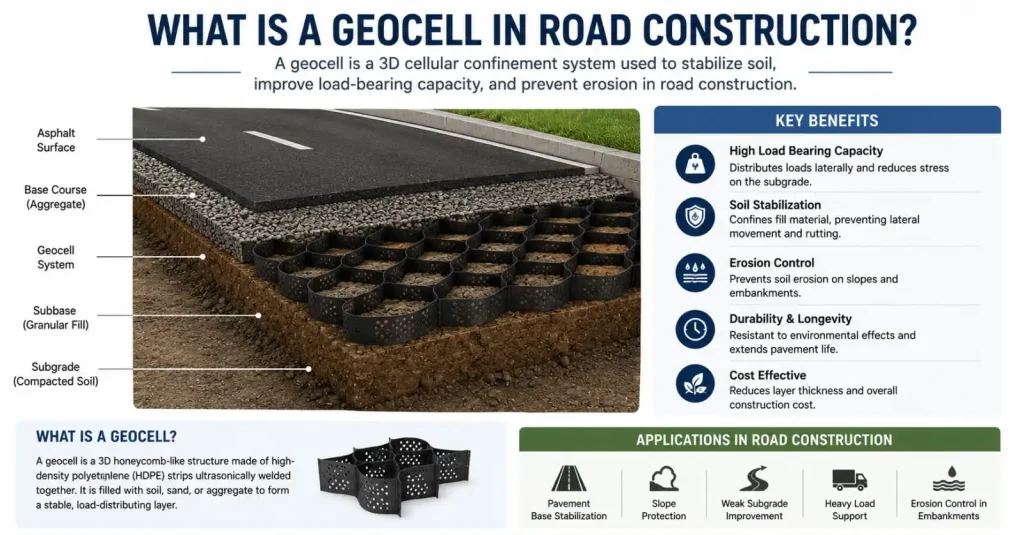
Let’s first understand how geocells are made. The polymer sheets weld together at regular intervals to form a geocell. It forms a structure similar to a three-dimensional honeycomb.
The engineer expands the following materials to form an integration of cells:
- Soil
- Gravel
- Sand
- Crushed stone
Each cell contains material, and the gravel confines it inside a geocell. The result? It creates a strong and more stable layer. It carries the heavy loads easily.
What Are the Basic Components of Geocell in Construction?
Given below are the basic components of a geocell in construction:
- Polymer Strips
The core structure of a geocell means polymer strips. Manufacturers use materials like HDPE and PP to provide flexibility. What’s more? It ensures long-term durability in environmental conditions.
- Welded Joints
The welded joints connect the polymer strips at a fixed interval. They create a honey-comb pattern. As a result, the weight load efficiently distributes to the entire geocell system.
- Cell Structure
The strips form a network of cells when they expand. The infill material confines itself into cells. It not only improves strength but also the stability of the reinforced layer.
- Infill Material
The cells are filled with the below materials:
- Gravel
- Crushed aggregate
- Sand
- Local soil
These materials work with the geocell structure. The result? The load-bearing capacity and performance increases.
- Anchoring System
The geocell takes help from anchors and stakes to hold in position during installation. They prevent movement and also ensure that the system aligns properly before the use.
How Does Geocell Improve the Performance of Road Construction?
Imagine you place a heavy cupboard on soft soil without support. The cupboard leg will sink into the ground. The situation differs when you place a large wooden board. The pressure on soil reduces as the weight distributes over a large area. A geocell system works similarly.
- Load Distribution
The aggregates inside the geocell spread the load of the wheel in a wider area. This reduces stress on weak subgrade soils.
- Soil Confinement
Do you know what prevents the lateral movement of soil and aggregates? It’s the honeycomb structure of the geocell in the road construction machine. This maintains the integrity of the foundation of the road.
- Reduced Rutting
The continuous traffic loads on the road result in the formation of ruts. But it becomes less so when geocell locks the aggregate in place.
- Better Bearing Capacity
Weak soils become strong when you reinforce them with a geocell system. This means? The roads support heavier traffic loads.
- Improved Performance in Wet Conditions
Water makes the road foundations weak. A geocell confines and minimizes deformation even when moisture levels increase. This is why geocells for road construction are popular in flood-prone and soft-soil regions.
What Are the Types of Geocell in Construction?
Engineers require different types of geocell systems for different projects. Given below are some types of geocell in construction:
- HDPE Geocells
HDPE refers to high-density polyethylene geocells. They are commonly used because of their:
- Flexibility
- Chemical resistance
- Long-service life
Note: The application of HDPE geocells is most common for road construction.
- Polypropylene Geocells
Polypropylene comes with high stiffness and strength in comparison to HDPE. As a result, they are suitable for roads carrying heavy loads.
- Novel Polymer Alloy (NPA) Geocells
The demanding infrastructure projects need novel polymer alloy geocells. Why? They offer superior creep resistance and long-term performance.
- Perforated Geocells
This type of geocell in construction contains small holes in the cell wall. They improve the interaction between cells and boost the confinement of the soil.
- Non-Perforated Geocells
They are the first choice when water flow through the cells is not necessary.
What Are the Key Functions of Geocell in Construction?
Geocell technology has the ability to perform multiple functions together. This is why it is popular. Given below are some key functions of geocell in construction:
- Soil Stabilization: The cellular confinement allows the weak and unstable soil to gain strength.
- Load Support: The geocall system distributes traffic loads efficiently.
- Erosion Control: Geocells not only protect slopes but also the drainage channels from erosion.
- Base Reinforcement: Road base layers become strong and more durable when they reinforce with geocell structures.
- Settlement Reduction: The system reduces uneven settlement. This maintains the level of roads over time.
What Are the Advantages of Using Geocells in Construction?
The geocell system is not only about engineering performance. Given below are the advantages of using geocells in construction:
- Reduced Material Requirement: Geocell systems in construction improve load distribution. Thus, the engineer can use thin aggregate layers.
- Faster Construction: It is simple and quick to install the geocell systems for construction.
- Cost Savings: The project cost is lower because of less excavation and aggregate needs.
- Longer Road Life: The geocell system on roads leads to less rutting and deformation. This means longer road life and durability.
- Sustainability: Locally available fill materials are sufficient for many projects. This means there is no need for transporting aggregates in large volumes.
What Are the Factors to Consider When Choosing the Geocell System?
Given below are the factors you need to consider when choosing the geocell system:
- Soil Conditions
The performance of a geocell system depends on the strength and type of existing soil. You may need strong reinforcement for weak or loose soil. Why? This is because it reduces the settlement over time.
- Traffic Load
Roads that carry heavy trucks and frequent traffic need strong geocall systems. The high load capacities prevent rutting and surface deformation. Besides this, it protects against structural damage even when there is continuous vehicle movement.
- Cell Depth
It affects the level of confinement necessary for the fill material. The geocells that are deep provide great stability and reinforcement for tough ground conditions and heavy loads.
- Material Type
Geocells are found in different materials like HDPE, PP, and NPA.
Geocells are available in different materials like HDPE, PP, and NPA. Be wise when choosing among them, as they offer different levels of strength and flexibility. Their durability and resistance to environmental stress factors also vary.
- Drainage Requirements
Perforated geocells often benefit projects with significant water flow. It ensures proper drainage while it maintains soil confinement. Moreover, it reduces the risk of water-related pavement damage.
What Are the Common Mistakes to Avoid During Geocell Installation?
The common mistakes to avoid when you install geocell are:
- Poor Surface Preparation: Level and compact the subgrade properly before you install it.
- Inadequate Anchoring: The geocell structure may shift during filling due to improper anchoring.
- Uneven Cell Expansion: Cell expansion must be uniform to achieve the required design dimensions.
- Incorrect Fill Material: Avoid using unsuitable infill. It can reduce the effectiveness of the geocell system.
- Insufficient Compaction: Proper compaction ensures the infill works together with the geocell.
- Ignoring Drainage: Poor drainage can compromise road performance over time.
Conclusion
Road construction is often a battle against nature. Many factors, such as weak soil, heavy traffic, or changing weather conditions, can reduce the lifespan of a road. This is why engineers rely on technologies like geocell. They create strong and more resilient road foundations.
FAQs
1. What is a geocell used for in road construction?
A geocell is used to stabilize weak soil, improve load distribution, reduce rutting, and increase the lifespan of roads.
2. How does geocell improve road performance?
The geocell confines aggregate within its cells, preventing lateral movement and spreading loads over a larger area.
3. Is geocell suitable for rural roads?
Yes. Geocell for road construction is particularly effective for rural roads built on weak or moisture-sensitive soils.
4. What materials are geocells made from?
Most geocell systems are manufactured using HDPE, polypropylene, or advanced polymer alloys.
5. Can geocells reduce construction costs?
Yes. By reducing excavation depth and aggregate requirements, a geocell system can lower overall project costs.
6. What is the lifespan of a geocell system?
Depending on material quality and installation, a properly installed geocell system can perform effectively for several decades.
7. Can a geocell be used beyond road construction?
Absolutely. Besides geocells for road construction, they are also used for slope protection, erosion control, retaining walls, railway foundations, and landscaping projects.