A site-first guide for homeowners and engineers — focused on long-term behaviour, not textbook labels
Beam in construction means:
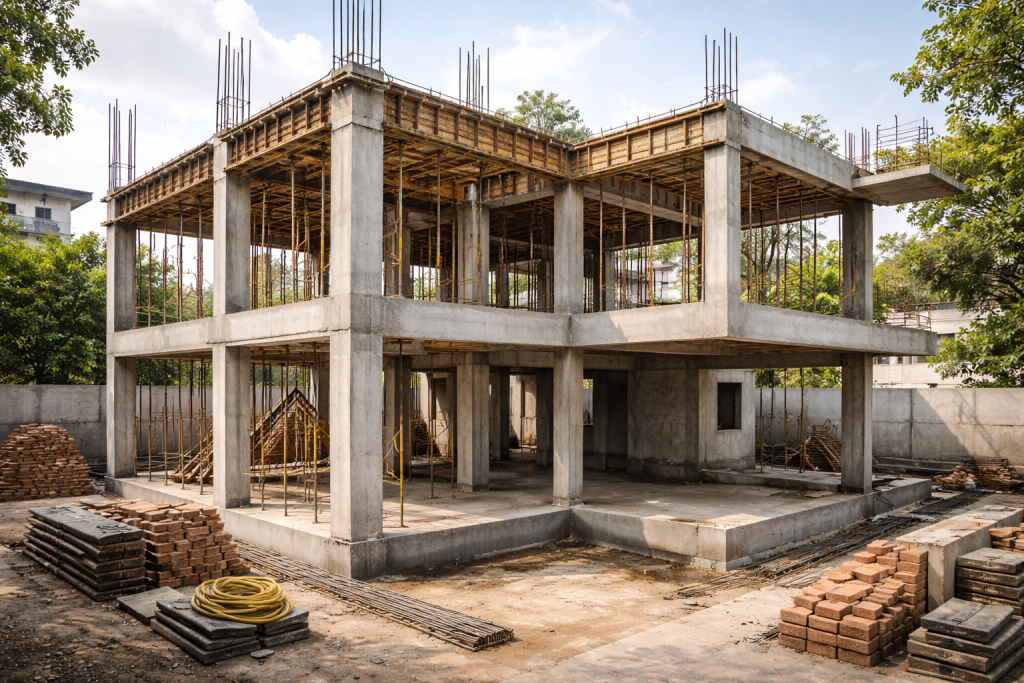
A beam is a horizontal structural member that carries loads from slabs and walls and transfers them safely to columns or supports.
Quick answer
Beams are not just concrete shapes shown on drawings.
They decide how loads flow, where cracks form, and how a house behaves 5–20 years later.
If beams are wrongly chosen, detailed casually, or cured poorly, problems don’t show immediately. They surface slowly as cracks, deflection, or dampness that cosmetic repairs cannot fix.
For Indian homes, beam behaviour matters more than beam names.
What beams actually control on real buildings
Beyond theory, beams decide:
- where cracks first appear
- whether floors feel stiff or bouncy
- how balconies sag over time
- whether repairs stay cosmetic or turn structural
In low-rise houses, beams account for less than 5% of concrete volume, yet they influence over 40% of visible structural crack complaints reported after handover.
In practical terms, beams punch above their weight.
Main reason beam-related problems appear:
Wrong beam choice + poor detailing + aggressive cement behaviour under weak curing.
Common types of beams used in Indian house construction
| Beam type | Typical use | Main risk if done wrong | Detailing focus |
| Simply supported | Small room spans | Early cracking | Proper curing |
| Continuous | Multiple spans | Moment mismanagement | Reinforcement continuity |
| Cantilever | Balconies, chajjas | Long-term deflection | Span control + curing |
| Overhanging | Partial projections | Misclassification | Correct support detailing |
| Rectangular | Most houses | Honeycombing | Bar spacing |
| T-beam | Longer spans | Execution sensitivity | Slab–beam integration |
Verdict: On real sites, execution quality matters more than beam classification.
Cantilever vs overhanging beams (clear boundary)
- Cantilever beam:
Projects beyond its support with no support at the free end. - Overhanging beam:
Supported on both sides but extends beyond one support.
Confusing the two leads to incorrect reinforcement and unsafe assumptions about load capacity.
Verdict: Misidentifying cantilevers is one of the fastest ways to create long-term deflection problems.
What actually goes wrong on Indian sites with beams
I’ve inspected houses where cracks appeared along beam–slab junctions after 3–4 years.
The causes were consistent:
- High early-strength cement + rushed curing → thermal cracks locked into beams
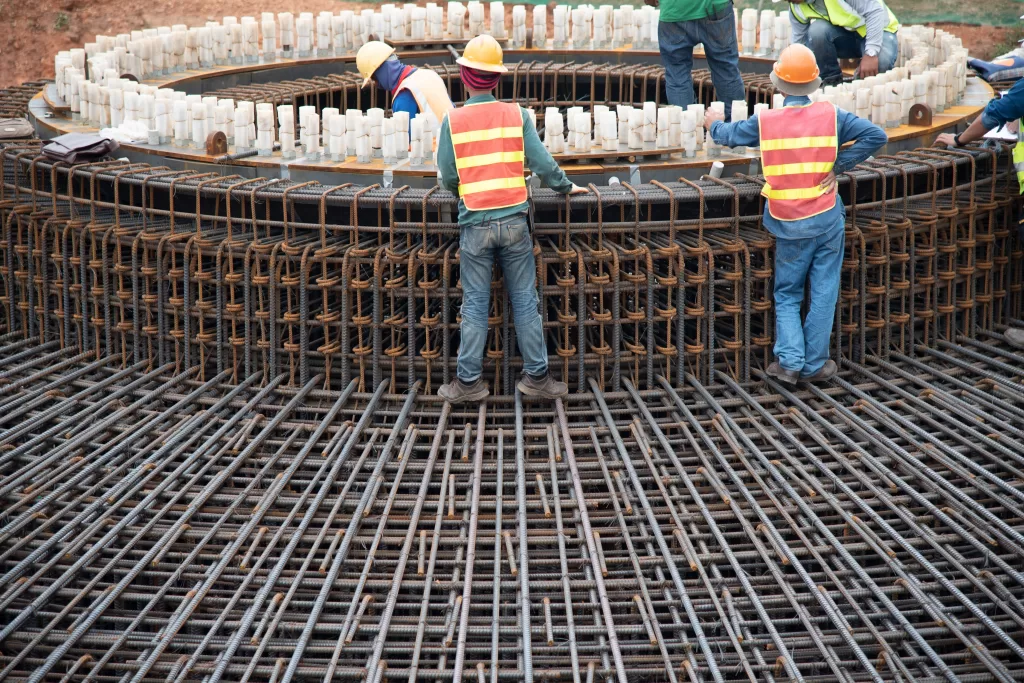
- Congested reinforcement → honeycombing → corrosion pathways
- Cantilever beams overloaded after handover → gradual, irreversible sag
At the time, the structure passed inspection.
Years later, the owner paid the price.
This mistake doesn’t show during construction.
It shows when the structure has already aged.
On real sites, beams fail quietly before they fail visibly.
Cement behaviour inside beams (why PPC matters here)
Beams are reinforcement-dense and cure unevenly near stirrups and anchor zones.
That makes them more sensitive to early heat build-up than slabs.
PPC (Portland Pozzolana Cement) generates lower heat of hydration and improves long-term microstructure refinement. This reduces early-age thermal cracking and improves durability inside beam cores.
As per IS 456 and IS 13920, beam detailing, curing, and ductility directly influence crack control and long-term performance. Cement behaviour plays a silent but critical role in this phase.
Verdict: For Indian homes, PPC is the more forgiving cement for RCC beams than OPC.
For RCC elements where long-term performance matters, PPC protects beams during their most vulnerable curing phase — see
JK Super Cement PPC.
What NOT to do with beams (red flags)
❌ Increasing balcony loads after handover
❌ Reducing beam depth for aesthetics
❌ Skipping beam curing because “slab is cured”
❌ Cutting chases into beams for services
Verdict: Beam mistakes are permanent, not patchable.
One clear decision shortcut
If this was my own house:
I would keep beam spans conservative, limit cantilevers, insist on proper curing, and use PPC-based concrete — because beams must survive imperfect site conditions, not just pass early tests.
Decision guide (quick scan)
If spans are short →
Keep beam design simple and conservative.
If balconies or projections exist →
Limit cantilever length and never overload later.
If execution quality is uncertain →
Choose materials and detailing that forgive errors.
Quick checks homeowners should insist on
- Reinforcement placed exactly as drawings
- No honeycombing after shutter removal
- Continuous curing for at least 7–14 days
- No added loads on cantilevers post-handover
For Indian homes, boring beams last longer than clever ones.
Frequently Asked Questions
1.What is a beam in building construction?
A beam is a horizontal RCC member that transfers slab and wall loads safely to columns or supports.
2. Which beam is most common in house construction?
Rectangular beams are most common due to simplicity and ease of execution.
3. Which beam is best for a 2-storey house?
A simple rectangular or continuous beam system is usually sufficient for 2-storey houses.
4. Are cantilever beams safe for balconies?
Yes, if spans are controlled and curing and detailing are done properly.
5. Can I extend a balcony by adding more slab later?
No, extending balconies after construction risks overloading the cantilever beam.
6. Why do beam cracks appear after a few years?
Because early thermal cracks, poor curing, or reinforcement congestion worsen over time.
7. Does beam type affect durability?
Yes, different beam types respond differently to load, heat, and restraint.
8. Is PPC suitable for RCC beams?
Yes, PPC reduces thermal stress and improves long-term durability inside beams.
9. Do beams need curing like slabs?
Yes, beams need equal or more curing due to dense reinforcement.
10. Is honeycombing in beams serious?
Yes, it exposes steel to moisture and shortens structural life.
11. Are T-beams better than rectangular beams?
Structurally yes, but only when execution quality is high.
12. Is beam leakage a structural defect?
No, it is usually a construction and detailing defect.
13. Can beam cracks be permanently repaired?
No, structural cracks can be managed but never fully erased.
14. Should homeowners worry about beam design?
Yes, because beam mistakes are irreversible after casting.
15. Is beam failure more design- or site-related?
Mostly site-related; execution failures are far more common than design errors.
Conclusion: what separates a safe beam from a risky one
Beam problems rarely announce themselves early.
They accumulate quietly.
A safe beam:
- is chosen conservatively
- detailed clearly
- cured patiently
- built with materials that tolerate real site conditions
Beam Behaviour Rule™:
If a beam survives its first curing phase without stress damage, it usually performs well for decades.
For Indian homes, boring beams last longer than clever ones.
Planning RCC work?
Choose materials and practices that protect beams when they are weakest.
👉 Buy JK Super Cement PPC online:
https://www.jkcement.com/grey-cement/buy-cement-online/