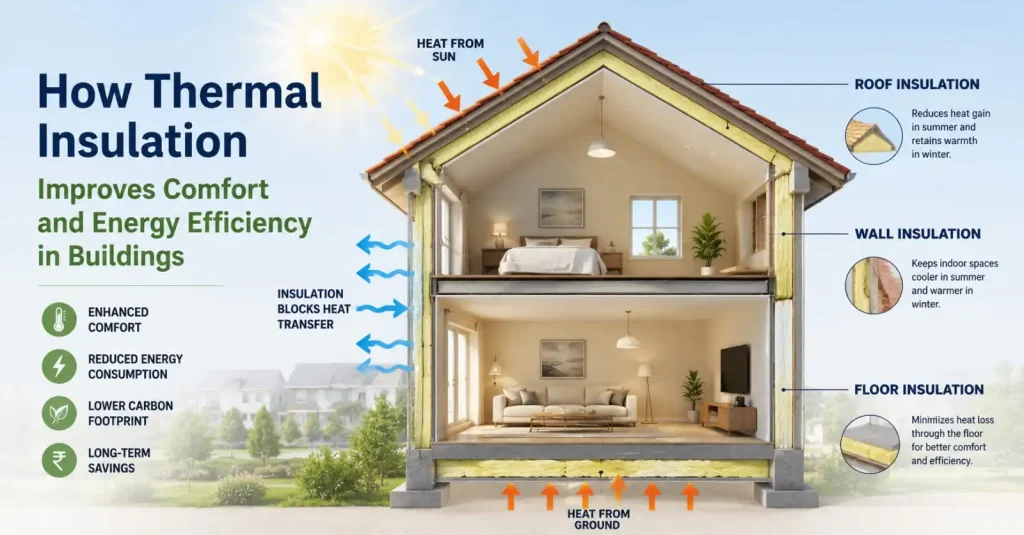
Thermal insulation keeps a building comfortable by slowing heat flow through the roof, walls, floors, and other exposed parts of the envelope. In hot Indian cities, the biggest payoff usually comes from stopping the roof and west-facing walls from storing daytime heat and releasing it indoors for hours after sunset.
Why Some Buildings Stay Comfortable While Others Feel Like Ovens?
If you’ve ever walked into a top-floor bedroom in May and felt heat radiating from the ceiling long after sunset, you’ve already experienced a thermal insulation problem.
This happens more often than many homeowners realize.
In cities like Delhi, Jaipur, Ahmedabad, Nagpur, and Hyderabad, roof surfaces can get brutally hot during peak summer afternoons. The slab stores heat all day, then leaks that heat into the rooms below even when the outdoor temperature starts dropping. People usually respond by upgrading AC tonnage, changing fans, or adding more cooling capacity. Sometimes that helps. Often it just means the cooling system works harder against a building that is still absorbing and releasing heat from every exposed surface.
One of the costliest mistakes on real projects is spending heavily on air-conditioning while leaving the roof completely uninsulated. The room cools slowly, the AC runs longer, and the electricity bill starts doing the talking. Thermal insulation matters because it changes how the building behaves, not because it adds another line item to the specification.
What Thermal Insulation Does?
At its simplest, thermal insulation is a system that slows down the movement of heat through a building.
Think of it as a protective layer between indoor and outdoor temperatures.
During summer, insulation helps prevent excessive outdoor heat from entering the building. During winter, it helps keep indoor warmth from escaping too quickly. It does not stop heat completely. Nothing in normal construction does. It slows heat movement enough that indoor spaces stay more stable and cooling or heating systems do less work.
A simple analogy helps. An insulated bottle keeps cold water cool for longer because it slows the exchange between the water inside and the hot air outside. Buildings follow the same logic, just at a much larger scale.
Thermal insulation is no longer optional in hot cities
Ten years ago, insulation was often treated as an upgrade you added only on premium projects. That thinking is fading because hotter summers, longer cooling seasons, and higher electricity costs have changed the math. In many Indian cities, discomfort is no longer limited to a few peak afternoon hours. Terraces stay hot, west walls keep radiating inward, and rooms take longer to settle even after sunset.
The pressure is financial as much as physical. Most owners do not notice the cost of unwanted heat every day because the AC hides it for a while. The bill exposes it later. Insulation rarely replaces air-conditioning in Indian summers, but it can reduce how hard the system has to run and how uneven the indoor comfort feels across different rooms.
Energy efficiency has also moved earlier in the design conversation. Whether the project is a private house trying to cut operating cost or a larger development looking at formal performance targets, insulation now sits much closer to core design decisions than it used to.
Heat does not enter every building the same way
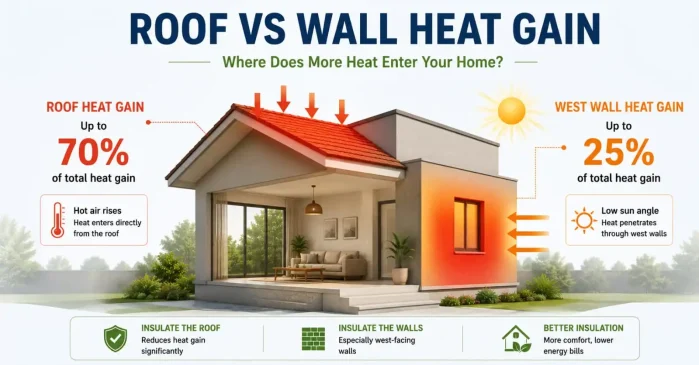
One of the most common mistakes is asking which insulation material is best before asking where the heat is actually entering.
In many independent homes, the roof is the biggest source of heat gain because it takes direct solar exposure for most of the day. That surprises owners who are focused on windows or indoor cooling appliances. On west-facing rooms, the wall becomes the bigger problem by late afternoon, especially when one bedroom stays tolerable and the room next to it feels noticeably harsher for no obvious reason except orientation. Commercial buildings are a different animal again because glazing, occupancy, equipment loads, and operating hours all change the heat pattern.
This is why material selection without heat-source diagnosis usually goes wrong. A house in Delhi with a bare terrace needs a different priority order from a school building with long occupied hours or a warehouse with a metal roof. The insulation decision starts with exposure, use, and building shape, not with a product brochure.
How thermal insulation works?
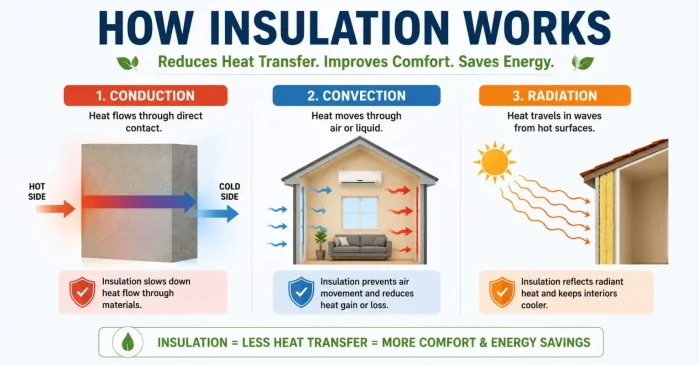
Heat naturally moves from warmer areas to cooler areas. This movement happens in three ways:
| Heat Transfer Method | What Happens |
| Conduction | Heat moves through solid materials like concrete, steel, and brick |
| Convection | Heat moves through air movement |
| Radiation | Heat travels through electromagnetic waves such as sunlight |
Thermal insulation materials are designed to resist one or more of these heat-transfer mechanisms.
Most materials do this by trapping tiny pockets of air.
Still air is a poor conductor of heat. By trapping air in controlled spaces, insulation slows thermal movement and improves building performance. That basic principle shows up across most mainstream insulation systems, from fiberglass to aerogel.
R-value matters, but it does not make the decision for you
Many technical articles spend too much time treating R-value like the final answer. For most building owners, it is just one useful filter.
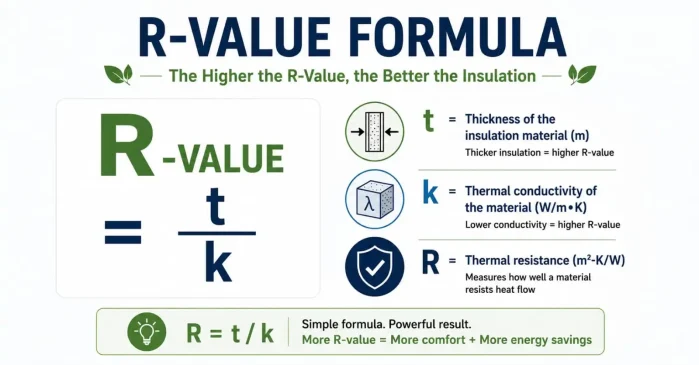
R-value measures resistance to heat flow. Higher R-value generally means better insulating performance. The relationship between thickness and thermal conductivity is:
R = t/k (Resistance equals Thickness divided by Thermal Conductivity).
Where:
- t = thickness of the material in meters
- k = thermal conductivity in W/mK
A lower thermal conductivity or a higher R-value means greater resistance to heat flow. But the highest lab value is not automatically the best site choice. A material can look excellent on paper and still be the wrong call once climate, moisture risk, structural load, detailing, installation quality, and maintenance are brought into the picture. That is where expensive over-specification often creeps in.
Thermal insulation materials in actual construction
Thermal insulation materials are engineered products used to slow heat transfer through roofs, walls, floors, ceilings, facades, and HVAC systems.
Each material brings a different balance of thermal performance, moisture resistance, fire behavior, durability, cost, and ease of installation. The job is not to find a universal winner. The job is to match the material to the building.
Fiberglass insulation
Fiberglass remains one of the most widely used insulation materials globally.
Made from fine glass fibers, it works by trapping air within a dense network of fibers.
Common applications
- Ceiling systems
- Internal wall cavities
- Acoustic partitions
- Retrofit projects
Why contractors like it
- Cost-effective
- Widely available
- Good sound absorption
- Relatively easy to install
What needs attention
- Fiberglass loses effectiveness when exposed to moisture, so waterproofing and moisture control still matter.
Mineral wool insulation
Mineral wool is often selected when fire performance and acoustic control are priorities.
Many commercial buildings use it because it handles more than thermal insulation alone.
Common applications
- Fire-rated walls
- Commercial projects
- Acoustic partitions
- Industrial buildings
Practical advantage
- If a project needs both sound control and thermal performance, mineral wool is often a strong candidate.
Expanded polystyrene (EPS)
EPS is one of the most common rigid insulation boards used in construction.
It is lightweight, relatively affordable, and widely available.
Common applications
- External wall insulation
- EIFS systems
- Foundation insulation
Why it stays popular
- For many residential projects, EPS offers a practical balance between performance and cost.
Extruded polystyrene (XPS)
XPS is frequently used where moisture resistance is critical.
Compared with EPS, it typically offers better moisture resistance, higher compressive strength, and improved thermal performance.
Common applications
- Roof insulation
- Inverted roofs
- Foundation walls
- Water-exposed environments
In Indian residential work, XPS is often one of the more practical roof insulation choices because it handles both thermal demand and site abuse better than softer alternatives.
Polyurethane foam (PUF)
When maximum thermal performance becomes the priority, polyurethane foam usually enters the discussion.
Its insulating performance is among the highest available in mainstream construction.
Common applications
- Industrial roofs
- Cold storage facilities
- Warehouses
- High-performance buildings
Warehouse owners often learn this late. The first focus goes to roofing sheets, span, or ventilation, and only after one brutal summer does insulation become urgent. That is usually when PUF starts looking less like an upgrade and more like overdue correction.
Material comparison by use, performance, and trade-off
One question comes up on almost every project: which insulation material should actually be chosen?
There is no universal winner. The right material for a warehouse in Rajasthan can be the wrong choice for an apartment block in Bengaluru.
| Material | Thermal Conductivity (W/mK) | R-Value (Per 25mm) | Best Use Case | Main Limitation |
| Fiberglass | 0.030-0.040 | R-3.1 to R-4.3 | Ceilings, wall cavities | Performance drops when wet |
| Mineral Wool | 0.031-0.045 | R-3.0 to R-3.8 | Fire-rated assemblies | Higher weight and cost |
| EPS | 0.030-0.038 | R-3.6 to R-4.2 | Residential walls | Lower fire performance |
| XPS | 0.029-0.035 | R-4.5 to R-5.0 | Roofs, foundations | Higher cost than EPS |
| Polyurethane Foam (PUF) | 0.022-0.028 | R-5.6 to R-8.0 | Warehouses, industrial buildings | Requires skilled installation |
| Cellulose | 0.035-0.042 | R-3.2 to R-3.8 | Retrofit projects | Can settle over time |
| Aerogel | 0.013-0.020 | R-10.3 to R-12.5 | Premium high-performance projects | Extremely expensive |
A practical reading of this table is more useful than chasing the top number. If budget is tight, EPS usually gives a decent cost-to-performance balance. If roof performance matters most, XPS often earns the extra spend. If the project is industrial and heat control is severe, PUF usually moves to the front. Aerogel sits in a different category altogether and only makes sense where space constraints are so tight that conventional thickness is not workable.
Climate changes the recommendation
Many insulation articles talk about material properties without talking enough about climate, which is where bad advice starts.
In Delhi NCR and much of North India, roof heat gain is usually the first battle, so XPS on roofs and selective EPS on walls often makes practical sense. In Rajasthan and other hot-arid regions, the building envelope keeps storing heat for long stretches, which pushes high-performance roof assemblies, reflective surfaces, and in some cases PUF systems higher up the list. Coastal projects are trickier because moisture sits in the same conversation as heat, so moisture resistance and waterproofing discipline can matter more than chasing maximum R-value. In colder hill regions, retaining indoor warmth becomes the bigger job, which is one reason mineral wool stays relevant.
The mistake is copying a detail from one city to another as if heat behaves the same way everywhere. It does not. Jaipur, Kochi, Shimla, and Ahmedabad should not be reading from the same insulation script.
Roof insulation usually comes first in homes
For most independent homes in hot Indian climates, roof insulation should usually be addressed before wall insulation.
The reason is simple. The roof takes direct sunlight for long hours, and a bare slab can become the single largest source of indoor discomfort. Homes sometimes get wall insulation first because it feels more visible or easier to discuss, but the result can be underwhelming if the terrace is still acting like a stored-heat battery above the occupied rooms.
Wall insulation starts becoming more valuable when the building has strong west exposure, large glazed areas, or a multi-storey form where facade heat gain becomes harder to ignore. In those cases, roof and wall insulation work best together rather than as competing choices.
Thermal bridging quietly ruins good insulation work
Thermal bridging is one of the least understood reasons insulation systems underperform.
It happens when heat bypasses the insulation through conductive elements such as concrete beams, columns, balcony slabs, steel framing, or window frames.
The easiest way to picture it is a winter jacket with a metal strip running through it. Most of the jacket is doing its job, but the metal keeps carrying heat across the barrier. Buildings do the same thing. Some of the most frustrating projects are the ones where a good insulation material was installed correctly in patches, but the building still performed poorly because structural elements were left acting as heat shortcuts.
The answer is continuity. A cavity material on its own often does less than expected if the structure keeps interrupting the thermal line. Continuous external insulation layers, better detailing around junctions, and fewer exposed conductive paths usually matter more than adding thickness blindly.
Insulation and waterproofing are different jobs
Many homeowners assume waterproofing and insulation do the same thing.
They do not.
| Thermal Insulation | Waterproofing |
| Controls heat transfer | Stops water penetration |
| Improves comfort | Prevents leakage |
| Reduces energy use | Protects structural elements |
| Focuses on temperature | Focuses on moisture |
Both systems are necessary, and one does not replace the other.
A common site mistake is installing insulation over an unresolved leakage problem. The leak stays, the insulation gets compromised, and the repair becomes more expensive than it needed to be. The safer sequence is simple: waterproofing first, insulation second, finishing layer third.
Seven insulation mistakes that keep repeating
1. Treating insulation as an afterthought
By the time occupants start complaining about heat, many design decisions are already locked in. Retrofitting is usually more expensive than planning correctly from the beginning.
2. Choosing materials only on price
The cheapest material often becomes expensive once poor performance, replacement, or user dissatisfaction enters the picture. Material selection should balance cost, climate, building type, and durability.
3. Ignoring roof insulation
This remains one of the most common missed opportunities in residential construction.
4. Poor installation quality
Even excellent insulation materials can underperform when gaps are left between boards, joints are poorly sealed, or thickness varies across the surface.
5. Installing insulation over unresolved moisture problems
Moisture usually wins. Leakage should be resolved before insulation installation starts.
6. Overlooking thermal bridges
This quietly reduces performance and often goes unnoticed until energy consumption remains higher than expected.
7. Using one solution for every climate
What works in Jaipur may not be right for Kochi. What works in Shimla may be unnecessary in Ahmedabad.
Conclusion
Thermal insulation is no longer a premium upgrade reserved for specialized projects.
It is becoming part of basic good construction because it directly affects comfort, running cost, and long-term building performance.
The buildings that stay comfortable through harsh summers are often not the ones with the biggest air-conditioning systems. They are the ones that manage heat properly from the start, especially at the roof, the exposed walls, and the weak junctions where heat slips through more easily than expected.
Frequently Asked Questions
Does thermal insulation really reduce electricity bills?
Yes. By reducing unwanted heat gain and heat loss, insulation lowers the workload on HVAC systems. The actual savings depend on climate, building design, insulation quality, and occupancy patterns.
Is roof insulation more important than wall insulation?
For many independent homes in hot Indian climates, roof insulation often delivers the greatest immediate benefit because roofs receive direct solar exposure for long periods.
Which thermal insulation material is best for residential buildings?
There is no universal answer. EPS and XPS are commonly selected because they offer a strong balance of performance, durability, and cost.
Can thermal insulation work without waterproofing?
No.” Technically, insulation can function without waterproofing on internal drywalls or ceilings, but it cannot survive on an exposed external roof slab. Specifying “external roof insulation” in the question would make the answer technically flawless.
How long do insulation systems last?
Most modern insulation materials can perform for 20 to 50 years or longer when properly installed and protected from moisture damage.
Is thermal insulation worth the investment?
In most climates where cooling or heating loads are significant, insulation is among the highest-return building upgrades available because it reduces energy consumption for decades.
What causes thermal bridging?
Thermal bridging occurs when heat travels through conductive building components such as concrete, steel, or aluminum, bypassing the insulation layer.
Which insulation material offers the highest thermal performance?
Aerogel offers extremely high thermal performance, but its cost limits its use to specialized applications. Among commonly used construction materials, polyurethane foam provides some of the strongest insulating performance.