When people start planning a new home, most of the attention goes to floor plans, room sizes, elevation designs, and interior finishes. But before any of that comes into the picture, there is one rule that quietly shapes the entire building layout. Why? This is because of the setback in construction. Wondering what it is and why it is important?
Read on this blog post to find out.
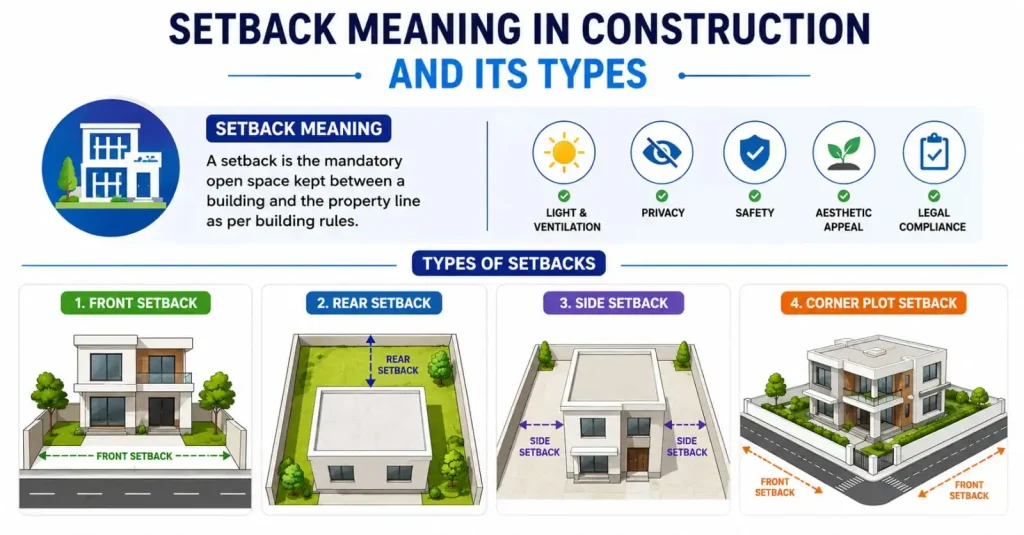
What is a Setback in Construction?
If you see any open space left between the building structure and the property line, consider it a setback. This space is free from permanent construction. It also serves multiple purposes.
Let’s understand it this way: Suppose you own a 40-foot-wide plot. A front setback of 10 feet and a side setback of 5 feet is necessary as per the local building guidelines. What does it mean? Your house cannot occupy the entire width of the plot.
So, what else can you do? You have to position the building within the approved area. This means you must keep open spaces around it. A setback is not a waste of space. But you can use it for:
- Landscaping
- Driveaways
- Gardens
- Walkaways
- Rainwater drainage
- Utility access
- Ventilation zones
Setbacks in construction planning are the most important that architects consider before preparing a building layout.
Why Are Setbacks Important in Building Planning?
The setback is important besides legal requirements. Why? Given below are some importances of setbacks in building planning:
- Proper Ventilation
The primary reason is access to natural light and fresh air. The construction of buildings without a space often feels dark and congested. They result in poor ventilation. However, proper setbacks create separation for sunlight and airflow to reach the entire structure.
- Ensure Safety
Another reason for having a setback is safety. They provide access routes to rescue personnel in emergencies like fire. However, emergency response is difficult without sufficient setback space.
- Improve Privacy
It is indeed true that nobody wants a neighbor’s window facing towards their bedroom. Am I right? Setbacks save you here. They separate the properties comfortably and maintain privacy.
- Easy Maintenance
It is convenient with setbacks to inspect and repair the walls. From plumbing lines to electric conduits, they make maintenance easy and effortless.
What Are the Different Types of Setbacks in Construction?
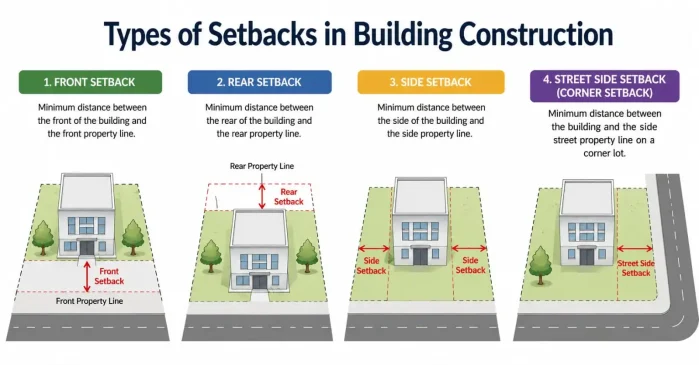
All the setbacks are not the same. They depend on the location of the building boundary. Given below are the four types of setbacks in construction:
- Front Setback
It is the distance between the building and the road-facing boundary of the plot. This setback creates space for:
- Parking
- Landscaping
- Pedestrian access
- Utility connections
Front setbacks usually have strict guidelines because they impact the street appearance and urban planning.
- Rear Setback
The applications of rear setbacks are:
- Service areas
- Utility zones
- Gardens
- Ventilation corridors
Any guesses about the area? Well, they are found at the back of the property.
- Side Setback
Those who need the following must choose the side setback in building construction:
- Cross ventilation
- Daylight penetration
- Fire safety access
The important part? Side setbacks are open spaces left on either side of the building.
- Corner Plot Setback
If the location of the plot intersects with the road, you will require additional setback space. This is because they face two roads.
These setback rules not only improve visibility for vehicles but also maintain road safety.
What Are the Setback Rules in Building Construction?
There is no single setback standard that applies everywhere. Setback rules vary according to the following:
- Building by-laws
- Development authorities
- Municipal regulations
But how to decide the setback requirements? What exactly does it depend on? Below are the factors on which it depends:
- Size of the plot
- Height of the building
- Category of land use
- Width of the road
- Floor Area Ratio (FAR)
- Local zoning regulations
To illustrate, a small residential house may require a small setback distance in comparison to high-rise apartment buildings.
It is advisable to consult the authorities before finalizing any building design. It may create serious complications later if you ignore the setback rules.
How to Calculate the Setback Distance for a Building?
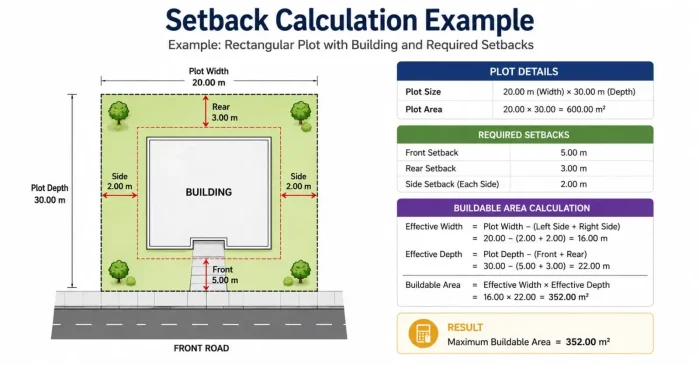
You need to calculate the setback distance to review local building regulations. The authority that governs the area specifies the minimum setback requirements. These needs depend on three details:
- Plot
- Dimensions
- Building type
Let’s understand it with an example.
Assume a plot measures 50 feet in width and 80 feet in depth. The setbacks that you need to have are the following:
- Front setback: 10 feet
- Rear setback: 8 feet
- Left side setback: 5 feet
- Right side setback: 5 feet
Hence, the building area would be:
- Width: 50 – 5 – 5 = 40 feet
- Depth: 80 – 10 – 8 = 62 feet
The maximum limit for the building footprint is 40 x 60 = 2,480 square feet.
So, what’s the learning from an example? The distance of setback directly influences building size and layout. An architect calculates these dimensions during site planning. This is to ensure compliance.
What is the Difference Between Setback vs. Margin Space?
You will often hear people say these terms. But they are not the same. A setback is the minimum distance limit between a building and the property boundary. It is mandatory by law. Whereas, the margin space is a broad term. It means an open space that surrounds a building.
To illustrate, imagine the owner requires a 5-foot setback as per the law. But he or she leaves 8 feet. So, the 5 feet is a setback requirement, and 8 feet is the actual marginal space. The confusion during the planning and approval process reduces when you understand these terms.
What Are the Benefits of Providing Proper Setbacks Around Buildings?
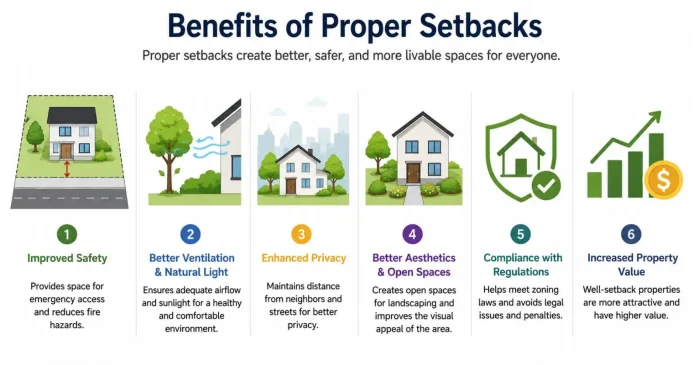
Given below are the benefits of providing proper setbacks around buildings:
- Ignoring Local Building By-Laws
The regulations for the setback vary from one city and municipality to another. Failing to verify local building by-laws can result in approval delays, penalties, design revisions, or even legal complications.
- Measuring Plot Boundaries Incorrectly
It is essential to measure the accurate plot in case of setback compliance. The minor errors in boundary calculations can result in violating the construction and rejecting the approval.
- Prioritizing Maximum Built-Up Area
The regulations often violate when you attempt to maximize the built-up area by reducing setback space. It becomes difficult to obtain building approvals and occupancy certificates in this case.
- Not Consulting Professionals
People with expertise know the local setback needs and approval procedure. Their expertise not only helps you ensure compliance but also helps you avoid mistakes. It streamlines the entire building permission process.
- Forgetting Future Road Widening Plans
The local authorities may require additional setback space to accommodate future road expansion and infrastructure projects. Your approvals and future property development plans may be affected if you ignore these provisions.
What Are the Consequences of Violating Setback Rules?
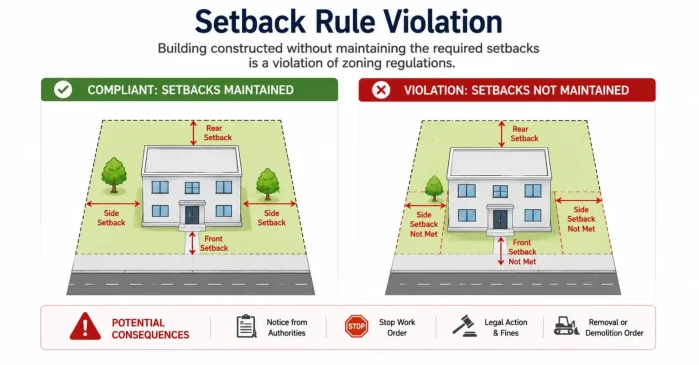
Every action has a positive or negative impact. But when it comes to violating the setback rules in home construction, the consequences are serious. The most immediate risk is that your building plans may not receive approval.
The authorities may take the following actions if the construction proceeds despite violation:
- Penalties
- Fines
- Stop-work notices
- Occupancy certificate delays
- Demolition orders for unauthorized portions
Setback problems in construction also create operational problems. Buildings may suffer from the following:
- Poor ventilation
- Reduced daylight
- Drainage difficulties
- Fire safety concerns
- Neighbour disputes
The important part? It makes the property resale difficult. This is because buyers and lenders prefer legally compliant structures. Hence, a small setback violation today can become a major headache years later.
The Final Words
A setback is much more than a regulatory requirement. It is a planning tool to maintain the safety and comfort of the buildings. The setback meaning helps you understand the importance and mistakes to install the setbacks in construction.
The smartest building projects are not the ones that maximize construction area at any cost. They are the ones that balance space, functionality, safety, and long-term value and proper setbacks play a key role in achieving that balance.
Frequently Asked Questions
1. What is the setback meaning in construction?
A setback is the minimum required distance between a building and the property boundary, as specified by local building regulations.
2. Why is a setback important in building planning?
A setback improves ventilation, natural lighting, privacy, safety, maintenance access, and compliance with municipal regulations.
3. How do I define setbacks simply?
To define setback simply, it is the open space that must be left between the building and the edge of the plot.
4. Are setback rules the same in every city?
No. Setback requirements vary depending on local municipal by-laws, zoning regulations, plot size, and building height.
5. Can I build inside the setback area?
Generally, permanent construction is not allowed within the mandatory setback area unless specifically permitted by local regulations.
6. What happens if setback rules are violated?
Violations may result in penalties, approval delays, legal notices, fines, or demolition of the unauthorized construction.
7. Does a larger setback increase property value?
In many cases, yes. Larger setbacks can improve aesthetics, ventilation, privacy, landscaping opportunities, and overall property appeal.