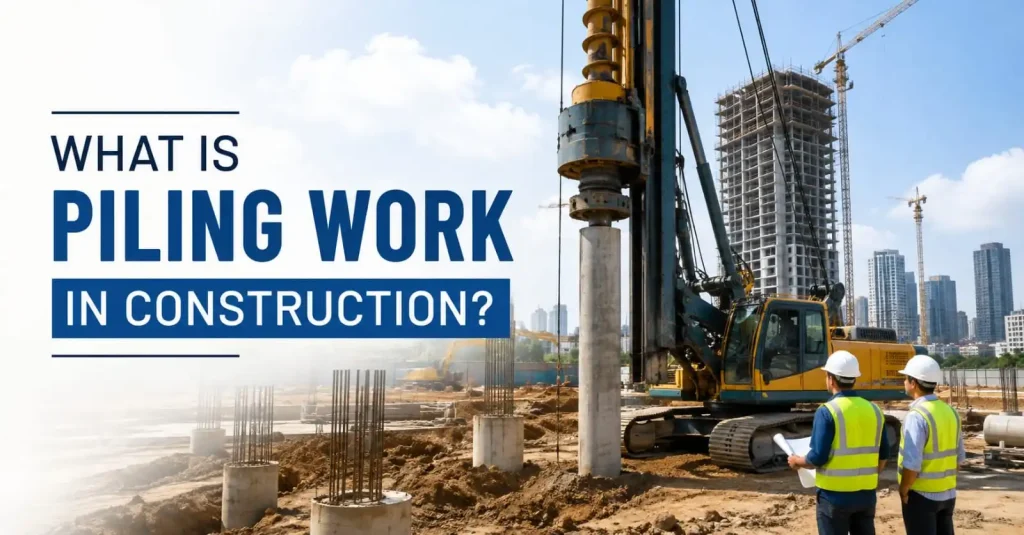
Every strong building stands on a strong foundation. But what happens if the ground fails to support structural weight? This often leads to functional failure. Thus, this is where piling work in construction comes into the picture. They transfer the weight of a structure from a weak surface to stronger layers below the ground. Read on this blog post to understand types and uses of piling work in construction.
What Is Piling Work in Construction?
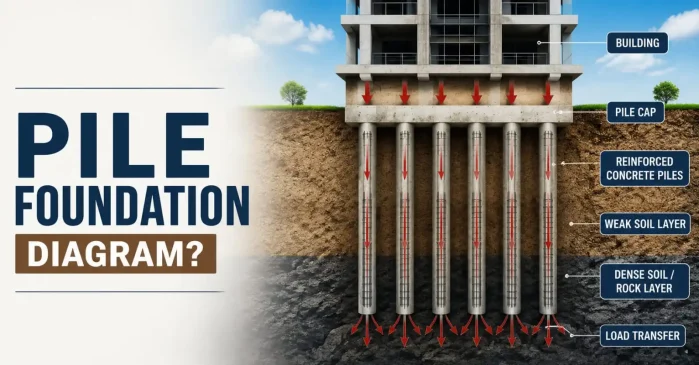
It is a foundation technique that engineers use if the top layer of soil fails to support a heavy load. They create long columns and bore deep into the ground. This process continues until columns reach a stronger soil or rock layer. These columns are known as piles. Thus, a simple piling work meaning is the process of transferring the structural load safely to stable ground below.
What Are the Common Uses of Piling Work in Construction?
Given below are the common applications of piling work in construction:
- High-rise buildings
- Bridges and flyovers
- Metro rail stations
- Industrial plants
- Dams
- Marine structures
- Buildings on reclaimed or soft soil
Note: The construction of buildings on weak soil may result in excessive settlement or structural cracks over time.
What Are the Different Types of Piling Work in Construction?
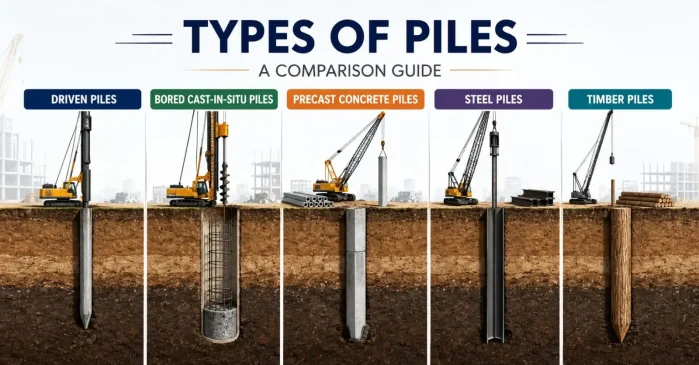
Given below are different types of piling work in construction:
- Driven Piles
The workers manufacture these piles to drive into the ground. How? They use hydraulic hammers or vibratory equipment to bore them. The common materials used to make driven piles are:
- Reinforced concrete
- Steel
- Timber
You will often see workers using driven piles where dense soil layers lie at greater depths.
- Bored Cast-in-Setu Piles
It is one of the most common piling methods in urban construction. The workers drill a borehole first to place a steel reinforcement inside it. Thereafter, they pour concrete to form a pile. This method is suitable for existing buildings and hospitals because it creates less vibration.
- Precast Concrete Piles
These piles are manufactured in a specific environment before they are transported to the construction site. The common advantages of precast concrete piling work in construction are:
- Control quality
- Quick installation
- Highly durable
The contractors face challenges in transporting precast concrete piles. This is because they are usually longer than other piles.
- Timber Piles
Timber piles are still popular for lightweight structures. Moreover, engineers use them for temporary works where groundwater conditions preserve the wood.
- Steel Piles
Steel H-piles and pipe piles are popular for the construction of the following projects:
- Heavy industrial projects
- Bridges
- Ports
- Marine structures
The high strength of steel piles allows them to penetrate hard soil layers easily.
What Is the Process for Piling Work in Construction?
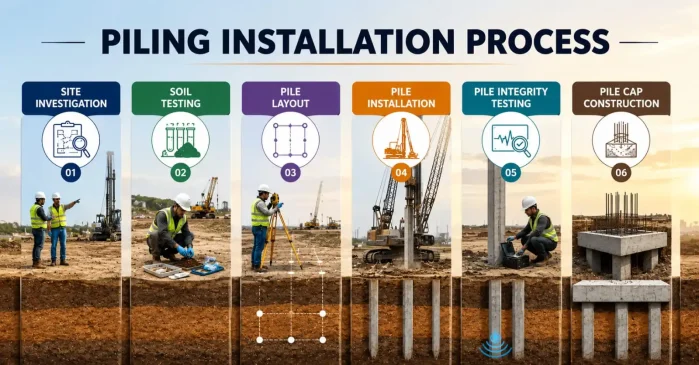
Given below is the process for piling work:
- Site Investigation
The first step is to investigate the soil before piling work to determine the following:
- Strength of soil
- Bearing capacity
- Groundwater level
- Rock depth
- Soil classification
The engineers use this information to decide the diameter, depth, and spacing for piling work.
- Choosing a Type of Piling Work
The next step is to design the piling system as per the soil reports and structural loads. The design must align with the below factors:
- Building load
- Ability to resist soil
- Safety factors
- Settlement limits
The proper design for piling work ensures durable structural performance.
- Marking Pile Locations
Survey teams mark the position for each pile as per the approved drawings. It is necessary to mark it accurately because small positioning errors can affect the structural alignment.
- Installation of Piles
The engineers start placing piles according to one of the following methods:
- Hammer the driven piles into the ground
- Drill or concrete the bored piles
- Lower the steel reinforcement cages as needed.
You will often see modern piling rigs using GPS and monitoring systems for better accuracy.
- Pile Integrity Testing
This step involves testing the chosen piles after installation to verify their quality. Some common tests are given below:
- Pile Load Test
- Low Strain Integrity Test
- Crosshole Sonic Logging (CSL)
These tests ensure that the piles carry the loads safely.
- Construction of Pile Cap
A reinforced concrete pile cap connects multiple piles together at this stage. Hence, the pile cap distributes the building load evenly before the superstructure construction begins.
The Final Words
Piling work is one of the most important parts to create a strong structure. It not only ensures long-term safety but also provides durability to the structures. There are different types of piling works in construction. Thus, it is advisable to hire an expert who understands what is piling work. They will help you choose the best method for piling work for your project.
FAQs
1. What is piling work?
Piling work is a deep foundation method where long structural elements, called piles, are installed into the ground to transfer building loads to strong soil or bedrock. It provides a stable foundation for structures built on weak, loose, or waterlogged soil.
2. Why is piling work important in construction?
Piling work is important because it supports heavy structures, prevents uneven settlement, and improves foundation stability on weak soil. It ensures buildings, bridges, and other infrastructure remain safe, durable, and structurally stable over the long term.
3. What are the different types of piling work?
The main types of piling work include driven piles, bored cast-in-situ piles, precast concrete piles, steel piles, and timber piles. Engineers choose the pile type based on soil conditions, structural load, project size, and site requirements.
4. How deep are construction piles installed?
Construction piles are typically installed between 10 and 50 metres deep, although some projects require greater depths. The exact pile depth depends on soil conditions, groundwater levels, foundation design, and the weight of the structure.
5. Where is piling work commonly used?
Piling work is commonly used for high-rise buildings, bridges, metro rail projects, industrial facilities, marine structures, retaining walls, and buildings on soft, reclaimed, or waterlogged land where shallow foundations are unsuitable.
6. Is piling work necessary for every building?
Piling work is not required for every building. Structures built on strong, stable soil with lighter loads can use shallow foundations. Piling is needed when weak soil or heavy structural loads require a deep foundation.
7. How long does piling work take?
Piling work can take anywhere from a few days to several weeks, depending on project size, soil conditions, pile type, equipment, and the number of piles required. Larger commercial and infrastructure projects typically take longer.