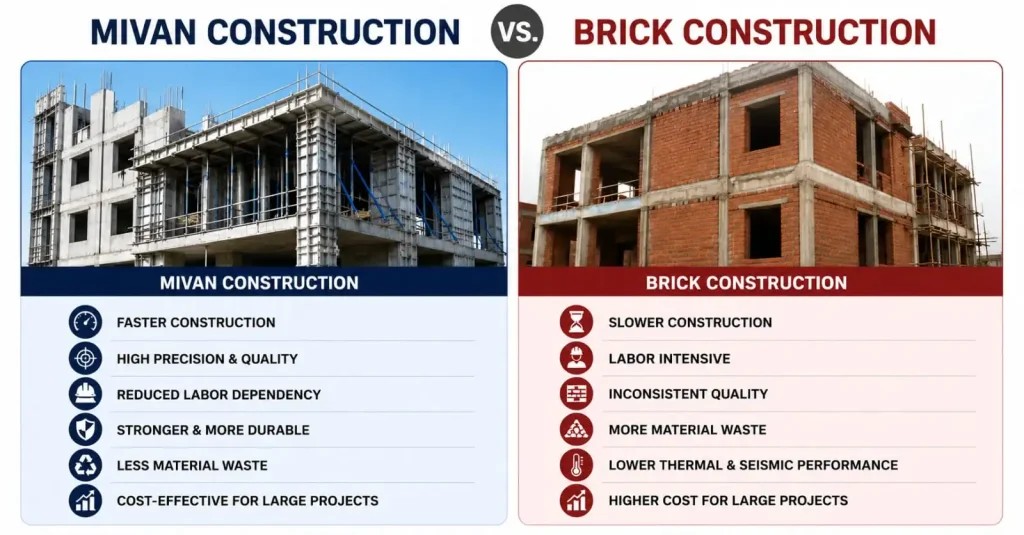
Mivan construction is popular in metro cities where deadlines are tighter than parking spaces. At the same time, traditional brick construction is still everywhere around us. It is found everywhere from village homes in Rajasthan to independent houses in Gurgaon. Brick wall construction continues to be the default choice for many contractors and homeowners.
So naturally, one question keeps coming up:
Mivan construction vs brick construction: Which is actually better? The answer is not as simple as picking one winner. Why? Because both methods solve different problems. One is built for speed and scale. The other is built for flexibility and familiarity.
Keep reading this blog post to learn the difference between Mivan construction and brick wall construction.
What is Mivan Construction?
Mivan construction is the fast, factory-style way of building structures using aluminum formwork. Instead of building walls separately with bricks, the entire structure, including walls, slabs, beams, and staircases are cast together using concrete.
The process uses pre-designed aluminum molds called Mivan formwork. Concrete is poured into these molds. Once it sets, the molds are removed and reused for the next floor. Simple idea. But the speed is what changed the game. A floor in Mivan construction can sometimes be completed in 7–10 days if planning is strong.
That’s why builders use it heavily in:
- High-rise apartments
- Large township projects
- Mass housing schemes
- Commercial towers
You’ll notice most modern urban housing projects now prefer Mivan construction because repetition makes the system efficient.
What Are the Advantages and Disadvantages of Mivan Construction?
Given below are the pros and cons of Mivan construction:
Advantages of Mivan Construction
1. Extremely Fast Construction
This is the biggest reason developers choose Mivan construction. Time savings are massive. And in real estate, time literally means money. Faster completion means:
- Earlier possession
- Lower labour overheads
- Faster project turnover
2. Better Structural Strength
Since walls are RCC concrete instead of regular brick construction, the building behaves like a monolithic structure. That helps during earthquakes and heavy structural loads. This is especially useful in high-rise construction.
3. Smooth Wall Finish
One thing contractors appreciate about Mivan Construction is the wall finish. The concrete surface comes out much smoother compared to traditional brick wall construction. That reduces plaster usage considerably.
4. Lower Material Wastage
Because formwork is reusable and execution is systematic, wastage reduces on-site. Less debris. Cleaner site conditions. More predictable material usage.
Disadvantages of Mivan Construction
1. High Initial Cost
The aluminum formwork system is expensive. Very expensive for small projects. Which is why Mivan construction usually makes financial sense only in large repetitive developments.
2. Design Flexibility is Limited
Want to shift a wall later? Not easy. Since walls are structural concrete walls, modifications become difficult compared to brick construction.
3. Repairs Can Be Complicated
In traditional brick wall construction, electrical or plumbing repairs are easier. With concrete walls, cutting and chasing work becomes harder.
4. Skilled Planning is Necessary
Mivan construction works brilliantly when planning is perfect. But mistakes become costly. Very costly. Once concrete is poured, there’s little room for adjustment.
What is Traditional Brick Wall Construction?
Traditional brick construction is exactly what most Indians grew up seeing around them. Bricks. Cement mortar. Columns. Beams. Manual wall construction. Layer by layer.
This method has been used for decades because it’s simple, flexible, and understood by almost every local contractor. In brick wall construction, the RCC frame carries the structural load while bricks mainly act as partition walls.
This gives homeowners more freedom for:
- Future renovation
- Interior modifications
- Easy repairs
- Layout changes
And honestly, that flexibility matters a lot in Indian homes. Families grow. Rooms change. One extra floor suddenly appears after five years. Traditional brick construction adapts better to these realities. That’s why even today, independent homes and smaller residential projects still heavily depend on brick construction.
What Are the Advantages and Disadvantages of Traditional Brick Wall Construction?
Given below are the pros and cons of brick construction:
Advantages of Brick Wall Construction
1. More Flexible for Design Changes
This is where brick construction wins comfortably. Need to break a wall later? Extend a room? Change plumbing lines? Traditional brick wall construction makes these changes easier and cheaper.
2. Lower Initial Investment
Unlike Mivan construction, there’s no major formwork investment required. For smaller builders and homeowners, this matters a lot.
3. Better Thermal Comfort
Bricks naturally provide decent insulation. In many North Indian towns where summers are brutal, homes built using brick construction often feel cooler than pure concrete structures.
4. Easier Local Labour Availability
Almost every local mason understands brick wall construction. No specialised training needed. That keeps labour dependency manageable.
Disadvantages of Brick Construction
1. Slower Construction Speed
Brick-by-brick work takes time. And delays become common during:
- Monsoons
- Labour shortages
- Festival seasons
We’ve all seen sites go half-empty during Diwali week.
2. More Material Wastage
Traditional brick construction usually generates more debris and uneven material consumption.
3. Surface Finish Needs More Work
Brick walls require proper plastering before paint. That increases finishing timelines.
4. Structural Load is Higher
Brick walls add dead load to the structure. In taller buildings, this becomes a major engineering consideration.
Mivan Construction vs. Brick Construction: Which is Better?
Here’s where the real comparison becomes easier.
| Factor | Mivan Construction | Brick Construction |
| Best for | Large projects | Small and medium projects |
| Speed | Very fast | Slower |
| Structural strength | Very high | Moderate |
| Flexibility | Limited | High |
| Labor requirement | Skilled | Regular Masonry |
| Initial cost | High | Lower |
When people compare Mivan construction vs brick construction, speed versus flexibility usually becomes the deciding factor. Builders prefer speed. Homeowners often prefer flexibility. Both perspectives are valid.
Which Construction Method is Better for Different Projects?
For High-Rise Apartments
Mivan construction usually makes more sense. Because:
- Speed matters
- Repetition exists
- Structural efficiency is important
This is why most metro-city towers now use mivan construction.
For Independent Homes
Traditional brick construction often works better. Especially if:
- The owner may renovate later
- Budget is tighter
- Local contractor experience matters
For Affordable Housing Projects
Mivan construction can reduce long-term project timelines significantly. And when hundreds of identical units are involved, the economics improve.
For Luxury Villas
Many architects still prefer brick wall construction because it allows:
- Custom detailing
- Curved layouts
- Design freedom
- Easier interior modifications
So again, there’s no universal winner. Project type changes everything.
What Are the Expert Tips for Choosing Between Mivan Construction and Brick Wall Construction?
Before finalising between Mivan construction and brick construction, keep these practical points in mind:
- Understand Your Project Scale: Small 2-floor home? Mivan construction may not be cost-effective. A large residential township will have a different story.
- Think About Future Changes: Indian homes evolve constantly. If future renovations are likely, brick wall construction gives more freedom.
- Don’t ignore Climate Conditions: Concrete-heavy structures can absorb more heat. In hot regions, insulation planning becomes important when it comes to Mivan construction.
- Check Contractor Experience: An inexperienced contractor handling Mivan construction can create serious execution issues. The system demands discipline.
- Choose the Right Cement and Materials: No matter which method you choose, material quality matters more than shortcuts. Poor cement quality can ruin both systems.
That’s why many contractors prefer trusted brands like JK Cement for consistent performance across structural and finishing applications.
The Final Words
The debate around Mivan construction vs. brick construction will probably continue for years. Because construction isn’t one-size-fits-all. Mivan construction is fast, efficient, and ideal for large modern developments. Whereas brick construction is flexible, familiar, and practical for customized homes. One prioritizes speed. The other prioritizes adaptability.
FAQs
1. What is Mivan construction in simple words?
Mivan construction is a modern building method where aluminum formwork is used to cast concrete walls and slabs together instead of using traditional brick wall construction.
2. Is Mivan construction stronger than brick construction?
Yes, structurally, Mivan construction is generally stronger because it creates a monolithic RCC structure.
3. Why do builders prefer Mivan construction?
Mostly builders prefer Mivan construction because of speed. Large builders can complete projects much faster using Mivan construction.
4. Is brick construction cheaper than Mivan construction?
Yes, brick construction is cheaper for smaller projectsFor smaller projects, yes. Traditional brick construction usually has lower initial costs.
5. Can walls be modified easily in Mivan construction?
The walls cannot be modified easily in Mivan construction. Since many walls are structural concrete walls, modifications become difficult compared to brick wall construction.
6. Which construction method is better for independent houses?
In many cases, brick construction works better for independent homes because it offers easier repairs and future renovations.
7. Does Mivan construction reduce plaster work?
Yes. One major advantage of Mivan construction is the smoother wall finish, which reduces plastering requirements.