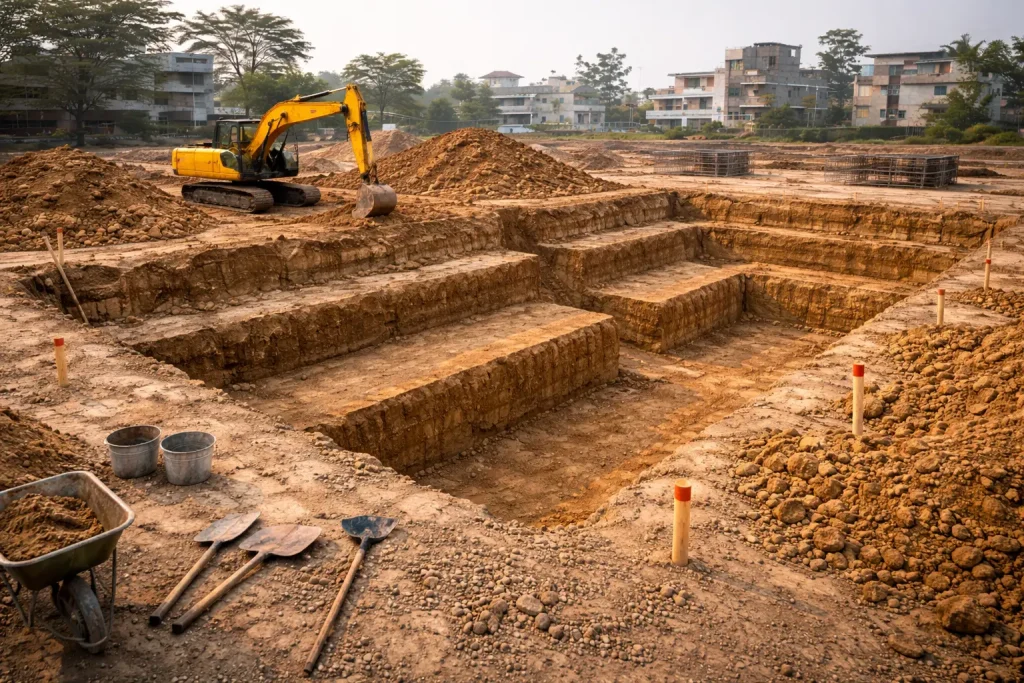
Before a single brick is laid or cement mixed, another crucial step occurs on every site.
The ground is opened up, soil is removed, and levels are checked repeatedly. That process is excavation.
If you ask – What is excavation – the simple answer is this: it is the controlled digging of earth to prepare land for construction.
The meaning of excavation in construction is straightforward – it involves making the ground ready so that the structure above doesn’t fail later.
It’s akin to setting the base of a cupboard. If the floor isn’t level, the doors won’t close properly—no matter how good the wood.
People often underestimate excavation because once it’s completed, it disappears.
You don’t see it in the finished building. However, every crack, slope issue, or water seepage problem usually traces back to poor excavation.
Excavation determines how stable, dry, and durable the building will be. Get the excavation wrong, and no amount of good concrete can save the building. Let’s define excavation and its importance in construction.
What is Excavation?
What is excavation in construction terms?
It is the process of cutting and removing soil, rock, or earth from a site to create space for foundations, basements, trenches, or utilities.
To define excavate means more than just digging a hole.
It involves:
- Digging to the correct depth
- Maintaining proper width
- Ensuring firm soil at the base
- Protecting nearby structures
- Checking soil types.
Black cotton soil, sandy soil, and rocky strata all behave differently. Excavation depth and methods are adjusted accordingly. In brief, excavation prepares the ground to safely carry the load of the building.
Types of Excavation Used in Construction
People often assume excavation is uniform, but that is a mistake. Different projects require different types of excavation.
1. Foundation Excavation
This is the most common. Soil is removed to reach hard strata where footings can rest securely. When people ask what excavation is, this is usually what they mean.
2. Trench Excavation
Used for pipelines, drainage lines, and cables. It is narrow, deep, and requires proper support to avoid collapse.
3. Basement Excavation
Large-scale excavation for underground floors. Dewatering and side support are critical here.
4. Rock Excavation
Where soil transitions to rock, excavation involves breakers or controlled blasting. Costs and time increase significantly.
5. Earth Excavation
Common in roadwork and plot levelling, where soft soil is spread across a broad area.
Each type has its approach, but the fundamental rule remains: excavation must be precise.
How Excavation Is Carried Out on a Site
Many ask what excavation actually involves on-site. It’s not just about digging and moving on.
The best way to define excavation is to know what specific steps it follows:
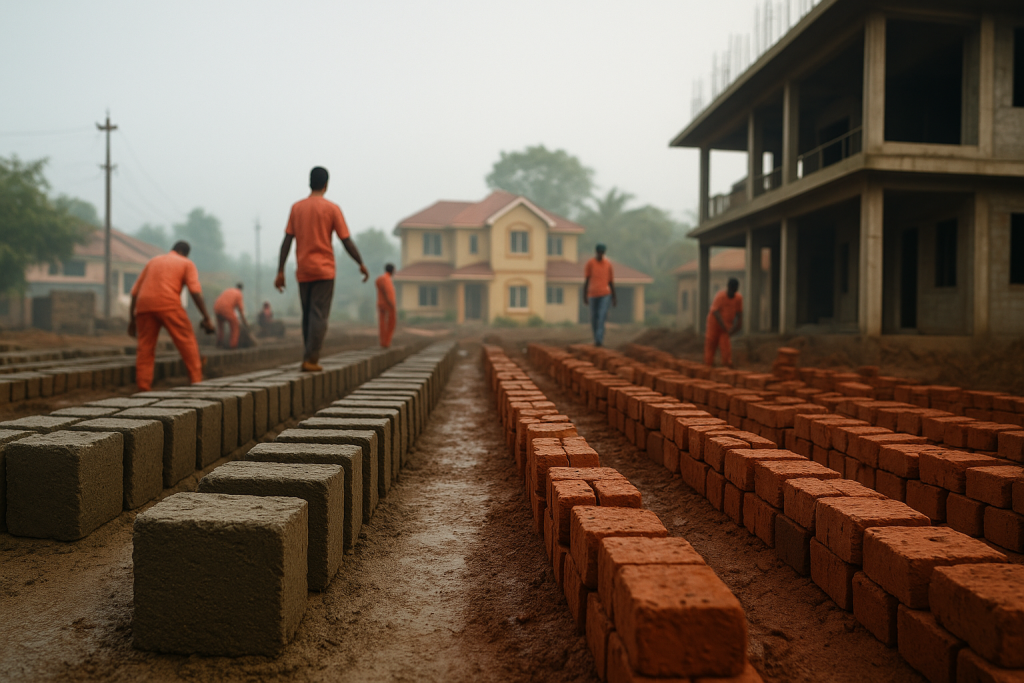
- Site boundaries are marked
- Excavation lines are measured from drawings
- Soil is removed layer by layer
- Levels are checked regularly
- Loose soil is compacted or removed
- Water is pumped out if necessary
Here, the true meaning of excavation becomes practical. Over-digging wastes concrete, while under-digging weakens foundations.
Good engineers pause several times to check levels, while poor sites keep digging, hoping it will work out later.
Why Excavation Quality Is So Critical
To truly define excavate, see it as risk management.
Poor excavation can lead to:
- Uneven settlement
- Cracks in walls
- Sloped floors
- Water seepage below
Buildings where excavation is deeper than needed, then filled loosely, soil settling causes gaps under foundations.
That’s why understanding what excavation means matters – it’s not about speed, but precision.
Excavation and Foundation Performance
Here’s a truth most realise too late.
Concrete does not fail first; ground preparation does. No matter how excellent the cement, if excavation is uneven or the soil is weak, foundations will suffer.
On many sites, contractors prefer using a Best cement like JK Super Cement for foundation and PCC work, especially when excavation levels are accurate and the base soil is properly prepared.
This perspective is reflected in practical guidance, where proper groundwork is always linked to long-lasting durability.
Common Excavation Mistakes to Watch For
If supervising a site, watch out for these errors:
- Digging without checking drawings
- Uneven base levels
- Loose soil left at the bottom
- Ignoring groundwater
- Excavation done before boundary verification
Most of these mistakes stem from not understanding what excavation involves beyond basic digging.
So, what is the meaning of excavation in construction?
It’s the quiet process that determines everything that follows. It’s shaping the earth so the building can stand safely for decades.
If planning construction, don’t rush excavation.
Measure it. Supervise it. Get it right.
The rest of the building depends on it.
FAQs
1. What is excavation in construction?
Excavation is the process of removing soil or rock to prepare land for foundations and structures.
2. What is excavation simply?
It means digging the earth in a way that a building can be constructed safely.
3. How is excavation different from normal digging?
Excavation is controlled digging based on drawings, soil type, and safety rules. Normal digging has no such agenda or considerations.
4. Why is excavation important before foundation work?
Because foundations depend on firm, level soil to perform correctly.
5. What are the main types of excavation?
Foundation, trench, basement, earth, and rock excavation.
6. Can poor excavation affect cement performance?
Yes. Poor excavation can undermine even the strongest concrete. If the ground beneath is weak, it will not support the structure.
7. Who supervises excavation on site?
A site engineer usually oversees excavation.