If you’ve ever stood on a construction site during the early stages, when only columns are standing and everything else feels half-done, you’ve probably heard someone say, “Yahan tie beam dena padega.” Most homeowners nod along. Some junior engineers check drawings.
And a few quietly wonder — what is tie beam, really, and why does everyone suddenly get serious about it?
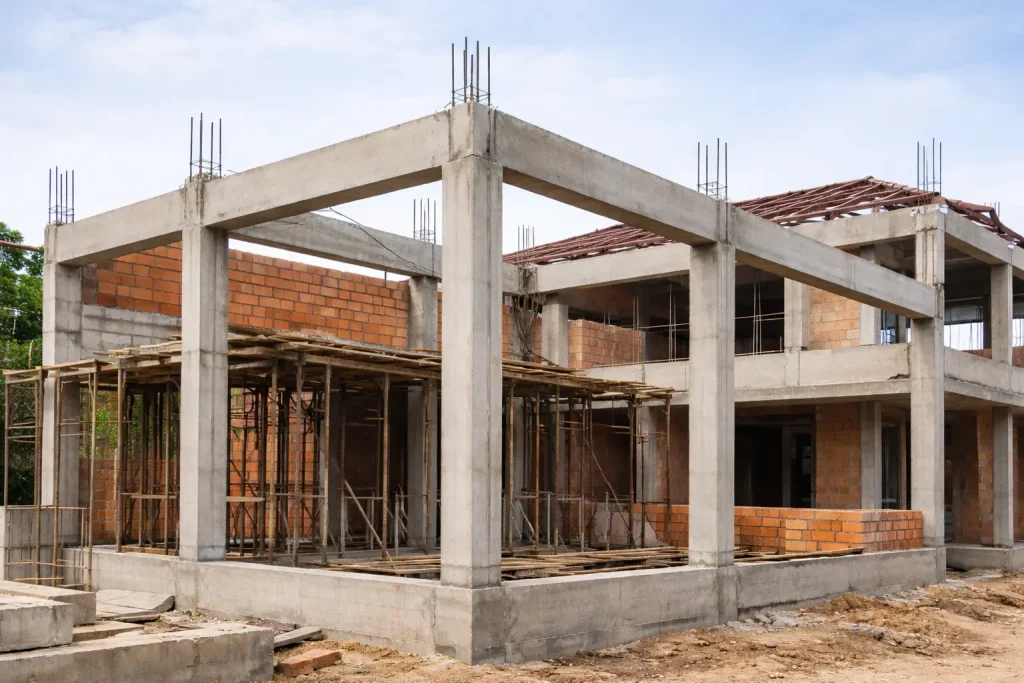
In simple terms, a tie beam is a horizontal reinforced concrete beam that connects two or more columns.
Its job isn’t to carry floors or walls.
Its job is to make sure columns don’t behave like individual fighters, but like a team.
Think of it as tying together loose bamboo poles.
One pole alone wobbles.
Tie them together, and suddenly they stand firm.
That’s the most honest way to understand what is tie beam.
Why Tie Beams Are Used in Buildings (And Why Engineers Insist on Them)
On Indian sites, soil conditions change every few kilometres.
Black cotton soil here.
Loose fill there.
Add monsoons, and things move — slowly, silently.
Columns react to this movement. If left independent, one column may settle slightly more than the other. Cracks follow. Walls suffer.
A tie beam helps columns share these stresses.
Instead of one column taking the hit, the system absorbs it together.
That’s why engineers push for tie beams even when they’re not visible in the finished house.
And yes, concrete quality matters here.
A dependable cement like JK Cement, known for consistent strength and bonding, ensures the tie beam actually performs the way it’s meant to — not just during curing, but years later.
What Is Tie Beam Doing Structurally Between Columns?
Structurally speaking, a tie beam reduces the effective length of columns.
Less length means less slenderness.
Less slenderness means better stability.
But let’s keep it practical.
Imagine two columns standing 4–5 metres apart.
Without a tie beam, they’re like two people standing back-to-back, unsupported.
Add a tie beam, and suddenly they’re holding hands.
That’s what is tie beam doing — improving lateral stability without carrying vertical load.
Tie Beam Design Basics: Size, Steel, and Placement Explained Simply
Now let’s talk tie beam design, without drowning in formulas.
A typical tie beam design depends on:
- Column size and spacing
- Soil condition
- Seismic zone
- Height of columns
Usually, it includes:
- Longitudinal steel bars (top and bottom)
- Stirrups at regular spacing
- Depth similar to plinth beams, but different purpose
One mistake people make is assuming tie beams are optional.
They’re not.
They’re preventive maintenance for your structure.
Using reliable materials — good steel and consistent cement like JK Cement — ensures the tie beam design on paper actually works on site.
Factors That Influence Tie Beam Design on Indian Sites
In seismic zones or uneven soil conditions, engineers often add tie beams even when drawings look “extra”.
This isn’t overdesign.
It’s experience speaking.
I’ve seen small residential projects skip tie beams to save cost.
Two monsoons later, diagonal cracks appear.
Repair costs cross what the tie beam would’ve cost in the first place.
That’s site reality.
Tie Beam and Plinth Beam: Why They Are Often Confused
This is where most confusion happens.
Both are horizontal.
Both are RCC.
Both appear close to ground level.
So people mix up tie beam and plinth beam all the time.
But their roles are completely different.
Difference Between Tie Beam and Plinth Beam in Real Construction Terms
A plinth beam is provided at plinth level and supports walls.
It distributes wall loads and reduces settlement issues.
A tie beam connects columns and improves structural stability.
It does not carry wall loads.
So when comparing tie beam and plinth beam, remember:
- Plinth beam supports masonry
- Tie beam supports columns
They may sit at the same height sometimes, but they don’t do the same job.
When Tie Beam and Plinth Beam Are at the Same Level
In some designs, engineers combine tie beam and plinth beam at plinth level.
That doesn’t mean they’ve become one element functionally.
It just means the beam is designed to perform both roles.
This is why drawings — and not assumptions — matter.
Where Tie Beams Are Provided in Residential Buildings
A tie beam is commonly provided:
- At plinth level (structural requirement)
- Between tall columns to reduce slenderness
- In seismic zones
- In framed structures with large column spacing
Every placement comes from structural logic, not decoration.
That’s why what is tie beam is less about appearance and more about long-term performance.
Is Tie Beam Necessary for Independent Houses and G+1 Homes?
Short answer — if the engineer says yes, then absolutely.
The cost of a tie beam is small compared to total construction cost.
But the protection it offers against cracks, settlement, and future repairs is massive.
Skipping it is like skipping seatbelts because you’re driving slow.
Common Site Mistakes Related to Tie Beam Construction
Some mistakes I’ve seen repeatedly:
- Reducing steel to save money
- Using poor-quality concrete
- Improper curing
- Treating tie beam as a wall-supporting beam
A tie beam design only works when execution respects it.
This is where consistent materials, like JK Cement, help maintain quality across batches and pours.
Role of Quality Cement in Tie Beam Performance Over Time
Tie beams aren’t visible later.
You can’t repaint them.
You can’t replace them.
So the concrete has to last.
Using reliable cement ensures:
- Better bonding with steel
- Consistent strength gain
- Reduced shrinkage cracks
That’s why experienced contractors don’t compromise here.
Final Thoughts: Understanding What Is Tie Beam Beyond Drawings
Good construction isn’t about fancy finishes.
It’s about invisible decisions made early.
A properly planned tie beam, backed by thoughtful tie beam design, and built with dependable materials, quietly protects your home for decades.
You may never see it once the house is complete.
But every time your walls stay crack-free through monsoons and summers, it’s doing its job.
And honestly — that’s the best kind of engineering.
FAQs
1. What is a tie beam in construction?
A tie beam is a concrete beam that joins columns together so they stay stable and don’t move on their own.
2. Why do builders give tie beams?
Tie beams are given to keep columns aligned and prevent cracks caused by soil movement or settlement.
3. Does a tie beam support walls?
No. Tie beams don’t take wall load. They only help columns work together.
4. What’s the real difference between a tie beam and a plinth beam?
Plinth beams hold walls. Tie beams hold columns steady.
5. Where are tie beams usually provided?
They’re mostly provided between columns, usually at plinth level or mid-height if columns are tall.
6. Is a tie beam really needed for a small house?
In many cases, yes — especially if the soil isn’t great or the engineer recommends it.
7. Can tie beam and plinth beam be at the same height?
Yes, they can be at the same level, but they’re designed to do different jobs.
8. What decides the size and steel of a tie beam?
It depends on column spacing, soil condition, and how tall the structure is.
9. Are tie beams important in earthquake-prone areas?
Very much. Tie beams help the building handle side forces better during tremors.
10. What should be kept in mind while constructing a tie beam?
Good steel, proper concrete mix, and curing — because once it’s done, you can’t fix it later.