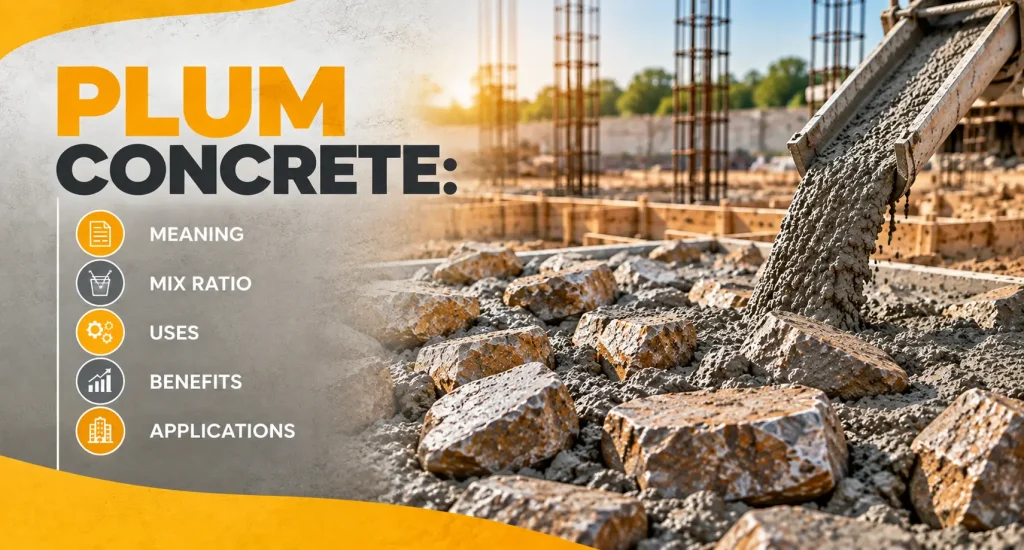
Construction involves using the right materials in the right place. However, many people confuse more concrete with durable structures. But it’s not true! Sometimes it’s about following a smarter approach. Modern construction highly depends on plum concrete. Why? This is because it fills large volumes without using a full-depth conventional concrete mix.
The method can reduce the quantity of cement and fine aggregates needed for certain mass concrete works. It is especially useful where the concrete volume is large and the structural demand is relatively low. But plum concrete is not simply concrete mixed with random stones. So, what exactly is plum concrete? Read on this blog post to find out!
Quick Answer
Plum concrete is a mass concrete that contains large stones or boulders. These elements are known as plums. They are embedded within a conventional concrete mix. The plum occupies a significant part of the total volume. The remaining space gets filled with concrete. This approach works well for the following applications:
- Foundations
- Retaining structures
- Bed foundations
- Large non-structural construction
- Lightly loaded work
The exact mix and stone proportions should follow the project design and applicable specifications.
What Is Plum Concrete?
Plum concrete combines two main components. The first is ordinary concrete. The second is large-sized stones or boulders. These large stones are called plums. Workers place the plums within fresh concrete. The concrete then fills the gaps around them. This reduces the amount of cement concrete required for the same overall volume.
The technique becomes useful when a large mass needs filling but does not require the performance of a fully reinforced concrete section. For example, consider a deep foundation bed over firm soil. Filling the entire volume with conventional concrete may not always make practical sense. Plum concrete can provide a more economical solution when the design permits it.
What Is the Plum Concrete Mix Ratio?
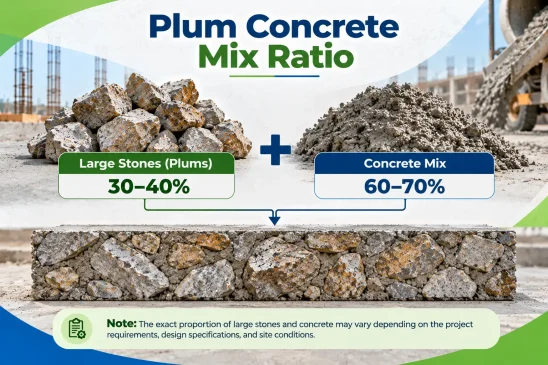
Each construction project requires a different plum concrete mix ratio. Many factors help engineers determine the exact proportion of the ratio. The most common approach is to keep the large stones within a controlled portion of the total concrete volume. The remaining volume consists of the concrete matrix.
A typical site practice may use around 30% to 40% plums by volume, with the balance made up of concrete. The exact percentage should come from the project specification. The plums should also have a suitable size, shape, and cleanliness. They should not contain excessive dust or harmful material.
More importantly, workers must place enough concrete around each stone. Large voids between the plums can weaken the work. So, simply adding more stones does not make plum concrete better.
Good placement matters just as much as the material ratio.
How Is Plum Concrete Made?
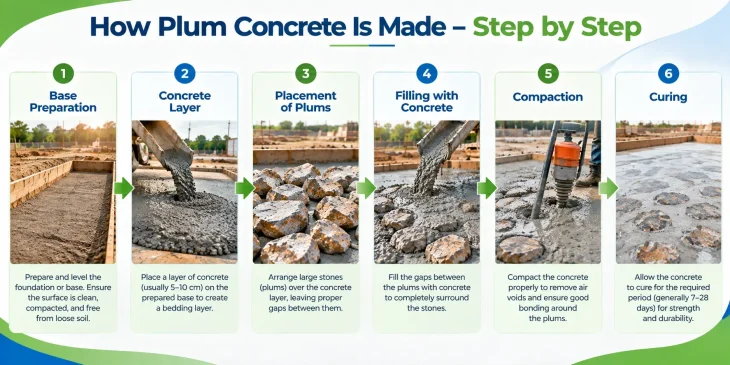
The process looks simple. But site execution needs care. First, workers prepare and clean the area. The concrete layer is prepared to position the large stones within the fresh concrete. The most important thing to consider is to ensure that there should be adequate space between individual stones.
Fresh concrete fills the gaps around the stones. The process continues in layers until the required thickness or level is reached. Proper compaction remains important. The concrete must surround the stones properly.
Workers should avoid direct contact between large stones where it can create continuous voids. The final surface should also receive suitable finishing and curing. As with other cement-based construction work, curing plays an important role in developing the required performance.
What Are the Common Uses of Plum Concrete Ratio?
Given below are the common applications of plum concrete ratio:
- Mass foundations: It can fill large foundation volumes where the design permits its use.
- Retaining structures: It can help form large concrete masses behind or below retaining elements.
- Bed foundations: It can provide a solid base beneath certain structures.
- Dams and mass concrete works: It can be considered where large concrete volumes are required and the design allows it.
- Slope protection: It may also find use in selected heavy-duty filling applications.
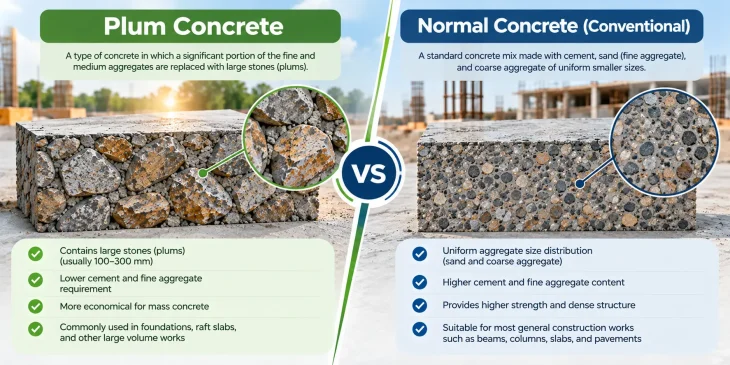
What Are the Benefits of Plum Concrete Ratio?
The following are the benefits of the plum concrete ratio in construction:
- Consume Less Material
Plum occupies a considerable volume. This means? It reduces the need for conventional concrete. The most intriguing part is that it can make large-volume work more economical.
- Useful for Large Sections
Some construction areas require considerable thickness. Thus, it is not necessary to use conventional concrete throughout these sections. You can simply use plum concrete to fill these sections.
- Faster Filling
Large stones occupy space quickly. This is why the filling process becomes quicker for suitable applications. However, actual productivity still depends on site conditions and placement methods.
- Better Use of Resources
Plum concrete also helps you reduce dependence on conventional concrete materials. This is because the locally available suitable stones help you fill those needs.
- Practical for Mass Concrete
Plum concrete can work well where the structure needs a large mass rather than a highly reinforced structural member. That makes it useful in several foundation and filling applications.
The Final Words
Plum concrete is a practical construction technique. It uses large stones within a concrete matrix to fill large volumes more efficiently. When the application allows it, the method can reduce concrete consumption and improve cost efficiency.
But there is no shortcut around proper engineering. The right stone size matters. The right proportion matters. Good compaction matters. And curing still matters.
For any cement-based construction work, choosing a quality cement is equally important.
FAQs
1. Is plum concrete stronger than normal concrete?
Plum concrete serves a different purpose than normal concrete. Its performance depends on the concrete mix, stone quality, placement, compaction and the application where it is used.
2. Can plum concrete be used for foundations?
Yes. Plum concrete can be used for suitable foundation and mass concrete applications. However, its use should follow the structural design, project specifications, and site requirements.
3. What are the main benefits of plum concrete?
The main benefits of plum concrete include reduced concrete consumption, lower material costs, and economical filling of large volumes. It is commonly useful in suitable mass concrete applications.
4. Can plum concrete replace RCC?
Plum concrete cannot automatically replace RCC. Reinforced cement concrete is designed to handle structural loads with reinforcement. Plum concrete has specific applications and should be used only where permitted by design.
5. Why is proper compaction important in plum concrete?
Proper compaction helps concrete fill the spaces around the plums. Poor compaction can create voids, reduce uniformity, and affect the quality and durability of the finished work.
6. What is the typical plum concrete ratio?
A commonly used site practice keeps plums around 30% to 40% of the total volume. The exact proportion should follow project specifications and engineering requirements.