People talk a lot about cement and steel.
But if you ask anyone who’s actually stood near a brick wall being built, they’ll tell you this— Walls don’t hold because of bricks. They hold because of mortar.
That’s mortar in construction, plain and simple.
It’s the mix that sits between bricks or blocks and makes them behave like one piece instead of a pile. That’s the mortar meaning most people miss.
It’s not decoration.
It’s control.
Mortar Meaning, the Way It’s Learned on Site
On paper, mortar is cement, sand, and water.
On site, mortar is adjusted.
No two bricks are the same. Some have good water absorption. Some are rough. Some come chipped straight from the stack.
Mortar handles all of that.
So when we say mortar meaning, we’re really talking about how masonry forgives small mistakes.
Good mortar covers errors quietly.
Bad mortar exposes them fast.
Why Mortar Is Used in Construction (And Why People Get It Wrong)
In mortar construction, people often think more strength is better.
It isn’t.
Mortar isn’t supposed to be the strongest part of the wall.
Bricks should survive.
Mortar should take the stress.
If mortar is too weak, joints wash out.
If mortar is too strong, bricks crack—and that’s worse.
Old masons know this instinctively.
That’s why they don’t chase high cement content without reason.
Cement Mortar: What’s Actually Used Today
Most sites today run on cement mortar.
Not because it’s trendy.
Because it’s predictable.
Cement mortar is just cement, sand, and water in fixed ratios.
You’ll see it everywhere—
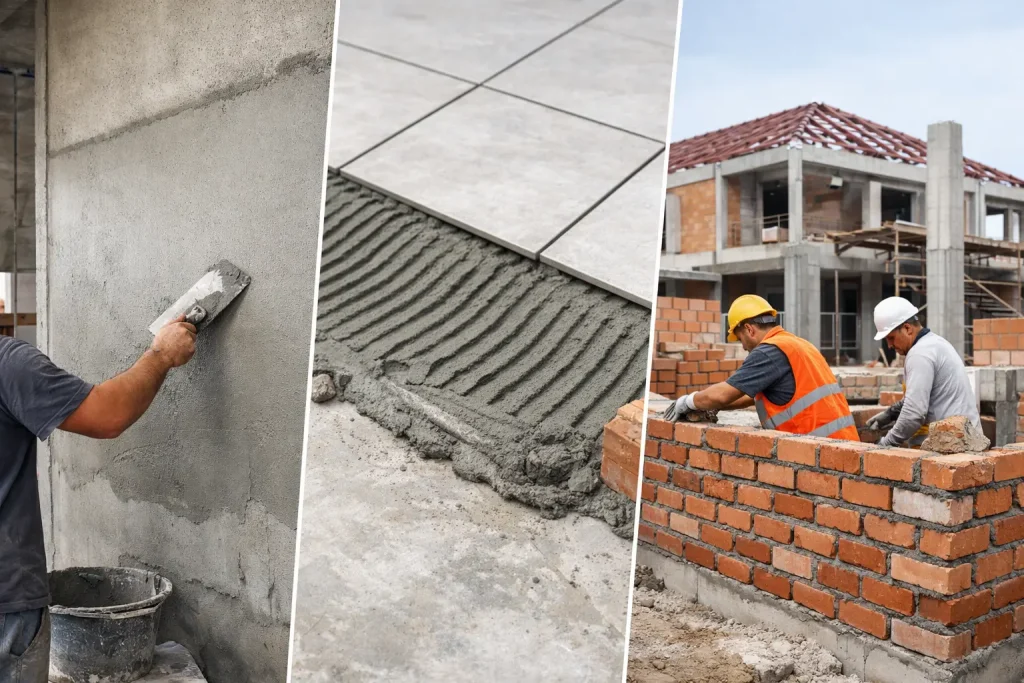
Brickwork.
Blockwork.
Plaster.
Floor bases.
Typical site mixes:
1:6 cement mortar for brickwork
1:4 cement mortar for plaster
1:3 where strength really matters
Here’s where cement quality starts showing.
On many sites, contractors stick to one cement brand—often JK Cement—because the mortar behaves the same batch after batch.
Same workability.
Same setting feel.
Less guesswork for the mason.
That consistency saves time, not just money.
Types of Mortar in Construction (Not All Are the Same)
There are different types of mortar in construction for a reason.
Walls don’t face the same conditions everywhere.
1. Cement Mortar- The most common.
Strong.
Sets fast.
Used for load-bearing work.
2. Lime Mortar- was traditionally used in old buildings
Softer.
More flexible.
Walls breathe better.
You still see it in restoration jobs.
3. Gauged Mortar
Cement plus lime.
Easier to work with.
Doesn’t crack as fast.
Useful when time on the joint matters.
4. Mud Mortar
Still around in villages.
Cheap.
Local materials.
Not for heavy loads.
Knowing these types of mortar in construction avoids bad decisions later.
Mortar vs Concrete (This Still Goes Wrong)
This mistake refuses to die.
Concrete is not mortar. Mortar is not concrete.
Concrete has aggregates. Mortar doesn’t.
Concrete takes loads. Mortar binds.
Put concrete between bricks and joints become rigid.
Put mortar where concrete should be and safety drops.
Simple difference.
Big consequences.
Why Mortar Fails (What Actually Happens)
Most failures aren’t dramatic.
They start small.
Dirty sand.
Extra water.
Guesswork ratios.
Reusing old mortar.
Even good cement mortar can’t survive bad habits.
That’s why consistent cement helps. With brands like JK Cement, masons don’t keep tweaking the mix every morning.
Mortar works the same way each time, so you always know what to expect when you’re building a wall.
Good Cement Makes Good Mortar
Mortar strength isn’t everything. Being able to handle it matters too.
Good cement gives:
Predictable setting
Better bonding
Less shrinkage
Cleaner joints
In mortar in construction, that reliability shows up months later—not on day one.
Walls don’t fail suddenly. They whisper first.
A crack.
A damp patch.
Peeling plaster.
Most of that points back to mortar. Understand the mortar meaning properly.
Use the right cement mortar. Choose the correct types of mortar in construction.
If nothing goes wrong, no one notices.
And honestly, that’s the best outcome on any site.
FAQs: Mortar in Construction
1. What’s mortar?
It’s the stuff that holds bricks or blocks together in a wall.
2. Is cement mortar better than lime mortar?
Cement mortar is stronger. Lime mortar is more flexible.
3. Which cement mortar ratio is used for brickwork?
1:6 cement mortar is standard.
4. Can mortar replace concrete?
No. They do different jobs.
5. Why do mortar joints crack?
Wrong ratios, extra water, or rushed work.
6. How long should cement mortar be cured?
Minimum 7 days.
7. Are there different types of mortar in construction for different needs?
Yes. Load, exposure, and climate decide.