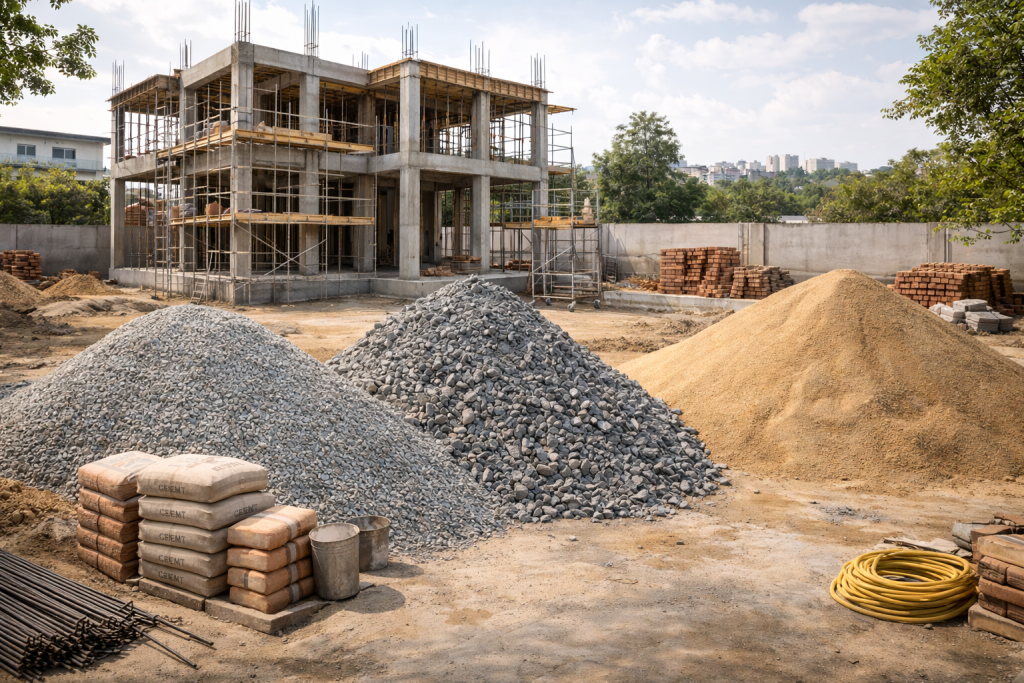
A site-first guide for homeowners and engineers — focused on behaviour, not just grading
Aggregates in construction mean:
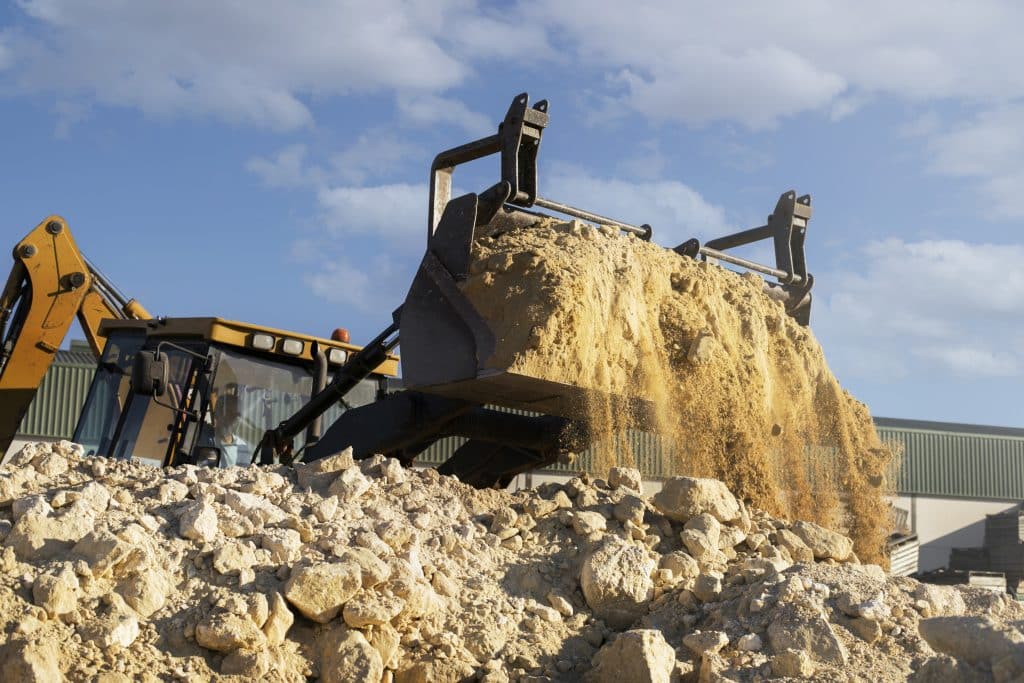
Aggregates are inert granular materials such as sand, gravel, and crushed stone that make up nearly 70–75% of concrete volume and largely decide its strength, cracking behaviour, and durability.
Quick answer
Cement binds.
Steel reinforces.
But aggregates decide how concrete actually behaves.
If aggregate quality is poor, no cement brand or steel grade can compensate. Concrete may pass cube tests yet fail slowly through cracking, seepage, and durability loss.
For Indian homes, aggregate quality matters more than cement brand choice.
What aggregates actually control on real sites
Beyond strength, aggregates control:
- workability and compaction
- shrinkage and crack formation
- permeability and seepage
- long-term durability of RCC
In typical Indian housing, aggregates form ~75% of concrete volume but account for over 60% of long-term durability complaints seen years after handover.
Verdict: Concrete fails from the inside out when aggregates are wrong.
Main reason concrete quality disappoints:
Dirty sand + flaky stone + no grading control.
Types of aggregates used in construction
| Type | Common use | Biggest risk | What to check |
| Natural sand | Plaster, concrete | High silt/clay | Bottle test, cleanliness |
| Manufactured sand (M-sand) | Concrete, plaster | Poor grading | Zone compliance |
| Crushed stone | RCC | Flakiness, elongation | Shape & size |
| River gravel | PCC | Smooth surface | Bond strength |
| All-in aggregate | Small works | No grading control | Avoid for RCC |
Verdict: On real sites, grading matters more than aggregate source.
What actually goes wrong on Indian sites with aggregates
I’ve inspected houses where concrete strength was “as per cube tests,” yet cracks appeared everywhere.
The reasons were consistent:
- Sand looked clean but carried silt → higher water demand → shrinkage cracks
- Aggregates were flaky → poor interlock → micro-cracking under load
- No sieve analysis → random grading → inconsistent concrete
Early in my career, I approved aggregates based on appearance because cube results were fine.
Two years later, seepage cracks appeared across beams.
The concrete passed tests — but failed life.
I’ve never been called back to fix concrete where aggregates were controlled.
I’ve been called back dozens of times where they weren’t.
Verdict: Aggregate mistakes hide behind good cube results.
Visual execution directive (critical)
Place a clean vs silty sand bottle test image immediately after this section so homeowners can visually reject bad sand on site without relying on verbal assurances.
[Image suggestion: Clean vs silty sand bottle test on site]
Standards anchoring (non-negotiable)
As per IS 383 (Specification for Aggregates) and IS 2386 (Methods of Test for Aggregates):
- aggregates must meet defined grading limits
- deleterious materials like silt, clay, and organic matter must be controlled
- flaky and elongated particles must be limited
- aggregates must be durable and sound
Using aggregates without sieve analysis is technically non-compliant with IS 383, even if cube strength passes.
This is not a recommendation.
It is a compliance requirement.
Verdict: Aggregates are governed by standards, not visual judgement.
One quantified field heuristic (non-negotiable)
- If sand silt content exceeds ~3–5%, expect visible shrinkage cracking within 12–24 months.
- If flaky index rises above ~25%, beam–slab micro-cracks usually appear within 2–3 monsoons.
These are not lab numbers.
They are site outcomes seen repeatedly.
[Image suggestion: Flaky vs cubical aggregate comparison]
[Image suggestion: Honeycombing caused by poor aggregates]
Cement–aggregate interaction (why PPC helps, but doesn’t fix bad aggregates)
PPC improves long-term pore refinement and reduces permeability.
But no cement can correct poor aggregate grading or dirty sand.
Good PPC + bad aggregates = disappointing concrete.
Good aggregates + average cement = durable concrete.
Verdict: Cement supports concrete, aggregates define it.
For RCC and plaster where durability matters, PPC performs best when paired with clean, well-graded aggregates — see
https://www.jkcement.com/grey-cement/jk-super-cement-ppc/
Immediate rejection triggers (binary site checks)
Reject aggregates immediately if you see:
- visible clay lumps or organic matter
- excessive flaky or elongated stones
- inconsistent colour or size across deliveries
- thick dust coating on aggregates
There is no partial acceptance here.
Verdict: Accepting bad aggregates is a permanent decision.
What NOT to do with aggregates (red flags)
❌ Using river sand without silt testing
❌ Mixing sand sources mid-project
❌ Washing aggregates on site as a “fix”
❌ Ignoring sieve analysis for RCC work
Verdict: Aggregate shortcuts show up years later, not during casting.
One clear decision shortcut
If this was my own house:
I would spend time and money ensuring clean, well-graded aggregates before worrying about cement grades — because aggregates decide durability long after construction ends.
Decision guide (quick scan)
If concrete cracks early →
Suspect aggregate grading before blaming cement.
If plaster debonds →
Check sand cleanliness first.
If seepage appears years later →
Revisit aggregate permeability, not surface coatings.
Frequently Asked Questions
What are aggregates in construction?
Aggregates are sand, gravel, or crushed stone that form the bulk of concrete and mortar.
Why are aggregates important in concrete?
They control strength, cracking, workability, and long-term durability.
Which aggregate is best for RCC work?
Clean, well-graded crushed stone complying with IS 383 is best.
Is river sand always good for construction?
No, river sand often contains excess silt and must be tested.
Is M-sand suitable for house construction?
Yes, if it meets grading and cleanliness limits as per IS 383.
Can bad aggregates affect waterproofing?
Yes, porous concrete from poor aggregates increases seepage risk.
Do aggregates affect curing?
Indirectly yes, through water demand and shrinkage behaviour.
Can cement compensate for poor aggregates?
No, cement cannot correct bad aggregate quality.
What test checks aggregate quality on site?
Sieve analysis as per IS 2386 and basic field tests.
Is flaky aggregate dangerous?
Yes, it reduces interlock and increases cracking risk.
Should aggregates be stored properly on site?
Yes, contamination during storage degrades quality.
How often should aggregates be tested?
Whenever the source changes or for critical RCC work.
Are all-in aggregates safe for RCC?
No, they offer poor grading control and should be avoided.
Do aggregates affect plaster finish?
Yes, dirty sand leads to weak, cracked plaster.
Who is responsible for aggregate quality?
The contractor and site engineer are responsible for approval and control.
Conclusion: aggregates decide the life of concrete
Concrete failures are rarely dramatic.
They are slow, silent, and internal.
Good aggregates:
- reduce cracking
- improve durability
- make concrete forgiving
Bad aggregates do the opposite.
Aggregate Quality Rule™:
If aggregates are wrong, everything built on them will age badly.
Most concrete failures blamed on “cement quality” actually begin at the aggregate yard.
Once concrete is cast, aggregate decisions cannot be corrected — only concealed.
Planning concrete work?
If aggregates are right, PPC improves durability.
If aggregates are wrong, buying better cement only delays failure.
👉 Buy JK Super Cement PPC online:
https://www.jkcement.com/grey-cement/buy-cement-online/