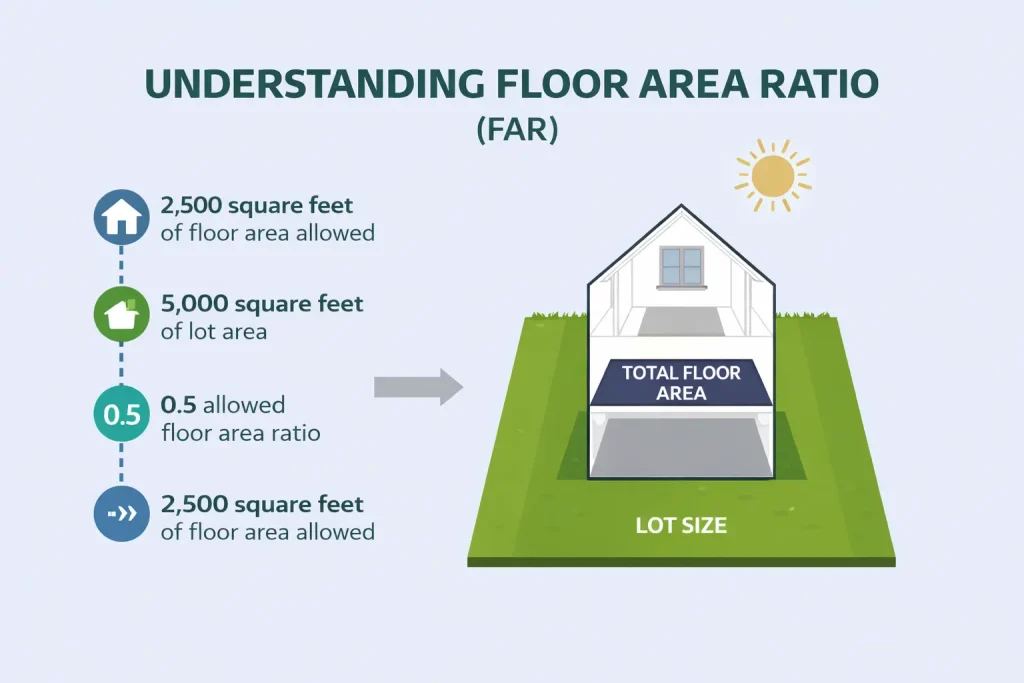
Floor Area Ratio (FAR) is the ratio of a building’s total built-up floor area to the area of the plot on which it stands.
It legally controls how much you are allowed to build on a piece of land.
In practical terms: FAR decides density, scale, and development intensity — not just height.
What Is Floor Area Ratio (FAR)?
Floor Area Ratio is a statutory planning control used by urban development authorities to regulate how much construction can happen on a plot.
It exists to ensure that:
- Cities do not become over-congested
- Roads, water, sewage, and fire access remain functional
- Buildings receive light, ventilation, and safety clearances
FAR is also known as:
- FSI (Floor Space Index)
- Plot Ratio
All three terms mean the same thing.
FAR Meaning in Practical Terms
FAR tells you how many times your plot area you are allowed to build as total floor area.
Example:
- Plot area = 200 sq m
- Permissible FAR = 2.0
- Maximum built-up area = 200 × 2.0 = 400 sq m
That 400 sq m can be arranged across floors in many ways — subject to height limits, setbacks, and fire rules.
Verdict: FAR controls total construction volume, not just number of floors.
Floor Area Ratio Formula
FAR = Total Built-Up Floor Area ÷ Plot Area
Rearranged:
Permissible Built-Up Area = FAR × Plot Area
Where:
- Built-up area = sum of all chargeable floor areas
- Plot area = net plot area as defined by local by-laws
Simple FAR Calculation Examples
| Plot Area (sq m) | FAR | Max Built-Up Area (sq m) |
| 100 | 1.5 | 150 |
| 200 | 2.0 | 400 |
| 300 | 2.5 | 750 |
| 500 | 3.0 | 1500 |
FAR vs Building Height
FAR does not directly decide height.
- FAR controls total area
- Height depends on zoning, setbacks, road width, fire norms, airport limits
Two buildings can use the same FAR and still look completely different in height and massing.
What Counts in FAR — and What Usually Doesn’t
(Exact rules vary by city; always check local DCRs)
Typically Counted in FAR
- Habitable rooms (living, bedrooms, kitchens)
- Internal corridors and lobbies
- Commercial or office floors
- Habitable basements (where permitted)
- Portions of balconies (rule-dependent)
Often Exempt or Partially Exempt
- Basement parking
- Stilt parking floors
- Staircases and lift shafts (up to limits)
- Pump rooms, electrical rooms, shafts
- Certain service balconies or ducts
Rule: Never assume exemptions — confirm locally before designing.
Typical FAR Ranges in Indian Cities (Indicative)
| Zone Type | Typical FAR |
| Low-density residential | 1.0 – 1.5 |
| Medium-density residential | 1.5 – 2.5 |
| High-density residential | 2.5 – 4.0 |
| Commercial cores | 3.0 – 5.0+ |
Actual FAR varies by:
- Road width
- Land use
- Transit proximity
- Master plan revisions
What Is Premium FAR?
Premium FAR is additional FAR that can be legally used by paying a fee to the development authority.
Example:
- Base FAR = 2.0
- Premium FAR purchased = 0.5
- Total usable FAR = 2.5
Authorities use premium FAR to:
- Manage density
- Fund infrastructure
- Channel growth into planned zones
Verdict: FAR becomes a priced planning resource.
The Direct Impact of FAR on Buildings
Planning & Design
- Higher FAR → denser layouts, vertical growth
- Lower FAR → more open space, lower heights
Structural Design
As FAR increases:
- Column sizes increase
- Foundations become heavier
- Concrete and steel consumption rises sharply
Verdict: FAR compliance does not replace structural engineering.
FAR and Construction Cost Relationship
| FAR Level | Cost Behaviour |
| Low FAR | Lower structural cost per sq ft |
| Medium FAR | Balanced cost |
| High FAR | Higher cost due to heavier structure |
High FAR demands:
- Better concrete quality
- Tighter quality control
- Stronger foundations
Decision Shortcuts
If it’s your own house:
Check FAR + setbacks before designing.
If it’s an apartment project:
Run feasibility using base FAR + premium FAR + structural cost impact.
One-Sentence Rule
FAR decides how much you may build. Engineering decides whether it will last.
FAQs
1. What is the floor area ratio?
It is the ratio of total built-up area to plot area, controlling how much construction is allowed.
2. What is the FAR formula?
FAR = Total built-up area ÷ Plot area.
3. Is FAR the same as FSI?
Yes. FAR and FSI mean the same thing.
4. What is premium FAR?
Extra buildable FAR allowed by paying charges to authorities.
5. Does higher FAR mean taller buildings?
Not always. Height depends on zoning and setbacks.
6. Does FAR include parking?
Usually parking basements are exempt, but rules vary by city.
7. Can FAR change over time?
Yes. FAR is revised through master plans and zoning updates.
8. Is high FAR good or bad?
Neither. It improves feasibility but increases complexity.
9. Can FAR violations be regularised?
Generally no. Excess FAR risks penalties or demolition.
10. Should FAR be checked before buying land?
Yes. FAR defines future development potential and value.
Conclusion
Floor Area Ratio is one of the most powerful numbers in construction planning.
It shapes legality, cost, structure, and long-term performance.
Understand FAR early. Design intelligently. Engineer for durability.