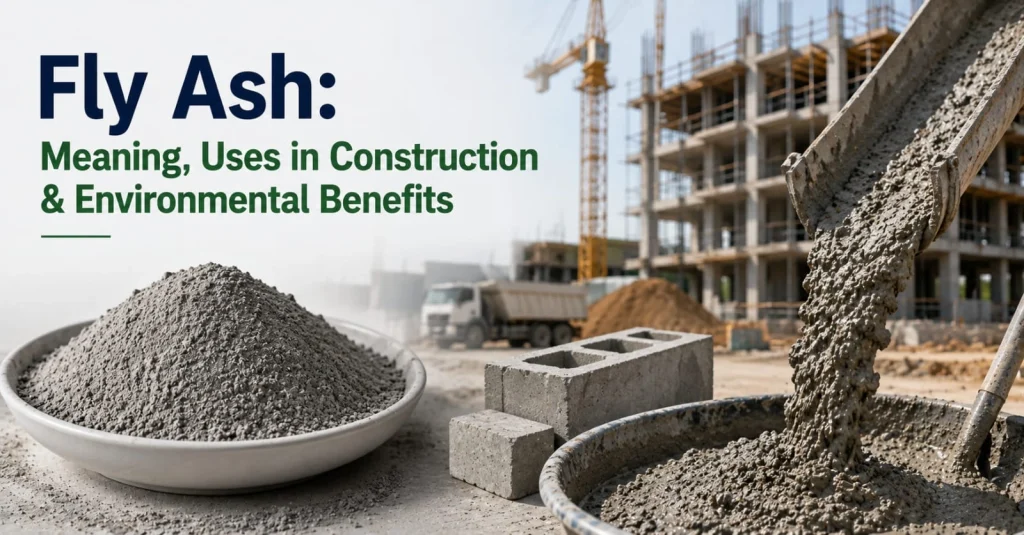
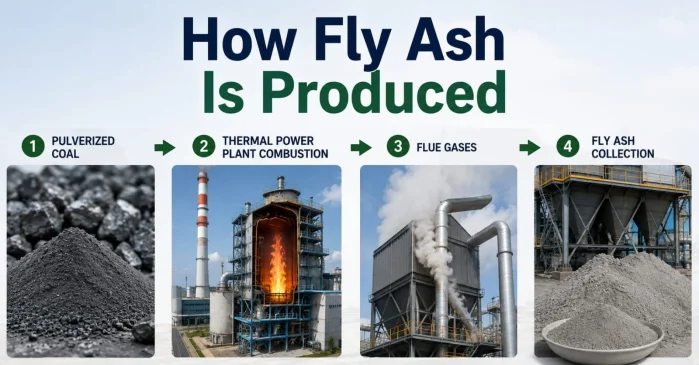
The term “recyclable” also applies in construction. One of the great examples of it is fly ash. It is produced when workers burn pulverized coal in thermal power plants. The best part? The manufacturers collect it from the flue gases. Fly ash in construction is not only used for masonry work. However, it also supports various other large construction projects. Read on this blog post to know more about fly ash in detail.
Quick Answer
Fly ash is a fine powder that is produced when coal or lignite combusts in thermal power plants. Fly ash in construction is commonly used as a pozzolanic material. The most common applications of fly ash are as follows:
Fly ash increases the lifespan of the structures. The best part is that they reduce the demand for cement.
What Is Fly Ash in Construction?
Fly ash is the fine residue that is produced when manufacturers burn pulverized coal. The coal releases gases upon burning. The fine residue in these gases results in fly ash. The particles of fly ash are very fine. What’s more? Some particles also have a spherical or glassy character. These fine particles improve the workability of a concrete mix. Fly ash also contains reactive mineral components. Hence, they participate in a pozzolanic reaction. Pulverized fuel ash is used for various purposes as per Indian Standard IS 3812 (Part 1): 2013. Some of them are as follows:
- Pozzolana
- Cover siliceous
- Calcareous varieties
Why Is Fly Ash Used in Construction?
Given below are the common uses of fly ash in construction:
- Better Workability
Fine fly ash particles mix easily with fresh concrete. This is useful if concrete must flow around reinforcement. Moreover, engineers recommend it for concrete to travel through pumping systems.
- Lower Water Demand
Fly ash mixed in proper proportions helps you reduce water consumption. The reports highlight that water demand may fall by up to 10% if there is 20% fly ash in the total cement material.
- Long-Term Strength
Strength development continues for a longer period in fly ash concrete. You might notice the slower early strength in some mixes. However, they perform excellently in the later ages if the workers design and cures them properly.
- Lower Heat of Hydration
Fly ash generates less heat. This is why it reduces the risk of temperature-related cracks. Engineers recommend using it for large infrastructure projects.
What Are the Different Types of Fly Ash in Construction?
Given below are different types of fly ash in construction:
- Siliceous and Calcareous Fly Ash
Pulverized fuel ash that engineers use as pozzolana falls under siliceous or calcareous fly ash under IS 3812 (Part 1): 2013. It is highly necessary if construction aligns with the Indian standards.
- Class F and Class C Fly Ash
The ASTM-based classification of Class F and Class C fly ash is also used in construction.
- Class F fly ash has higher pozzolanic content but is lower in calcium content.
- Class C fly ash contains more calcium. What’s more? It shows stronger self-cementing characteristics.
The experts advise avoiding choosing fly ash based on the label. However, you should consider your application before a final purchase decision.
What Are the Uses of Fly Ash in Construction?
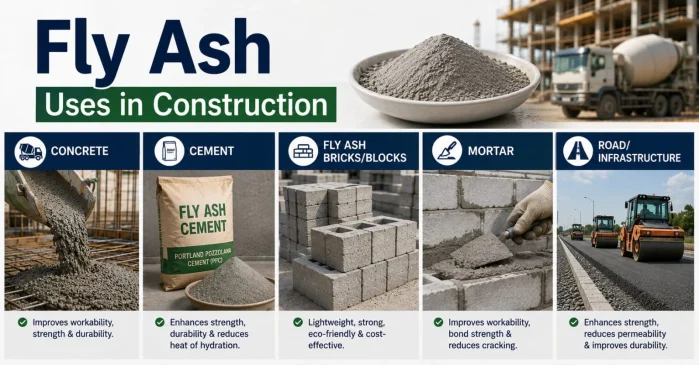
The following are the common uses of fly ash in construction:
- Concrete
Fly ash is popular in concrete mixes. It replaces traditional cementitious material. Structural engineers recommend using it for both residential buildings and infrastructure projects.
- Cement Manufacturing
This is one of the common uses of fly ash in construction. Fly ash helps you replace part of the clinker material in cement. JK Cement offers Portland Pozzolana Cement (PPC) for sustainable and cost-effective construction.
- Fly Ash Bricks and Blocks
Engineers also use fly ash to produce masonry units. Hence, they convert an industrial by-product into a useful building material.
- Large Infrastructural Projects
Road projects require quality building materials in large quantities. This is why engineers use fly ash in suitable embankments and some common infrastructural applications.
- Mine Filling and Reclamation
Fly ash is most commonly used for mine filling and reclamation of suitable areas. These applications consume substantial quantities of fly ash. Thus, it is necessary to ensure that the material meets project needs and environmental controls.
What Are the Environmental Benefits of Fly Ash in Construction?
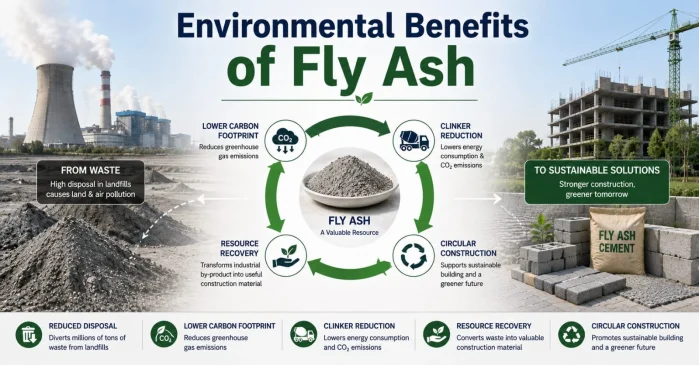
Given below are the environmental benefits of fly ash in construction:
- Less Disposal of Material
Fly ash in construction materials diverts suitable material from ash ponds and other disposal routes. The report highlights that 270.82 million tonnes of fly ash were used across applications in 2021-22.
- Lower Dependence on Virgin Resources
The demand for some virgin resources decreases when fly ash replaces part of traditional cement material. This is one of the ideal principles behind circular construction.
- Lower Need For Clinker
Clinker is one of the most important ingredients in the manufacture of cement. Clinker results in a lot of carbon emissions. Hence, fly ash in blended cement reduces the demand for clinker.
- Better Resource Recovery
Fly ash allows you to use an industrial by-product in construction. It is a resource material with applications across civil construction. This means it can be used for both masonry work and large infrastructural projects.
The Final Words
Fly ash is a smart way to use industrial by-products. It supports both practical performance and better resource management. However, it is necessary to choose the right type of fly ash in construction. Moreover, engineers must be careful about the proportions of fly ash used in masonry construction. It is one of the sustainable ways for the construction of buildings and infrastructure projects.
FAQs
1. Does Fly Ash Make Concrete Stronger?
Yes, fly ash can improve the long-term strength of concrete when used correctly. However, some fly ash concrete mixes may develop strength more slowly at early ages. The final performance depends on fly ash quality, replacement level, mix design, curing conditions and other materials used.
2. What Are the Main Types of Fly Ash?
Under IS 3812 (Part 1):2013, pulverized fuel ash used as pozzolana is classified as siliceous or calcareous fly ash. You may also come across Class F and Class C fly ash, classifications commonly used under ASTM standards.
3. Is Fly Ash Environmentally Friendly?
Fly ash can support more sustainable construction when used appropriately. It can reduce disposal requirements, replace part of conventional cementitious materials, conserve virgin resources and potentially lower embodied carbon. However, its environmental impact depends on sourcing, transportation, processing and application.
4. Can Fly Ash Completely Replace Cement?
Fly ash generally does not completely replace cement. It is primarily used as a supplementary cementitious material or partial replacement for conventional cementitious materials. The suitable replacement level depends on the application, project specifications, mix design and performance requirements.
5. Are Fly Ash Bricks Environmentally Friendly?
Yes, fly ash bricks can offer environmental benefits by putting an industrial by-product to productive use and reducing dependence on conventional fired clay bricks. However, their overall environmental performance depends on manufacturing methods, energy consumption, raw materials, transportation and product quality.
6. Is Fly Ash the Same as Cement?
Fly ash and cement are different construction materials. Fly ash is generally used as a supplementary cementitious or pozzolanic material. Unlike ordinary cement, fly ash typically contributes to cementitious properties through pozzolanic reactions when used appropriately in a cement-based mix.
7. Which Standard Covers Fly Ash in India?
In India, IS 3812 (Part 1):2013 covers pulverized fuel ash for use as pozzolana in cement, cement mortar and concrete. The standard provides requirements for the material so that suitable fly ash can be used reliably in construction applications.