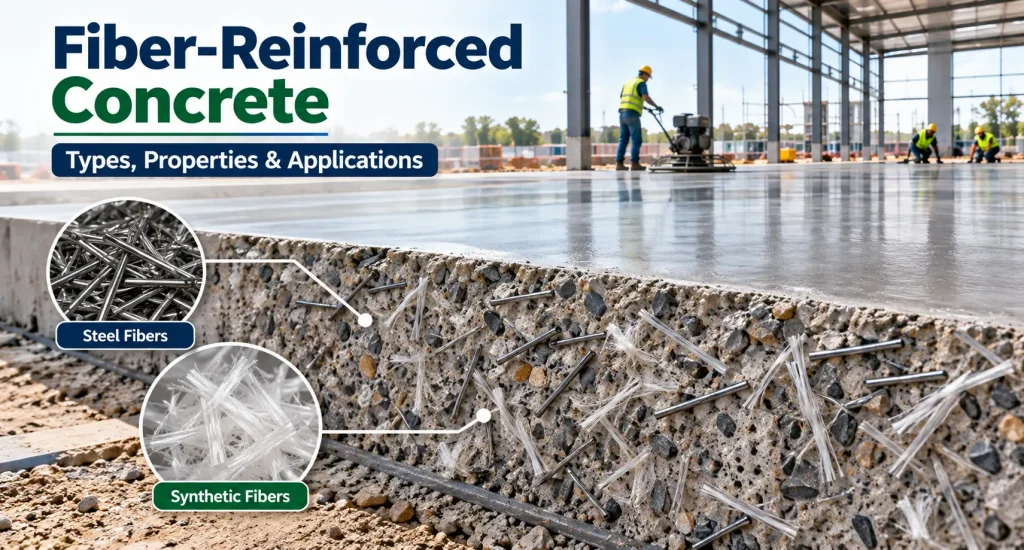
Concrete is strong in compression. But it has a limitation. It can crack when subjected to tension or continuous loading. This is where fibers can make a difference. Engineers mixes small fibers into the concrete mix to improve the performance of fiber-reinforced concrete. These fibers not only help you control cracks but also improve toughness. But all the fibers work differently. Steel fibers are ideal for heavy-duty applications. Synthetic fibers are useful for crack control. So, what is fiber-reinforced concrete and where does it make sense? Read on this blog post to find out!
What Is Fiber-Reinforced Concrete?
Fiber-reinforced concrete is a building material that contains uniform fibers. These fibers can be made of the following materials:
- Steel
- Polypropylene
- Glass
- Other suitable materials
Think of the fibers as tiny reinforcements spread throughout the concrete. Traditional reinforcement uses bars or welded mesh. Fibers work differently. They help control cracks at a much smaller scale and can improve the concrete’s post-cracking behavior. The final performance depends on the following factors:
- Fiber Type
- Fiber size
- Dosage
- Concrete mix
- Application
Fiber does not automatically make every concrete mix stronger. The right fiber needs to match the job.
What Are the Types of Fiber-Reinforced Concrete?
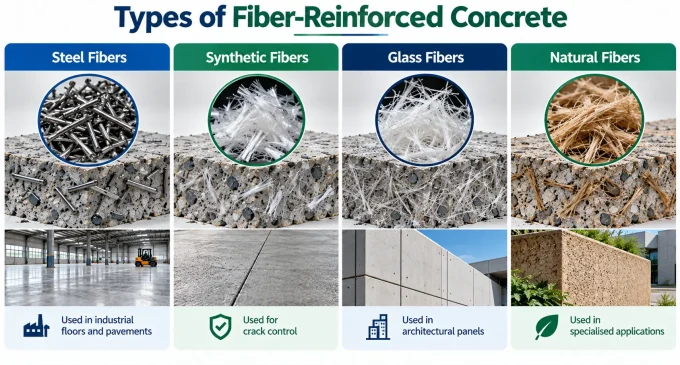
Given below are the different types of fiber-reinforced concrete:
- Steel Fiber Reinforced Concrete
Steel fiber reinforced concrete uses short steel fibers mixed into concrete. Steel fibers can improve toughness and impact resistance to crack growth. They are often considered for industrial floors, pavements, precast components, and heavy-duty structures.
The fiber shape and dosage matter. Hooked-end and other specially shaped fibers can provide better anchorage inside the concrete.
- Synthetic Fiber Reinforced Concrete
Synthetic fibers usually include polypropylene and other similar materials. They are lightweight and do not corrode. They are commonly used to control plastic shrinkage cracking. Some synthetic fiber systems can also improve toughness and impact resistance.
- Glass Fiber Reinforced Concrete
Glass fibers can be used to make glass fiber reinforced concrete. This type is useful where a relatively thin and lightweight concrete element is required. It finds applications in architectural panels and decorative elements.
- Natural Fiber Reinforced Concrete
Natural fibers can come from materials such as coir, sisal, and other plant sources. Research and specialized applications have explored these fibers as alternatives to conventional reinforcement. Their durability needs careful consideration.
What Are the Key Properties of Fiber-Reinforced Concrete?
The main reason to add fibers is not simply to increase compressive strength. The bigger advantage often appears after concrete starts to crack. Given below are the key properties of fiber-reinforced concrete:
- Crack control
- Toughness
- Resist impact
- Resist fatigue
- Post-cracking performance
- Durability
The actual improvement depends on the mix design and fibers used. That is why engineers should select fibers based on the required performance rather than simply choosing the highest fiber dosage.
What Are the Benefits of Fiber-Reinforced Concrete?
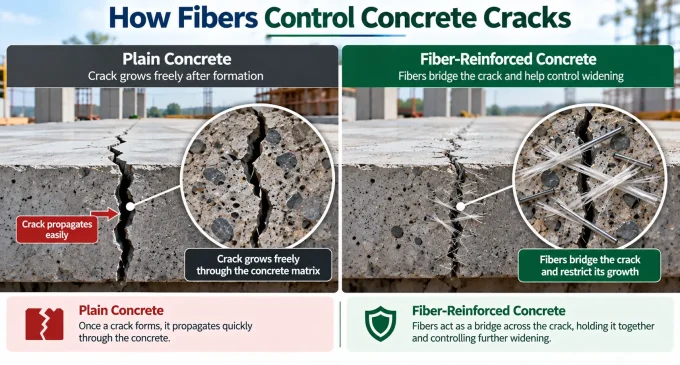
Given below are the benefits of fiber-reinforced concrete:
- Better Crack Control
Small cracks appear due to temperature changes. Hence, fibers can help distribute these cracks evenly. What’s more? It becomes easier for engineers to limit crack width.
- Improved Toughness
The load-carrying ability of plain concrete is lost after cracking. This is where a suitable fiber system is useful. It provides additional resistance to walls after cracking.
- Potentially Faster Construction
In some floor and pavement applications, fiber reinforcement can reduce or simplify the need for conventional mesh. However, this depends on structural design. It should never be assumed that fibers can replace reinforcement in every project.
- Improved Durability
Crack control can support long-term durability. The movement of water and other harmful substances through concrete is reduced due to small cracks. This is why it is essential to focus on good concrete quality and proper curing.
What Are the Applications of Fiber-Reinforced Concrete?
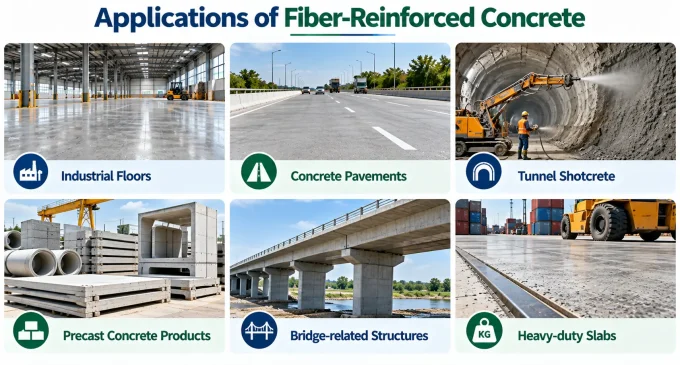
Given below are the common applications of fiber-reinforced concrete:
- Industrial floors
- Pavements
- Tunnels
- Shotcrete
- Precast products
- Slabs
- Bridge-related work
- Heavy-duty concrete surfaces
Fiber-Reinforced Concrete vs Traditional Reinforced Concrete
These two systems are not necessarily competitors. But both fiber-reinforced concrete and traditional reinforced concrete work together. Traditional reinforced concrete resists structural forces through steel bars or mesh. Fibers provide distributed reinforcement throughout the concrete.
For example, a structural slab may still require designed reinforcement bars. Fibers can then help with crack control and toughness. The decision depends on structural requirements, loading, span, exposure conditions, and applicable codes. A qualified structural engineer should make the final decision.
The Final Words
Concrete technology keeps moving forward. But the basic rule remains simple. The material must match the job. Fiber-reinforced concrete can offer better crack control, toughness, and impact resistance when the right fiber system is used correctly.
Steel fibers may suit demanding industrial applications. Synthetic fibers can help with crack control. Glass fibers work well for certain lightweight architectural elements. The choice should come from the performance requirement.
Not from a one-size-fits-all approach. For any concrete structure, good cement quality, correct mix design, proper placement, and curing still form the foundation of durable construction.
FAQs
1. Is steel fiber reinforced concrete stronger than normal concrete?
Steel fiber reinforced concrete can offer better toughness, crack resistance, and post-crack performance than conventional concrete. However, fibers do not automatically increase every strength property. Performance depends on the concrete mix, fiber type, dosage, distribution, and application.
2. Can fibers replace steel reinforcement in concrete?
Fibers can replace conventional steel reinforcement in some specifically designed concrete applications, but not in every structure. Structural reinforcement should only be replaced when permitted by the design and relevant engineering requirements. The application, loads, and required performance must be assessed before making this decision.
3. Where is fiber-reinforced concrete used?
Fiber-reinforced concrete is commonly used in industrial floors, concrete pavements, tunnels, shotcrete, precast elements, and architectural panels. It is selected where crack control, toughness, impact resistance, or durability is important. The fiber type depends on the application’s specific performance requirements.
4. Is fiber-reinforced concrete suitable for homes?
Yes, fiber-reinforced concrete can be suitable for selected residential applications. It may be used in floors, slabs, and other concrete elements where crack control is required. The appropriate fiber type and dosage depend on the concrete mix, application, and structural design.
5. Does fiber-reinforced concrete prevent cracks completely?
No, fiber-reinforced concrete does not prevent cracks completely. Concrete can still crack because of shrinkage, temperature changes, loading, and other factors. Fibers mainly help control crack formation, limit crack growth, and improve the concrete’s behavior after cracking.
6. What should be considered before using fibers in concrete?
Before using fibers, consider the concrete grade, fiber material, dosage, mixing method, expected loads, exposure conditions, and final application. Fiber selection should match the project’s performance requirements. A properly designed concrete mix helps ensure the fibers are distributed effectively throughout the concrete.