
Overview
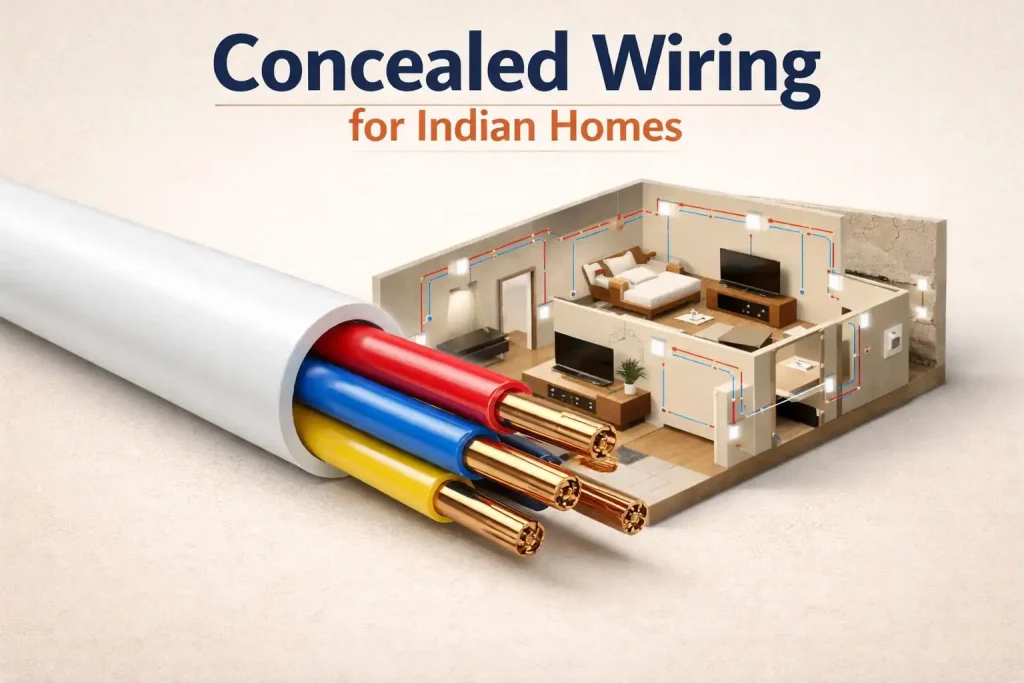
Walk into any modern home today and you won’t see wires running across walls anymore.
No plastic casing.
No exposed conduits.
No visible cable lines.
Everything is hidden.
That’s concealed wiring.
Instead of running wires on the surface, electrical cables are routed inside walls, ceilings, and floors, leaving only switches and sockets visible. The result is a cleaner look, better safety, and longer durability.
But concealed wiring also comes with one important condition — planning must happen before plastering. Once walls are finished, changing wiring becomes expensive and disruptive.
That’s why concealed wiring is not just an electrical decision.
It is part of construction planning itself.
What Is Concealed Wiring?
Concealed wiring means electrical cables run inside conduits embedded within building elements like walls, slabs, and ceilings.
The typical system includes:
- Conduits (PVC or metal pipes)
- Junction boxes
- Switch boxes
- Distribution boards
After installation, walls are plastered and finished.
Only switches and outlets remain visible.
This creates a clean, seamless interior — which is why concealed wiring has become the standard in modern Indian homes.
Unlike surface wiring, concealed wiring requires upfront planning, but delivers better long-term results.
Types of Concealed Wiring
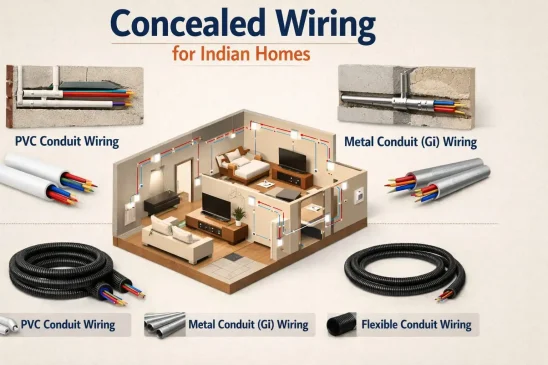
Different projects use different conduit systems depending on safety, cost, and usage.
PVC Conduit Wiring
This is the most common system in residential construction.
PVC conduits are:
- Lightweight
- Corrosion-resistant
- Easy to install
- Cost-effective
Because PVC is non-conductive, a separate earth wire is required.
Most apartments, villas, and houses use PVC concealed wiring.
Metal Conduit (GI) Wiring
Metal conduits are commonly used in:
- Commercial buildings
- Hospitals
- Data centers
- High-safety areas
Advantages include:
- Strong mechanical protection
- Better fire resistance
- Natural earthing path
However, metal conduits are more expensive and require skilled installation.
Flexible Conduit Wiring
Flexible conduits are used where rigid pipes cannot bend easily:
- Around beams
- Inside false ceilings
- Complex routing areas
These are usually combined with PVC or metal conduit systems.
Each type serves different project requirements.
Where Concealed Wiring Is Used
Today, concealed wiring dominates modern construction:
Residential homes
Apartments and villas
Commercial offices
Hotels and showrooms
Schools and institutions
Surface wiring is still used in:
Industrial sheds
Temporary structures
Low-budget projects
But for most modern homes, concealed wiring is now the preferred standard.
Advantages of Concealed Wiring
One of the biggest reasons concealed wiring is preferred is clean aesthetics.
Walls remain smooth and uncluttered, which suits modern interior design.
Beyond aesthetics, concealed wiring also improves safety. Since wires are hidden inside walls, the risk of accidental contact, tampering, or mechanical damage reduces significantly.
Durability is another major advantage. Conduits protect cables from:
- Moisture
- Dust
- Physical damage
- Corrosion
This often results in 30–50 years of wiring life when properly installed.
Fire safety also improves, especially when FR-LS cables and proper earthing are used.
Finally, concealed wiring gives flexibility in switch and socket placement without visible clutter — making interiors cleaner and more functional.
Disadvantages of Concealed Wiring
Despite its benefits, concealed wiring has some limitations.
The biggest challenge is modification difficulty.
Once wiring is plastered inside walls, adding new points requires cutting and re-plastering.
The cost is also higher. Concealed wiring can cost 25–40% more than surface wiring because of:
- Wall chasing
- Extra conduit
- Skilled labour
Fault finding can also be difficult. Locating cable damage sometimes requires instruments or wall cutting.
Another important factor is workmanship. Poor chasing, sharp bends, or loose boxes can cause long-term issues.
This is why concealed wiring must be planned carefully and executed properly.
Installation Process (Step-by-Step)
Concealed wiring installation typically follows this sequence:
First, mark all electrical points based on drawings.
This includes lights, switches, AC points, geysers, and appliances.
Next, wall chases are cut to accommodate conduits.
These grooves are typically 25–30 mm deep.
Then conduits are fixed inside chases using clamps or saddles.
Switch boxes and junction boxes are fixed level and aligned.
After plastering, wires are pulled through conduits.
Finally, circuits are tested before final finishing.
Testing before plastering is critical — faults discovered later become expensive to fix
Design Guidelines and Best Practices
Good concealed wiring depends on proper design.
Conduit sizing is important.
Typically:
- 20 mm conduits for lighting
- 25 mm conduits for power circuits
Conduits should never be overfilled.
Maximum filling should be around 40% of conduit capacity.
Wall chasing should be controlled.
Chases should not exceed one-third of wall thickness.
Never chase RCC beams or columns.
Maintain separation from plumbing lines — typically 150 mm distance.
Future-proofing is also important.
Provide spare conduits for:
- EV chargers
- Home automation
- Data cables
- Solar connections
Documentation of wiring layout is also essential for future maintenance
Concealed Wiring vs Other Systems
| Feature | Concealed | Surface Conduit | Casing-Capping |
| Cost | High | Low | Medium |
| Aesthetics | Excellent | Poor | Fair |
| Safety | Excellent | Fair | Good |
| Maintenance | Difficult | Easy | Medium |
| Durability | 40+ years | 20-30 years | 25 years |
Choose concealed for premium homes/offices. Surface for industrial/flexible needs.
Safety Standards
Concealed wiring should follow:
- IS 732 (Wiring Code)
- IS 694 (PVC cables)
- BIS certified materials
Bathrooms and kitchens should include:
- RCD protection
- Proper earthing
- Heavy-duty conduits
Regular inspection improves long-term safety.
Integration With Construction Planning
Concealed wiring works best when coordinated with civil construction.
With slump-tested concrete, conduits get proper embedment.
With fly ash bricks, straight chasing becomes easier.
With retaining walls, damp areas need additional protection.
Electrical planning should begin before plastering, not after.
This avoids rework and ensures better durability.
FAQs on Concealed Wiring
1. What is concealed wiring?
Concealed wiring runs cables inside conduits embedded in walls/ceilings.
Only switches and sockets remain visible for clean aesthetics.
PVC or metal pipes protect wires completely from view and damage.
2. What are the main advantages of concealed wiring?
Clean appearance with no visible cables or trunking.
Better safety since wires can’t be touched accidentally.
Longer life with protection from moisture, dust, physical damage.
3. What are the disadvantages of concealed wiring?
Higher installation cost (25-40% more than surface wiring).
Difficult modifications – requires wall cutting later.
Complex fault finding without proper documentation.
4. PVC or metal conduit – which is better for concealed wiring?
PVC conduits are cheaper, corrosion-free, easy to install.
Metal conduits offer better fire/mechanical protection.
Use PVC for homes, metal for commercial/high-risk areas.
5. Can concealed wiring be used in bathrooms?
Yes, but with IP-rated boxes and RCD protection mandatory.
Maintain separation from water pipes (150mm minimum).
Use heavy-duty conduits in wet zones.
6. How deep should wall chases be for conduits?
25-30mm deep, maximum 1/3 wall thickness.
Horizontal chases below 1.2m from floor, vertical above.
Never chase load-bearing RCC elements.
7. Is testing required before plastering?
Absolutely mandatory. Test continuity, insulation, earth resistance.
Fix faults when accessible, not after walls are finished.
Document test results for compliance records.
8. How to locate faults in concealed wiring?
Use continuity tester and insulation tester (megger).
Thermal camera for hot spots at DBs/junctions.
Follow circuit diagrams – poor documentation = major headache.
9. Can I upgrade surface wiring to concealed later?
Possible but expensive – involves wall demolition/repairs.
Much better planned during original construction.
Hybrid approach sometimes used in renovations.
10. What future-proofing should be done?
Empty conduits to EV charger, home server, solar inverter locations.
Higher capacity DB with spare ways.
CAT6/data conduits alongside power circuits.
Final Thought
Electrical wiring is invisible once construction is complete.
But mistakes remain hidden inside walls.
That is why concealed wiring must be:
- Planned early
- Installed carefully
- Documented properly
When done right, concealed wiring gives:
Cleaner homes
Better safety
Longer durability
Sometimes, the best construction decisions are the ones you never see — but benefit from every day.