Overview
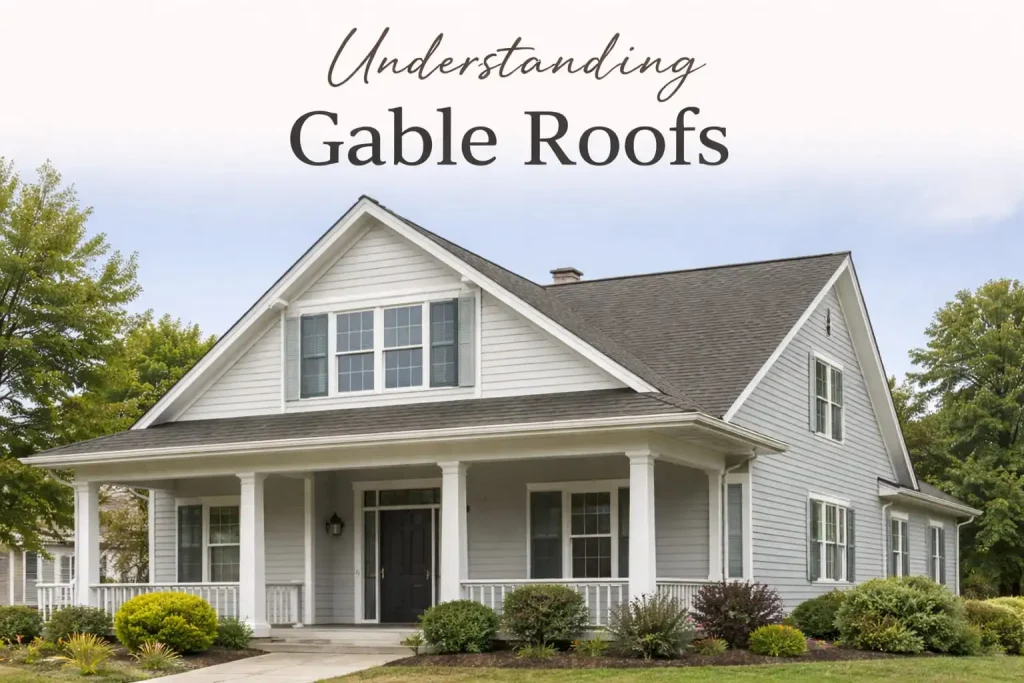
If you look at most homes—especially in hill stations, older colonies, or even newer villas—you’ll notice that sharp triangle sitting right under the roof. That’s the gable.
Simple shape, but it does a lot of heavy lifting.
It defines how your roof drains water, how heat behaves inside, and honestly, how your house looks from the outside. Get this wrong, and even a well-built home can feel flat. Get it right, and suddenly the same structure has character.
This guide breaks it down in a practical way—what a gable really is, how different roof types behave on site, and how to use gable windows without creating heat or leakage problems later.
What a Gable Actually Means
A gable is basically the triangular portion of a wall that sits between two sloping sides of a roof.
That triangle you see at the end of a house—that’s it.
Now, where people get confused is mixing up a few terms:
- Gable → the triangle itself
- Gable roof → the full roof system forming that triangle
- Gable end → the wall that holds that triangle
You’ll hear all three used interchangeably on site. Technically different. Practically? Same conversation.
What matters more is what that triangle is doing—handling water, wind, and space.
Why Gable Roofs Keep Showing Up Everywhere
There’s a reason you see gable roofs from Himachal homes to Kerala villas.
They just work.
At a basic level, a gable roof is two sloping sides meeting at a ridge. That’s it. No drama. No unnecessary complexity.
But that simple form solves three big problems:
- Water doesn’t sit → it runs off
- Heat doesn’t trap as easily → attic space acts as buffer
- Structure stays predictable → easier load transfer
And on actual sites, simplicity wins more often than fancy design.
You’ll rarely see a gable roof failing because of its shape. Failures usually come from bad joints, poor flashing, or rushed execution—not the form itself.
Types of Gable Roofs (And Where They Make Sense)
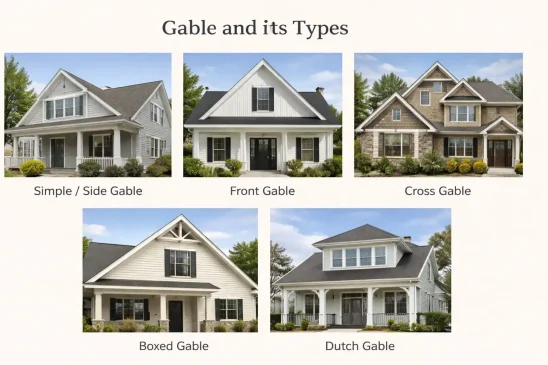
This is where design starts shifting from “standard” to “site-specific.”
Simple / Side Gable
The most straightforward version. Two equal slopes, ridge in the middle.
You’ll see this in farmhouses, small homes, even budget constructions.
Works well because:
- Easy to build
- Minimal chances of leakage
- Clean drainage
Front Gable
Here, the triangle faces the road.
It’s more about appearance than performance.
You’ll notice this in older Delhi houses or colonial-style homes—where the façade needs a focal point.
Cross Gable
Now things get slightly complex.
Multiple gable roofs intersecting—usually because the house layout isn’t rectangular anymore.
Looks great. But here’s the catch:
- More joints
- More valleys
- Higher leak risk
Honestly, this is where most waterproofing mistakes begin.
Boxed Gable
Edges are closed, giving a sharper, finished look.
Better for insulation and controlled detailing—but requires cleaner execution.
Dutch Gable
A hybrid—gable sitting on top of a hip roof.
Used when you want:
- Better wind stability (from hip)
- More space + aesthetics (from gable)
You’ll see this in premium builds more than standard homes.
What Works Well — And What Doesn’t
Let’s not over-glorify gable roofs. They’re great, but not perfect.
Where They Perform Really Well
- Heavy rainfall areas → water drains fast
- Snow regions → load doesn’t accumulate
- Homes needing attic or loft space
- Projects where long-term maintenance matters
Where You Need to Be Careful
- High wind zones → gable ends take direct force
- Complex layouts → more intersections = more risk
- Poor detailing → flashing mistakes show up fast
Honestly, I’ve seen homes where the roof design was perfect, but one badly sealed junction caused leakage within the first monsoon.
So again—design matters, but execution matters more.
Gable Windows — Where Design Meets Reality
This is where most people get excited.
Big glass. Full triangle. Pinterest-style elevations.
And then… summer hits.
A gable window is simply a window placed in that triangular wall. Sounds simple. But it changes how light, heat, and ventilation behave inside the space.
Why People Love Gable Windows
When done right, they’re one of the most impactful design elements in a home.
- Bring in a lot of natural light
- Open up views (sky, trees, hills—whatever you have)
- Make double-height spaces feel bigger
In hill homes or farmhouses, a full gable window can completely define the space.
But Here’s Where Things Go Wrong
This is the part most designs skip.
Large gable windows can create:
- Heat gain (especially west-facing)
- Glare during afternoons
- Leakage if joints aren’t detailed properly
You’d think it’s just glass—but the real work is happening at edges, seals, and slope junctions.
Practical Gable Window Design Ideas
Full Triangle Glass
Looks stunning. Works best in cooler climates or shaded orientations.
In hotter regions, you’ll need:
- Low-E glass
- External shading
- Or internal blinds
Split Composition (Smarter Option)
Instead of one big triangle:
- Use rectangular windows below
- Add a triangular piece on top
This reduces cost, improves control, and makes maintenance easier.
Clustered Windows
Multiple smaller windows arranged within the gable.
More flexible:
- Better ventilation
- Easier shading
- Less thermal stress
Masonry + Window Mix
Common in Indian homes.
Solid wall + smaller window inside the gable.
Less dramatic, but far more practical.
If This Was My Own House
I’d keep it simple.
- A clean gable roof (no unnecessary intersections)
- Limited but well-placed gable glazing
- Proper shading based on orientation
- Strong focus on joint detailing
Because roofs don’t fail because of design ideas.
They fail because of ignored details.
FAQs
What is a gable in simple terms?
A gable is the triangular part of a wall formed between two sloping roof sides. It’s the visible “triangle” you see at the end of many houses and plays a role in drainage and structure.
What is a gable roof and why is it common?
A gable roof has two sloping sides meeting at a ridge, forming triangular ends. It’s widely used because it drains water efficiently, is easy to build, and creates usable attic space.
What are the main types of gable roofs?
Common types include simple gable, front gable, cross gable, boxed gable, and Dutch gable. The choice depends on layout complexity, design intent, and climate conditions.
What is a gable end?
A gable end is the wall section that contains the triangular gable. It can be plain or decorative and often becomes a visual focal point of the house.
What is a gable window?
A gable window is placed within the triangular gable wall, often high up, to bring in light and sometimes ventilation into lofts or upper spaces.
Are gable roofs better than flat roofs for rain?
Yes, gable roofs drain water much faster because of their slope. This reduces chances of leakage and water stagnation compared to flat roofs.
What are the disadvantages of gable roofs?
They can be vulnerable to strong winds and become complex at intersections like cross gables. Poor detailing at joints can also lead to leakage.
Do gable windows always have to be triangular?
No, they can be rectangular, arched, or a mix of shapes. Many designs combine standard rectangular windows with a triangular top section.
How do you prevent heat from large gable windows?
Use solar-control glass, add shading elements, and consider orientation carefully. Splitting the window into smaller units also helps manage heat better.
What should I consider before choosing a gable roof?
Focus on climate, wind exposure, roof complexity, and detailing quality. Also plan how much light you want through gable windows and how you’ll control heat.