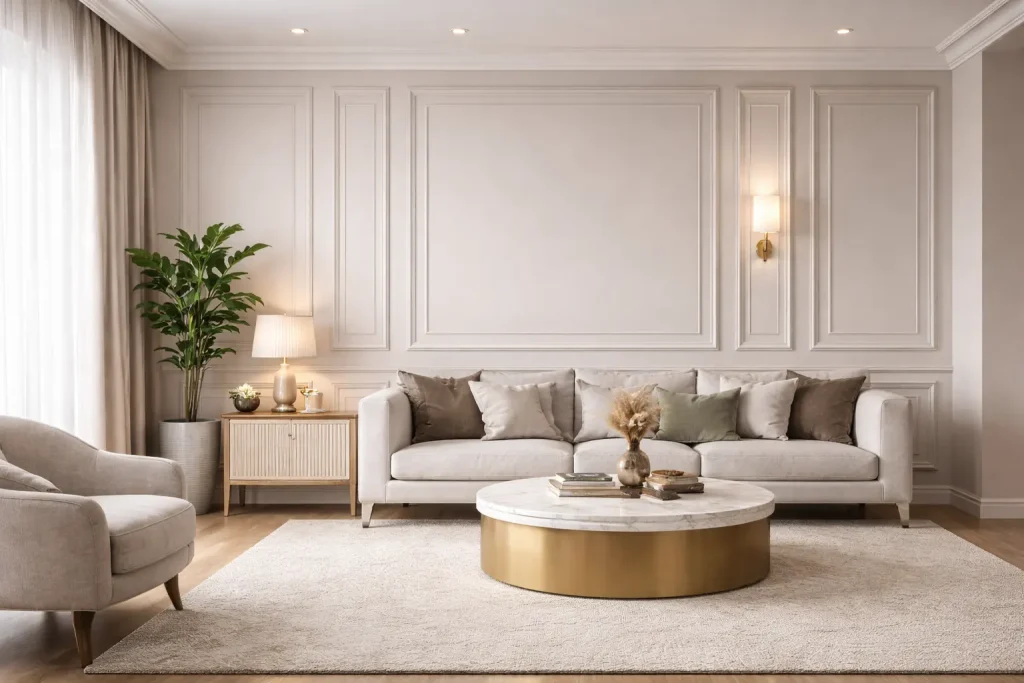
Wall moulding in 2026 isn’t about decoration.
It’s about proportion. It’s about shadow. It’s about turning flat, lifeless walls into architectural surfaces.
Because here’s what usually happens.
A plain painted wall looks good for six months. A properly designed moulded wall looks intentional for years.
And in Indian apartments between 900–1,800 sq ft, wall moulding has quietly become one of the smartest ways to make interiors feel structured, expensive, and thoughtfully designed — without knocking down walls or spending on stone cladding.
But when it’s done badly? It cracks. It swells. It looks forced.
The difference isn’t trend. It’s layout logic and material discipline.
Quick Answer
Wall moulding is a decorative and protective wall treatment made using raised trims, panels, or fluted profiles that add depth, symmetry, and architectural definition to interior walls.
When done correctly, wall moulding:
- Adds visual structure
- Enhances resale appeal
- Hides minor plaster imperfections
- Protects high-contact wall zones
- Improves how light and shadow fall on surfaces
When done poorly, it:
- Feels cluttered
- Develops joint cracks
- Swells during monsoon (wrong material)
- Ages unevenly
Good moulding is subtle. Bad moulding screams.
Why Wall Moulding Is Dominating 2026 Interiors
Flat walls are fading out. Modern interiors are shifting toward:
- Architectural surfaces
- Texture over loud colour
- Subtle shadow instead of heavy wallpaper
- Quiet luxury finishes
Paint gives colour. Moulding gives structure. And structure is what makes a room feel expensive.
Wall moulding also works beautifully with:
- Layered ceiling lighting
- Warm wood flooring
- Slim glass partitions
- Neutral palettes
It doesn’t overpower a room. It frames it.
What Wall Moulding Actually Does (Beyond Aesthetics)
On real Indian sites, moulding serves practical purposes:
- Covers minor plaster unevenness
- Conceals hairline shrinkage cracks
- Protects corridor and dining walls from chair impact
- Frames artwork or TV panels
- Replaces bulky headboards in bedrooms
It’s often used in:
- Living room feature walls
- Bedroom backdrops
- Passage walls
- Dining areas
It’s not a fad. It’s architectural framing made accessible.
Types of Wall Moulding Used in Indian Homes (2026)
1. Picture Frame Moulding
Rectangular trims arranged symmetrically. Clean. Balanced. Classic.
Best suited for:
- Living rooms
- Passage walls
- Formal areas
2026 trend shift: Double-layer panels (smaller rectangle inside a larger one) for added depth.
Rule that cannot be ignored: Spacing must be equal. Even 10mm variation ruins symmetry.
2. Wainscoting (Half-Wall Moulding)
Covers lower 1/3rd of the wall. Standard height: 900–1,000 mm from floor.
Used in:
- Dining spaces
- Bedrooms
- Corridors
Modern update: Vertical slatted profiles instead of ornate carvings. It protects walls from chair backs and daily scuff marks.
3. Fluted / Ribbed Panels
Vertical grooves running floor-to-ceiling.
Why they work so well:
- Make ceilings appear taller
- Add texture without visual clutter
- Pair beautifully with cove lighting
Perfect for:
- TV feature walls
- Headboard walls
- Accent zones
This is one of the strongest 2026 trends.
4. Board & Batten
Vertical strips at even intervals.
Best for:
- Contemporary apartments
- Modern farmhouse themes
2026 version: Slim profiles. No bulky strips. Clean lines age better.
5. Full-Height Panel Grids
Entire wall covered in structured panels.
Works well in:
- Large living rooms
- High ceilings
- Formal spaces
Avoid in:
- Compact bedrooms
- Narrow rooms
Too much geometry in a small space feels heavy.
Material Selection (Where Most Mistakes Happen)
| Material | Moisture Resistance | Durability | Best Use |
|---|---|---|---|
| MDF | Low | Good | Dry bedrooms only |
| PVC | High | Very Good | All-rounder |
| PU (Polyurethane) | High | Excellent | Long-term homes |
| Solid Wood | Medium | High | Luxury feature walls |
| Gypsum | Medium | Moderate | Dry interiors |
Blunt truth: If your wall has even minor moisture history — Avoid MDF. PVC and PU handle Indian humidity far better. Many moulding failures in India are not design failures. They are moisture failures.
Proportion Rules Most Homeowners Ignore
Moulding is mathematics.
- Vertical panels elongate walls
- Horizontal breaks widen rooms
- Equal spacing creates calm
- Uneven grids create chaos
If panels are too small → wall feels busy. If panels are too large → wall feels empty.
Proportion matters more than profile style. Before installation, draw it full-scale on the wall with chalk tape. Most contractors skip this step. That’s where regret begins.
2026 Colour Trends for Wall Moulding
1. Colour Drenching
Same colour for wall and moulding. Different sheen:
- Matte wall
- Satin moulding
Creates subtle shadow depth. Elegant. Understated.
2. Contrast Trim
Light wall + darker moulding or Dark wall + light moulding.
Examples:
- Sage wall + off-white trim
- Cream wall + charcoal moulding
Adds drama without wallpaper. Grey-on-grey is fading. Warm neutrals are rising.
What Goes Wrong on Indian Sites
Real issues observed:
- MDF installed on slightly damp wall → swelling
- Cheap adhesive → panels detach
- Joints not filled properly → cracks after 3 months
- No primer → patchy paint finish
- Over-designing small rooms → visual clutter
These problems don’t appear immediately. They appear after the first monsoon. Substrate preparation matters more than the moulding profile.
Cost Guide (India 2026)
| Type | Installed Cost (Approx.) |
|---|---|
| Basic PVC Strips | ₹90 – ₹150 / sq ft |
| MDF Panel Moulding | ₹180 – ₹280 / sq ft |
| Fluted PVC Panels | ₹350 – ₹650 / sq ft |
| PU Premium Profiles | ₹250 – ₹500 / sq ft |
| Wood Veneer Panels | ₹700 – ₹1,500+ / sq ft |
Always include: Primer cost, two finish coats, skilled labour. Cheap labour ruins expensive moulding.
Where Wall Moulding Works Best
- Living room feature wall
- Bedroom headboard wall
- Dining backdrop
- Staircase wall
Where To Avoid It
- Damp exterior-facing walls
- Very small bedrooms
- Kitchens near direct heat
Restraint is part of good design.
If This Were My Own Home
I would:
- Use PVC or PU profiles
- Limit moulding to one or two walls
- Keep spacing symmetrical
- Pair with warm layered lighting
- Avoid overly classical, ornate designs
Simple moulding ages better than decorative excess.
FAQs
Is wall moulding still in style in 2026?
Yes. Modern wall moulding has shifted toward minimalist profiles, fluted textures, and proportion-driven layouts rather than heavy classical ornamentation.
Which material is best for wall moulding in Indian homes?
PVC and PU perform best due to moisture resistance and durability. MDF should only be used in dry, well-ventilated rooms.
Does wall moulding make a room look smaller?
Only if poorly proportioned. Vertical fluted panels can actually make ceilings look taller and rooms feel larger.
Can moulding be installed over painted walls?
Yes, but the wall must be sanded and levelled first for proper adhesion and seamless finishing.
How high should wainscoting be?
Traditionally around 900–1,000 mm. In modern designs, it can extend to 5–6 feet for a dramatic effect.
Is wall moulding expensive?
It is significantly more affordable than full wall cladding or stone treatments while delivering comparable architectural depth.
How long does wall moulding last?
10–15 years when installed correctly using moisture-resistant materials and proper priming.
Can wall moulding increase resale value?
Yes. Buyers perceive moulding as a permanent architectural upgrade rather than temporary décor.
Final Thought
Paint changes colour. Wall moulding changes structure. And structure is what makes a room feel intentional.
If proportion is respected, materials are chosen wisely, and installation is disciplined — wall moulding becomes a long-term architectural asset.
Design with restraint. Install with precision. Let the shadows do the work.