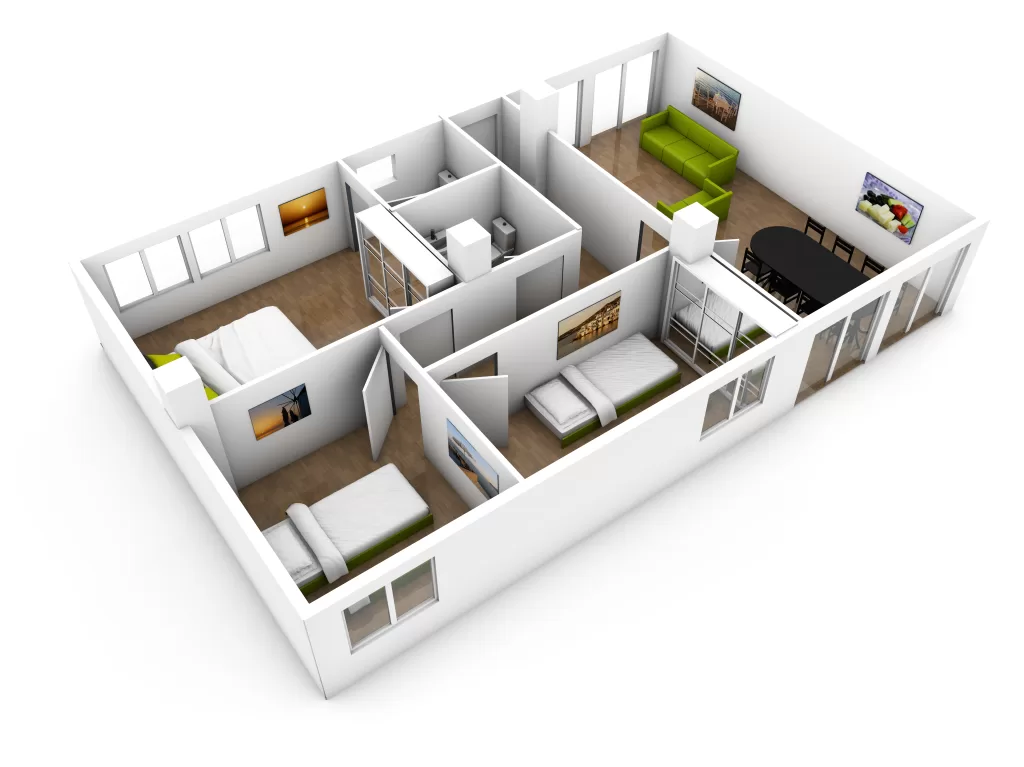
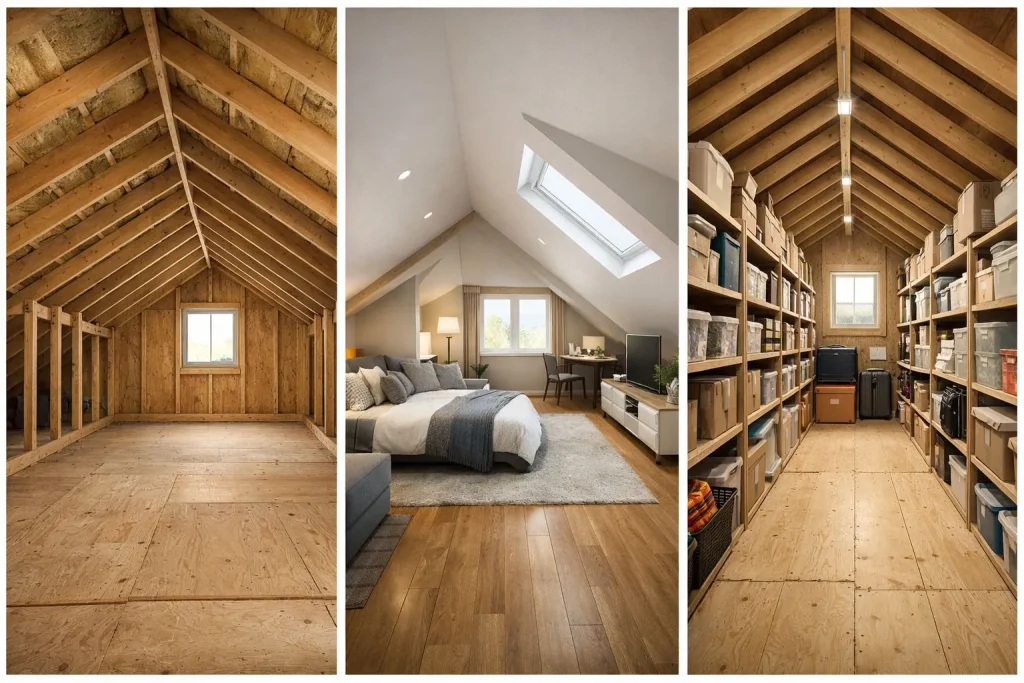
We’ve all heard the word ‘attic’ being used, often at our own homes. In simple terms, an attic refers to the space between the ceiling of the top floor and the roof.
Most people don’t think about the attic when building a house.
It’s usually an afterthought. A dark space. A place to dump old trunks, suitcases, and broken furniture.
For many homeowners, especially in India, understanding the meaning of attic helps make better design and usage decisions.
But on-site, the attic plays a quiet but important role in how a house feels and performs. Temperature control. Storage. Even structural balance. Once you understand the real attic meaning, you realise it’s not wasted space—it’s unused potential.
In Indian homes, especially independent houses and villas, the idea of an attic is slowly making a comeback. Earlier, we saw it in old bungalows. Today, it’s returning in modern homes as loft-style storage or even cosy reading corners. Knowing the meaning of attic in Hindi also helps homeowners explain it better to local contractors and masons, who may use regional terms but understand the concept well.
This blog breaks down the meaning and uses of an attic.
What Is An Attic Really?
The attic, in architecture, is the space created directly under a pitched roof, above the ceiling of the highest occupied floor. That’s it.
An attic is not always meant to be lived in. Traditionally, it served three main purposes:
- Thermal insulation
- Storage
- Structural buffer between the roof and the rooms.
In practical terms, the meaning of attic in Hindi is often explained as “छत के नीचे बनी खाली जगह”. Some regions also call it “माळा” or “परछत्ती”, depending on usage.
What matters is how it’s designed in:
- Height
- Access
- Ventilation
- Load-bearing capacity
A poorly planned attic becomes useless. A well-planned attic quietly improves comfort and space efficiency.
Is Attic The Same As A Loft?
This is where most people get confused. Let’s clear it up with site logic.
- An Attic is located below the roof as a part of the structure, like a separate room, whereas a loft is built within a room.
- The meaning of attic stays consistent – it’s linked to the roof structure.
A loft is a platform or space within the room, or at times, above wardrobes or kitchens.
- The attic is usually an enclosed area, while a loft can be open, semi-open or closed.
- The attic is a more traditional architectural element, and a loft is more of an interior design element.
The meaning of attic in Hindi may be the same as a “loft”, but structurally, they are completely different design concepts.
On-site, it is important to know the difference as both require different slab thickness and load design.
Purpose And Common Uses Of The Attic
Once you understand the meaning of attic, its uses make sense.
1. Storage Space
This is the most common use. Old furniture, festival décor, luggage—things you don’t need daily. A properly built attic keeps these items out of living spaces.
2. Thermal Comfort
Air trapped in the attic acts as insulation. In hot Indian summers, this buffer reduces heat entering living rooms. That’s a big reason architects still respect the original attic meaning.
3. Mechanical Services
Water tanks, AC ducts, wiring trays – all fit neatly into attic spaces in well-planned homes.
4. Living or Activity Space
In modern homes, attics are now:
- Home libraries
- Study corners
- Kids’ play areas
This works only if height, ventilation, and safety are planned properly.
5. Structural Balance
An attic helps distribute roof loads and protects ceilings from direct exposure to weather.
Practical Tips For Utilising The Attic In Homes
This is where experience matters.
If you’re planning an attic, don’t just ask “Can we make one?”
Ask “Will it work properly?”
Here are practical tips from site experience:
1. Plan height early
Minimum usable height matters. Low attics quickly become useless.
2. Ensure ventilation
Poor airflow turns an attic into an oven. This defeats the whole attic meaning of thermal comfort.
3. Use lightweight materials
Heavy loads stress slabs and beams unnecessarily.
4. Provide safe access
Fixed ladders or compact stairs are safer than makeshift solutions.
5. Use good-quality cement and concrete.
Structural consistency is key. The durability of the attic rests entirely on proper slab design and reliable building materials. This is where trusted cement brands like JK Super Cement help maintain long-term safety.
6. Think future use
Attics can be easily converted into a study, studio or work space later on.
The Attic In Indian Homes
In India, attics are making sense again because:
- Plot sizes are shrinking
- Vertical space is underused
- Storage needs are growing
The meaning of attic is evolving—from dead space to smart space. Builders who plan attics well deliver homes that feel bigger without increasing the footprint.
Once you truly understand ‘attic meaning’, you stop seeing it as wasted height and start seeing it as a hidden value. Whether it’s storage, insulation, or extra usable space, a well-designed attic improves comfort and efficiency.
If you’re planning a home or renovating one, take a moment to look up—your attic might be your smartest unused space. Build smart. Use space wisely, and never ignore what’s above your ceiling.
FAQs
1. What is the meaning of attic in architecture?
Attic meaning is: the space between the top floor ceiling and the roof, used for storage, insulation, or services.
2. Are attic and loft the same?
No. An attic sits under the roof, while a loft is created inside a room.
3. What is attic meaning in Hindi?
Attic meaning in Hindi is commonly explained as परछत्ती
4. Can an attic be used as a living space?
Yes, if height, ventilation, and safety are properly planned.
5. Does an attic help with temperature control?
Yes. An attic acts as a thermal buffer, reducing heat transfer.
6. Is attic construction expensive?
Not if planned early. Retrofitting later usually costs more.
7. Should an attic be load-bearing?
Only if intended for use. Storage-only attics require a lighter design