Terracotta roof tiles haven’t really gone anywhere—and there’s a reason for that.
In Indian conditions, where heat, rain, and time all test a house, they hold up.
They keep the interior cooler, handle heavy rain without much fuss, and over the years, they don’t start looking tired the way some finishes do.
When you’re weighing options, terracotta roof tiles usually come up when the goal is simple: build once, don’t keep fixing things every few years.
Spend a little time in older homes across Kerala or Karnataka—you’ll see these roofs still doing their job. No drama. No maintenance headaches. Just steady performance.
What Are Terracotta Roof Tiles?
Terracotta clay roof tiles are made from natural clay, shaped, fired at high temperatures, and that’s about it.
No extra layers. No artificial coatings.
That process gives them:
- The familiar reddish, earthy tone.
- Good heat resistance.
- A natural way of letting air move, instead of trapping it.
That’s why houses with terracotta roof tiles don’t feel as suffocating as concrete slab homes in peak summer. And over time, they don’t get spoiled.
They age. Slight colour changes, a bit of character, but it works.
Why Terracotta Roof Tiles Still Make Sense in India
They’ve stuck around because they solve real problems.
1. Cooler Interiors
In Indian summers, the roof takes the worst hit.
Terracotta roof tiles cut down how much heat gets inside, so rooms below stay more comfortable.
2. Rain Is Not a Problem
With the right slope, terracotta clay roof tiles let water run off quickly.
No standing water, no seepage issues—provided the job is done properly.
3. Long Life
It’s not unusual for these roofs to last 20–30 years.
Sometimes longer, with basic upkeep.
4. They Age Well
Paint fades—Polish peels.
These tiles don’t. They just settle into their looks.
That’s also why newer homes are picking up modern terracotta roof tiles—to get that same feel without going fully traditional.
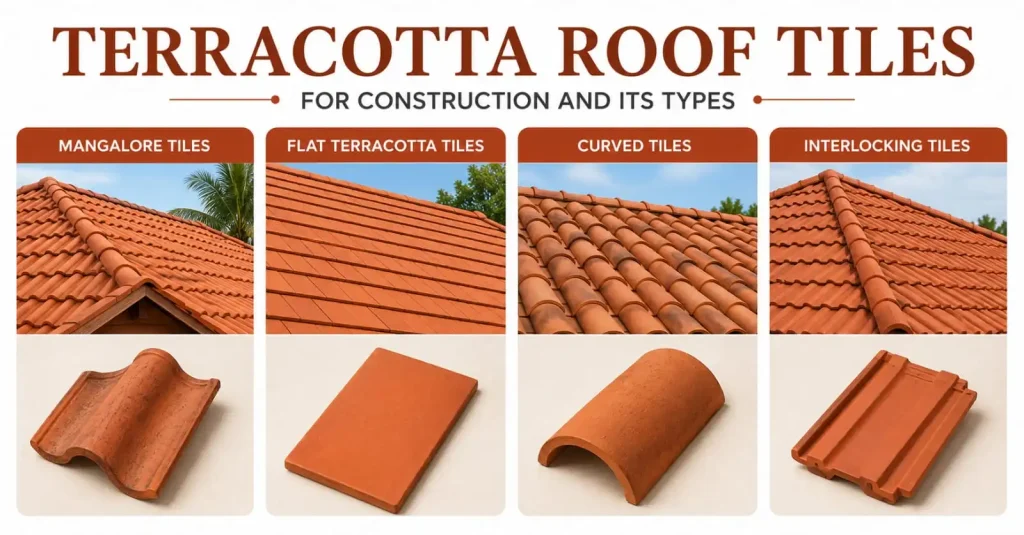
Types of Terracotta Roof Tiles You’ll Come Across
From a distance, they might look similar. Up close, they’re not.
- Mangalore Tiles
Probably the most common. Interlocking and reliable, especially in heavy rainfall areas.
- Flat Terracotta Tiles
Cleaner lines. You’ll see these more in modern terracotta roof tiles setups.
- Curved Tiles
Old-school style. Still used in traditional homes.
- Interlocking Tiles
Better grip, better alignment. Less chance of shifting during strong winds.
Most people today don’t stick to just one type—they balance looks and function depending on the house.
Installation: Where Things Usually Go Wrong
This is where the real difference shows.
Good tiles won’t save a bad job.
Basic Flow:
- A strong roof frame (steel or wood).
- Proper slope for water to run off.
- Tiles laid in an overlapping pattern.
- Fixed using hooks or fasteners.
- Ridge tiles placed on top to seal.
Sounds straightforward. But the execution is everything.
Common Issues:
- Wrong slope → water collects.
- Loose fixing → tiles move in the wind.
- No waterproofing layer.
- Poor workmanship.
A lot of times, people blame the tiles. In reality, it’s the installation that failed.
Even top-quality terracotta clay roof tiles won’t perform if the base work isn’t right.
Terracotta Roof Tile Price in India
This is where most decisions start.
The terracotta roof tile price depends on a few things:
Type of tile
- Thickness
- Where it’s sourced from
- Finish quality
Rough Range:
- Basic tiles: ₹25 – ₹40 per piece
- Mangalore tiles: ₹40 – ₹70 per piece
- Premium or designer tiles: ₹70 – ₹120+ per piece
Don’t Forget:
- Labour cost
- Roof framework
- Waterproofing
So yes, the terracotta roof tile price might look reasonable upfront—but look at the full system cost, not just the tile.
That said, compared to fixing cracked concrete roofs later, it often balances out.
Terracotta vs Concrete Roof: Real Difference
This comes up all the time.
Terracotta Roof Tiles
- Cooler inside
- Better suited for sloped roofs
- Needs careful installation
Concrete Slab
- Strong, flat
- Faster to build
- Holds heat longer
Anyone who’s stood under a concrete roof in May heat knows the difference.
That’s where terracotta roof tiles quietly win.
Where They Work Best
They’re not for every structure.
Best Fit for:
- Independent houses
- Farmhouses
- Villas
- Coastal or high rainfall regions
Not Ideal for:
- High-rise buildings
- Flat-roof apartments
A well-planned roof using modern terracotta roof tiles can change how a home feels, both outside and inside.
Things to Check Before You Decide
Most of this comes from seeing what goes wrong on-site.
Tap tiles to check for cracks
- Don’t cut corners on labour
- Get the slope right
- Make sure access for repairs is planned
- Use ridge tiles properly
And one thing people often miss:
- Don’t decide only on the terracotta roof tile price.
- Cheaper tiles often mean uneven firing—and that leads to breakage later.
Trends keep changing in construction. But some materials don’t fade out—they just keep proving themselves. Terracotta roof tiles fall into that category.
Nothing flashy. Nothing overdone. Just something that works—and keeps working. Terracotta roofing is a practical choice.
In a place like India, where the weather keeps pushing materials to their limits, terracotta roof tiles just keep doing their job. Quietly, without asking for attention.
And for most homeowners, that’s what is really needed.
FAQs
1. What are terracotta roof tiles made of?
Natural clay that is heated at high temperatures.
2. Do they work well in Indian weather?
Yes. Especially in hot and rainy areas, as they help with both heat and water.
3. What’s the usual terracotta roof tile price?
Depending on the quality and type, they usually cost between ₹25 and ₹120 each.
4. How long do they last?
20–30 years is common. Longer if maintained properly.
5. Do they need maintenance?
Simply cleaning and replacing any broken tiles.
6. How are modern terracotta roof tiles different from terracotta tiles?
Mostly in appearance and finish. Functionally, they’re quite similar.
7. Do they break easily?
Good quality ones usually don’t. But poor handling or bad installation can cause damage.