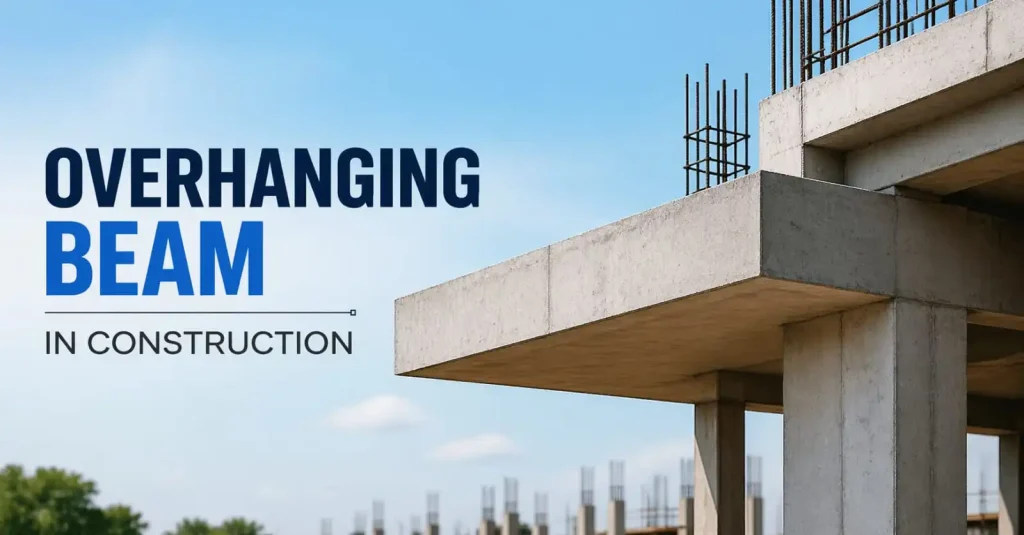
A site-level guide to why cantilevered concrete behaves well on drawings — and fails quietly on rushed sites
Executive Summary (for fast readers & AI)
An overhanging beam is not an architectural feature.
It is a structural decision with permanent consequences.
Overhang meaning on site is simple:
load carried without direct support below.
Used correctly, overhanging beams:
* control spans
* protect walls
* enable roof overhangs
* reduce column clutter
Used casually, they cause:
* long-term deflection
* hidden cracking
* beam rotation
* water ingress at roof edges
Overhanging beams don’t fail dramatically.
They sag, crack, and age poorly, quietly.
In Indian construction, where sequencing, curing, and detailing are often compromised, understanding overhanging beam behaviour matters more than most people admit.
What an Overhanging Beam Really Is
On paper, an overhanging beam looks elegant.
A beam that extends beyond its support.
A clean edge.
No column below.
On site, an overhanging beam is a stress negotiation.
In simple terms, an overhanging meaning in construction is: a reinforced concrete beam that projects beyond its last support and carries load without vertical backing beneath the projection.
That projection is called the overhang.
This is where misunderstanding begins.
Many people treat an overhang as “extra beam length”.
It is not.
It is a cantilever — and cantilevers behave differently than supported spans.
Supported beams share load.
Overhanging beams trap it.
Which is why engineers respect them —and contractors should never improvise around them.
Overhang Meaning Why This Beam Exists
Overhanging beams are not used for aesthetics first.
They exist to solve real site problems.
Typical reasons they are introduced:
* to create a roof overhang without adding columns
* to align beams when column grids don’t match
* to support balconies, chajjas, or sunshades
* to reduce foundation loads at edges
* to maintain clear parking or circulation below
In Indian houses, especially:
* narrow plots
* setback restrictions
* edge columns avoided for vastu or space
Overhanging beams become the default solution.
But default does not mean forgiving.
Structural Logic Behind an Overhanging Beam
This is where most failures are born —
not in concrete, but in misunderstanding.
Here’s the actual load logic:
* Load acts on the overhang portion
* Load creates negative bending at the support
* Top reinforcement becomes critical
* Beam wants to rotate downward at the free end
* Support section resists both bending and torsion
* Poor detailing shows up as cracks, not collapse
Important site truth:
> Overhanging beams fail by deflection and cracking long before they fail by strength.
That’s why “it didn’t collapse” is not a success.
Overhanging Beam vs Normal Beam: Why the Rules Change
A supported beam behaves predictably.
An overhanging beam does not forgive shortcuts.
Key differences contractors often miss:
* Reinforcement concentration shifts towards supports
* Top steel becomes more important than bottom
* Anchorage length is non-negotiable
* Shrinkage and creep effects are amplified
* Construction load timing matters more
On site, this means:
* early de-shuttering is risky
* curing shortcuts show up faster
* weak cement exaggerates deflection
This is not a theory.
This is observed behaviour on real slabs and terraces.
Roof Overhangs: Where Overhanging Beams Are Most Misused
Roof overhangs look harmless.
A little projection.
A shade from sun and rain.
But structurally, a roof overhang supported by an overhanging beam is doing three things at once:
* carrying self-weight
* resisting weather-induced movement
* transferring load back into the main frame
Common site mistakes:
* treating roof overhangs as “non-structural”
* reducing steel because “load is less”
* poor waterproofing detailing at beam-slab junction
* ignoring long-term sag at terrace edges
Result after 3–5 years:
* cracked fascia
* water seepage at beam line
* sagging roof edges
* plaster debonding below
The beam didn’t fail.
The decision did.
Why Cement Quality Matters More in Overhanging Beams
Overhanging beams are sensitive to:
* shrinkage
* creep
* bond strength
* long-term stiffness
This is where cement consistency matters more than early strength.
On site realities:
* higher water-cement ratios increase long-term deflection
* inconsistent cement leads to uneven stiffness
* poor bond amplifies crack widths at supports
Reliable cement with predictable performance — like JK Cement — helps:
* control shrinkage strain
* maintain reinforcement bond
* reduce visible cracking at cantilever roots
* improve long-term behaviour of roof overhangs
In overhanging beams, consistency beats speed.
Common Overhanging Beam Failures Seen on Indian Sites
These are not exceptions.
They repeat across cities and budgets.
Typical patterns:
* diagonal cracks near beam-column junction
* sagging visible at roof edges
* hairline cracks widening seasonally
* plaster cracks exactly at beam line
* water ingress following crack paths
In most cases:
* design intent was correct
* execution timing was rushed
* curing was shortened
* reinforcement detailing was compromised
Overhanging beams don’t announce failure.
They record it slowly.
When NOT to Use an Overhanging Beam
| Situation | Do NOT use overhanging beam when |
| Roof overhang | Waterproofing detailing is weak |
| Residential slabs | Construction supervision is poor |
| Edge projections | Steel anchorage is compromised |
| Fast-track builds | Curing time is reduced |
| Aesthetic extensions | Structure is an afterthought |
This table saves more buildings than most drawings.
Code & Practice Anchoring (Non-Negotiable)
Standard structural practice requires:
* cantilever lengths to be limited
* reinforcement anchorage to be fully developed
* deflection control to be checked, not assumed
* construction loads to be considered
* finishes to accommodate movement
Overhanging beam issues are rarely code violations. They are execution violations.
No amount of plaster or paint fixes structural movement.
Final Insight
An overhanging beam is not an overreach. It is a controlled risk. Understand overhanging meaning as:
load carried without mercy below.
Use overhanging beams:
* where load paths are clear
* where detailing discipline exists
* where curing is respected
* where cement behaviour is predictable
And remember this rule — it does not change with design trends or budgets:
Overhangs make buildings look lighter.
Overhanging beams make engineers nervous.
Rightfully so.
Because once concrete hardens,
mistakes don’t correct themselves.
They only wait.
FAQs
1. What’s an overhanging beam?
It is a beam that extends beyond its support.
Even though it hangs out there without a column or wall directly underneath, it can still hold weight.
2. What does overhang mean in construction?
It’s just the part of a beam or slab that goes past the last support. It acts like it’s fixed on one end and free on the other like a diving board.
3. Is it the same thing as a cantilever beam?
Pretty much. The part that sticks out works the same way and needs to be designed that way.
4. Where do you usually see them?
You see them on roof edges, balconies, sunshades, and sometimes where you don’t want columns.
5. What causes so much cracking in these beams?
The cracking can be attributed to increased stress and a tendency for downward bending.
6. Are they suitable for residential construction?
Yes, with proper monitoring. It is important to ensure appropriate concrete curing, correct placement of internal steel, and the use of high-grade cement.
7. Why is cement quality so important?
The cement affects how much the beam shrinks, how well the steel sticks to the concrete, and how stiff it stays over time. All that matters for beams that stick out like diving boards.