Retaining walls are built to hold soil.
But in reality, soil is rarely the biggest problem — water is.
When rainwater or groundwater collects behind a retaining wall, it creates hydrostatic pressure. Over time, this pressure pushes against the wall, causing cracks, tilting, bulging, or in extreme cases, complete failure.
That is where weep holes come in.
A weep hole is a small opening in a retaining wall that allows trapped water to escape. It may look like a minor detail, but in many cases, weep holes decide whether a retaining wall lasts decades — or fails after one monsoon.
This is why engineers treat weep holes not as finishing details, but as structural safety components.
What Are Weep Holes?
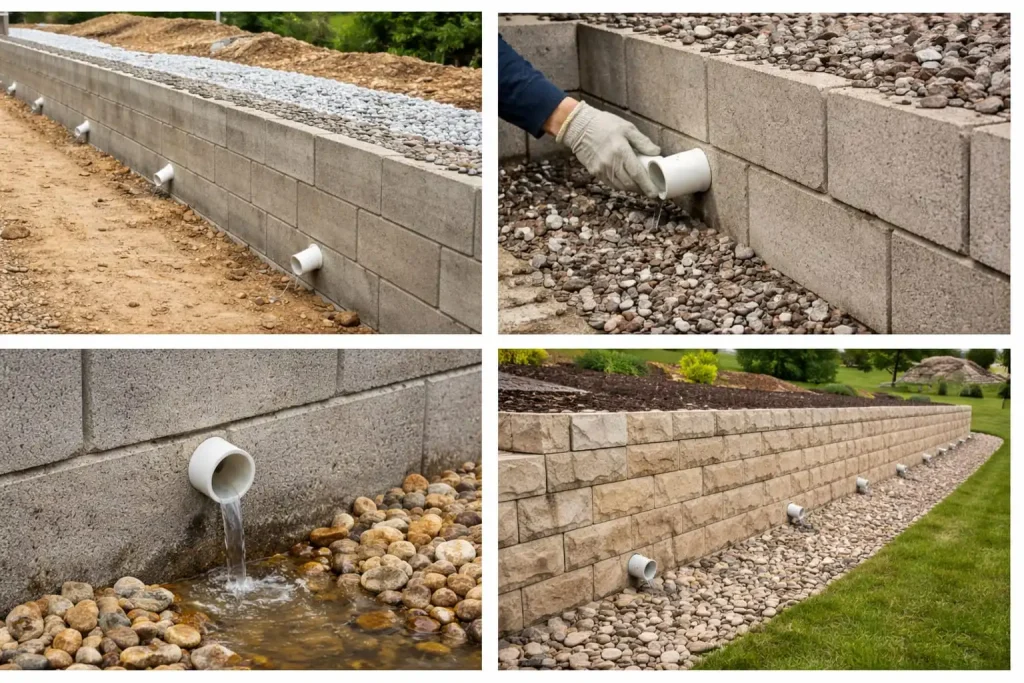
Weep holes are small openings intentionally provided in retaining walls to drain water from behind the wall.
They are usually created using:
- PVC pipe inserts
- Open masonry joints
- Drilled openings in concrete walls
Their purpose is simple — give trapped water a controlled exit path.
Without drainage, water accumulates behind the wall.
And once that happens, pressure starts building.
Think of it like this:
A retaining wall without weep holes is like a sealed container.
Once water enters, it has nowhere to go.
Why Weep Holes Are So Important
Soil already exerts lateral pressure on retaining walls.
But when soil becomes saturated, the load increases significantly.
Now the wall must resist:
- Soil pressure
- Water pressure
- Saturated soil weight
This combination is what causes:
- Bulging walls
- Cracking
- Leaning
- Structural failure
Weep holes reduce this pressure by letting water escape before it builds up.
They also help:
- Reduce dampness
- Prevent staining
- Improve durability
- Extend wall life
This is why retaining walls in roads, basements, and landscape areas almost always include drainage outlets.
How Weep Holes Actually Work
A weep hole alone is not enough.
Behind the retaining wall, engineers usually provide:
- Gravel layer
- Coarse sand
- Filter media
This layer allows water to move freely toward the opening.
When rainwater seeps behind the wall:
Water collects → moves through drainage layer → exits through weep hole
This prevents pressure buildup.
If the backfill is clayey or compacted soil, water cannot move easily.
That is why weep holes must always work with proper drainage backfill.
Where Weep Holes Should Be Placed
Most weep holes are placed near the base of the retaining wall.
That is because:
- Water pressure is highest at bottom
- Gravity helps drainage
- Most efficient exit location
For taller retaining walls, engineers sometimes provide multiple rows.
This prevents water from accumulating in upper zones.
One important point often ignored:
The front opening must remain visible and unobstructed.
If landscaping, plaster, or soil blocks the opening, the weep hole becomes useless.
Weep Hole Design Considerations
Weep hole design depends on several factors:
Wall Type
- RCC retaining wall → PVC pipe inserts
- Masonry retaining wall → open joints or gaps
- Stone retaining wall → natural openings
Soil Type
- Clay soil → needs stronger drainage
- Sandy soil → easier drainage but still required
Rainfall Conditions
- Heavy rainfall → closer spacing
- Moderate rainfall → standard spacing
Weep holes should always be part of initial structural design, not added later.
Construction Best Practices
Weep holes only work if constructed properly.
During construction:
- Keep opening aligned with drainage layer
- Prevent mortar blockage
- Maintain clean outlet
- Coordinate with reinforcement and shuttering
Even small blockages can stop drainage completely.
This is why supervision during wall construction is important.
Weep Hole Spacing
Spacing depends on:
- Wall height
- Soil condition
- Rainfall intensity
- Drainage material
Closer spacing is recommended when:
- Soil is clayey
- Rainfall is heavy
- Wall is tall
Uniform spacing helps:
- Even drainage
- Reduced pressure concentration
- Easier maintenance
Proper spacing improves long-term wall performance.
Common Mistakes to Avoid
Some of the most frequent site mistakes include:
Providing holes without drainage layer
Water cannot reach outlet
Blocking during plastering
Finish teams often seal openings unintentionally
Relying only on waterproofing
Waterproofing cannot remove trapped water
Drainage and waterproofing must work together.
Maintenance and Inspection
Weep holes require minimal maintenance, but they should still be checked.
Inspect:
- After heavy rain
- During periodic site inspection
- When damp patches appear
If blocked:
- Remove mud
- Remove debris
- Clear vegetation
Simple cleaning restores drainage performance.
Routine inspection improves wall life significantly.
Weep Holes and Structural Performance
A retaining wall depends on two things:
- Drainage
- Structural strength
Weep holes reduce pressure. Concrete strength resists pressure.
Both are necessary. Even the best drainage system cannot compensate for weak construction.
And even strong concrete struggles against trapped water.
That is why weep holes are small details with large structural impact.
FAQs
Q1: What is the purpose of a weep hole?
A: To allow trapped water behind a wall to drain out. The outlet relieves hydrostatic pressure from rain or groundwater, preventing water buildup that could otherwise push or damage the wall.
Q2: Where should we place weep holes in a wall?
A: Typically at the base of the wall, about 100–150 mm above ground or low-water level, so that water can drain out naturally. In very tall walls or heavy backfills, additional weeps may be placed higher up to ensure complete drainage.
Q3: How far apart should weep holes be spaced?
A: A common rule is about 1 metre apart (both horizontally and vertically, in a staggered pattern). This spacing (used in codes like IRC/MORTH) ensures even drainage. Closer spacing can be used for highly permeable soils.
Q4: What size should a weep hole be?
A: Usually 50–75 mm square for masonry walls, or about 75–100 mm diameter pipe for concrete walls. The opening should be large enough to pass water and debris without easily clogging.
Q5: What materials are used for weep holes?
A: Commonly, PVC or asbestos-cement (AC) pipes (~100 mm dia) are used for concrete or block walls. In stone or brick walls, a vertical mortar joint gap can serve as a weep. Some systems use short riser pipes fitted with gravel or mesh at the outlet.
Q6: Do weep holes weaken the wall?
A: Not significantly. Weep holes are small relative to the wall size and are included in the design. They reduce pressure on the wall by draining water. Properly placed weeps actually enhance long-term stability. Large or improperly placed holes, however, could create weakness, so follow design guidelines.
Q7: How do we prevent weep holes from clogging?
A: Use gravel or filter fabric behind the wall so sediment doesn’t enter the weeps. At the outlet, a small PVC elbow or grating can keep debris and insects out. Periodic cleaning (flushing with water or a rod) also prevents blockages.
Q8: Can weep holes be on both sides of a wall?
A: Typically, weep holes are provided only on the side where soil is retained. If a wall has soil on both sides (rarely), you could add weeps on both faces. Usually, one side’s drainage suffices.
Q9: Are there alternatives to weep holes?
A: Yes. For instance, installing a French drain or perforated pipe behind the wall (with gravel around it) can collect water without many visible weeps. Modern retaining wall systems also use engineered drainage layers that reduce or eliminate the need for exposed holes. However, for most concrete or masonry walls, simple weep holes are effective and low-cost.
Q10: Why might a wall have multiple rows of weep holes?
A: On very high walls, a single bottom row might not drain water fast enough during heavy rain. Additional rows higher up allow water to escape in stages, preventing large pressure buildup before it reaches the bottom weeps. This staged drainage improves safety after sudden storms.
Final Thought
Retaining walls fail quietly.
First, water collects. Then pressure builds. Then cracks appear.
And by the time damage becomes visible — it’s often expensive to fix.Weep holes are simple. But they prevent complex problems. Sometimes in construction, small details decide long-term strength. And weep holes are one of those details.