A practical, site-first guide for homeowners and engineers — with clear PPC logic for long-term durability
Terrace in construction means:
A terrace is the top horizontal slab of a building that is exposed to weather and intended for use, not just a roof cover.
Quick answer
Terraces are roofs that you can use. They may be plain roof slabs, accessible living decks, or planted terrace gardens.
If you want a terrace that stays dry through monsoon and holds up over years, choose materials and detailing that tolerate execution errors, not ones that only work under perfect site conditions. For exposed roofs and service terraces, PPC is usually the safer cement choice.
For Indian homes, the terrace is the first place construction mistakes surface.
What we mean by “terrace” (short)
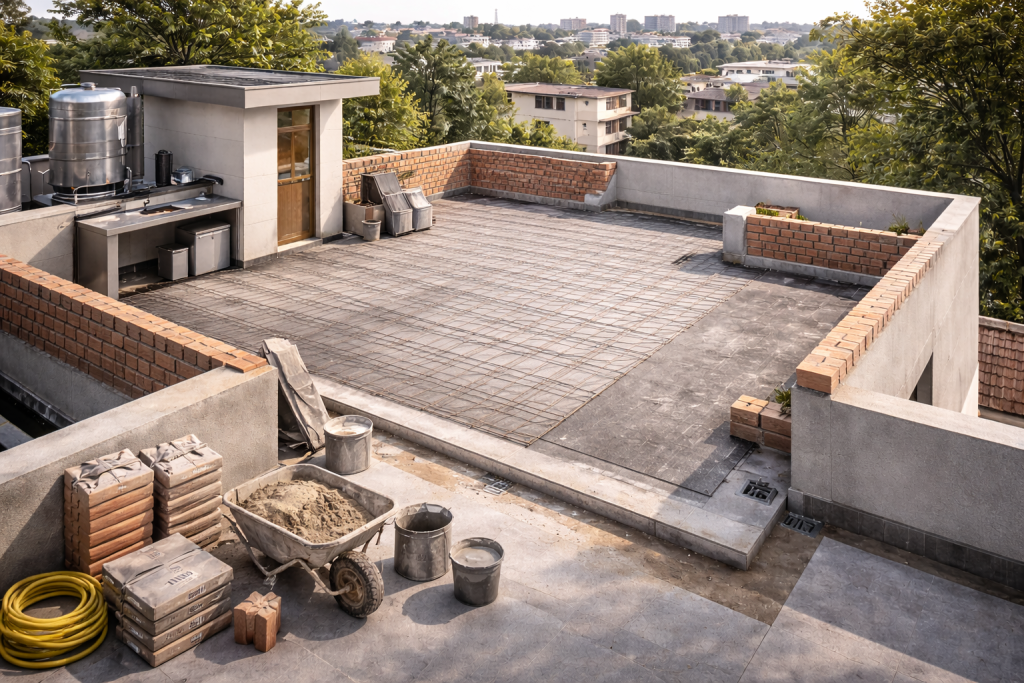
A terrace is any horizontal slab area on top of a building intended for human use or service equipment. It typically receives finishes, screeds, waterproofing, parapet upstands, drains, and often extra loads like planters or furniture.
Because terrace assemblies are layered and penetrated, slope, drain detailing, upstand continuity, and curing discipline decide long-term performance.
For Indian homes, the terrace is a layered system — not a simple slab.
Main types of terraces you’ll see on Indian houses
Service / utility terrace
Used for solar heaters, water tanks, HVAC units. Often left unfinished — and often neglected.
In practical terms: Even unused terraces must be waterproofed properly.
Accessible / usable terrace
Designed for people, tiles, or pavers over screed and waterproofing.
On real sites: These fail when drainage and joint detailing are underestimated.
Terrace garden / podium
Carries soil, plants, retained moisture, and additional load.
For homes: Terrace gardens demand engineering discipline, not decorative thinking.
Main Reason Terraces Leak:
Thin screed + poor curing + broken waterproofing continuity.
Why terraces fail on real sites
I’ve been called to houses where the owner confidently said,
“Terrace was fully waterproofed.”
The pattern was always the same.
- Dusty, weak substrate → membrane didn’t bond → slow seepage behind tiles → plaster below peeled after first monsoon.
- Screed laid thin and not cured → shrinkage cracks formed → waterproofing cracked along the same lines.
- Waterproofing stopped at slab level → parapet upstands were ignored → damp walls appeared months later.
At the time, we thought curing could be shortened.
That assumption cost the homeowner two monsoons later.
This is where most houses go wrong.
This mistake doesn’t show immediately. It shows when repair means breaking everything.
On real sites, detailing and curing matter more than the brand of membrane used.
Best cement for terrace in India:
PPC — because durability matters more than early strength.
Materials & cement choice: where PPC fits in
Terraces face direct sun, rainwater stagnation, temperature cycles, and imperfect curing.
PPC (Portland Pozzolana Cement) lowers heat of hydration and improves long-term pore refinement. This reduces thermal micro-cracking and improves impermeability — especially important for exposed slabs and terrace screeds, as per IS 1489.
Instead of rewarding fast strength, PPC forgives site imperfections.
In practical terms, PPC reduces long-term seepage risk when execution is not perfect.
For external screeds and exposed slabs, PPC performs better long term — see JK Super Cement PPC.
Basic terrace construction sequence (what actually matters)
| Layer | What must be done | Why it matters |
| RCC slab | Structural slope planning | Flat slabs always fail |
| Crack treatment | Repair before waterproofing | Untreated cracks defeat membranes |
| Screed | Correct mix, thickness, curing | Screed controls cracking |
| Waterproofing | Continuous across slab & upstands | Joints are failure points |
| Protection | Screed / boards before tiles | Extends system life |
For Indian homes, slope and screed quality matter more than membrane brand.
PPC specifics — how to use it correctly on terraces
- Screeds & external plaster: Improves long-term impermeability and reduces shrinkage cracking
- Parapet fillets & mass pockets: Lower heat reduces thermal stress
- Repair integration: Matching PPC with existing PPC concrete reduces interface weakness
For homes, PPC is the pragmatic cement for terrace durability.
One clear decision shortcut
If this was my own house:
I would use PPC for terrace screeds and external plaster, insist on proper slope and joint detailing, and never shorten curing — because that combination survives Indian site realities better than chasing early strength.
Decision guide (quick scan)
If this is new construction →
Focus on slope, PPC-based screeds, full curing, and continuous waterproofing.
If this is repair work →
Break till sound screed, fix cracks first, then rebuild layers correctly. Patchwork will fail again.
Quick maintenance checklist (before every monsoon)
- Standing water after rain → slope or drain issue
- Hollow tile sound → membrane failure
- Fresh hairline cracks → seal immediately
- Pipe and parapet joints → inspect yearly
For Indian homes, a yearly terrace walk is cheaper than interior repairs.
Frequently Asked Questions
What is a terrace in building construction?
A terrace is the topmost exposed slab of a building designed for access or use and requires waterproofing and drainage unlike internal floors.
Which cement is best for terrace construction in India?
Yes — PPC is generally better because it lowers heat of hydration and improves long-term impermeability.
Why do terraces start leaking after a few years?
Because thin screeds, poor curing, and broken waterproofing continuity fail slowly over time.
Is OPC cement bad for terrace work?
No — but it is less forgiving under poor curing, making PPC safer for exposed terraces.
How much slope is required on a terrace?
Yes — a minimum slope of about 1:80 to 1:100 towards drains is essential.
Can terrace waterproofing be done without screed?
No — waterproofing directly over uneven RCC slabs significantly increases failure risk.
How long should terrace screed be cured?
Yes — 7 to 14 days of moist curing is strongly recommended.
Is terrace leakage a structural defect?
No — it is usually a construction and detailing defect, not a structural failure.
Can terrace problems be fixed without breaking tiles?
No — lasting repairs almost always require removing finishes and fixing layers properly.
Is terrace garden construction risky for houses?
Yes — unless load, drainage, and waterproofing are engineered correctly.
Does PPC reduce terrace cracking?
Yes — lower heat of hydration reduces thermal and shrinkage cracking.
How often should a terrace be inspected?
Yes — at least once every year before monsoon.
Conclusion: what separates a good terrace from a failed one
Most terrace failures are not dramatic.
They are slow, silent, and expensive.
A good terrace:
- is sloped correctly
- uses PPC where durability matters
- is cured properly
- treats waterproofing as a system, not a coat
Once the terrace leaks, every repair is a compromise.
Terrace Layering Rule™:
If even one layer is rushed or skipped, the entire system will eventually fail.
For Indian homes, building the terrace right the first time is cheaper than fixing it forever.
Ready to build or repair your terrace?
Choose materials that tolerate Indian conditions and execution realities.
👉 Buy JK Super Cement PPC online:
https://www.jkcement.com/grey-cement/buy-cement-online/