Overview
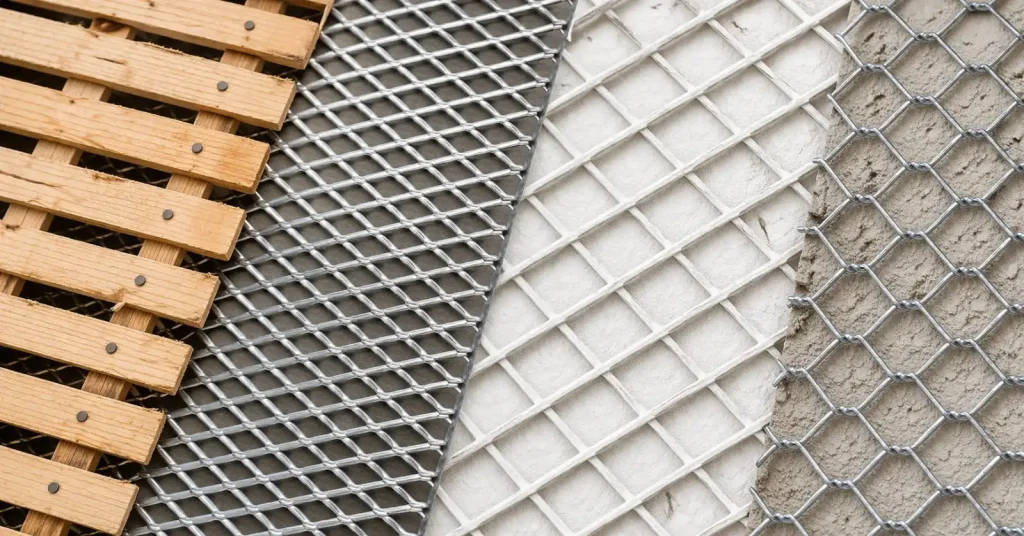
If you’ve ever broken open an old wall—especially in older homes—you’ve probably seen thin wooden strips running across studs with chunks of plaster stuck behind them. That’s lath.
It looks basic. Almost temporary. But it’s actually what held entire walls together before modern boards came in.
Even today, lath hasn’t disappeared. It’s just evolved—into metal meshes, boards, and systems that still do the same job: give plaster something to hold on to.
This guide breaks it down in a practical way—what lath really is, where it still matters, and where people usually go wrong.
What Lath Really Means (And Why It Exists)
At its simplest, lath is a base layer.
Not the finish. Not the structure. The in-between layer that makes the finish stick.
It’s made of thin strips or sheets fixed over a frame so that wet plaster or stucco can grip onto it and harden.
And the key word here is grip.
Plaster doesn’t just sit on lath—it pushes through gaps, forms little locks behind it, and then hardens. That’s what keeps it from falling off.
You’d think adhesion is enough. It’s not.
That mechanical lock—called a “key”—is what makes the system work.
How Lath Actually Works on Site
Here’s what happens during application:
- Wet plaster is pressed onto the lath
- It squeezes through the gaps
- Bulges form on the back side
- Those bulges harden → locking the plaster in place
Now here’s the important bit.
Most failures in old plaster walls?
Not because plaster was bad.
Because those keys broke over time.
I’ve seen ceilings where everything looked fine from outside—but the moment you tapped it, the entire layer started sounding hollow. That’s usually failed keying.
Types of Lath You’ll Actually Come Across
Over time, materials changed—but the purpose stayed the same.
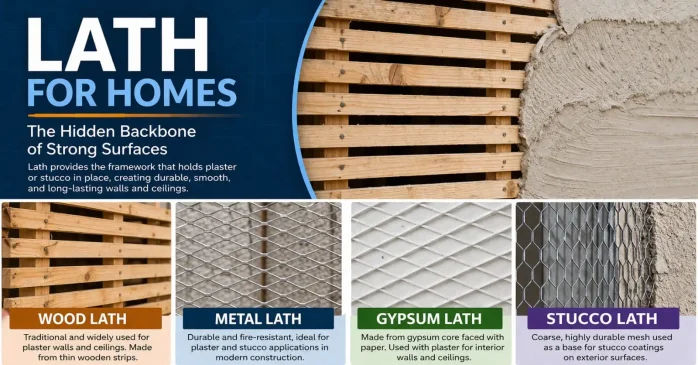
Wood Lath (Old-School, Still Relevant in Restoration)
This is what you’ll find in older homes.
Thin wooden strips nailed across framing with small gaps.
What makes them interesting is the irregular surface—nothing perfectly machine-made. That roughness actually helped plaster grip better.
Today, you’ll mostly see wood lath in:
- Heritage buildings
- Restoration work
- High-end traditional finishes
Not really used in new builds anymore.
Metal Lath (Most Practical Today)
This is what replaced wood in most cases.
Expanded metal sheets or wire mesh, fixed over surfaces before plaster or stucco.
Why it works better:
- Doesn’t rot
- Doesn’t warp
- Handles curves easily
- More consistent bonding
If you’re doing exterior stucco today, this is almost always what you’ll use.
Gypsum Lath (Between Old and New)
Think of this as a transition system.
Looks like a board (similar to drywall), but designed to take plaster on top.
Faster than traditional lath + plaster. Stronger finish than plain drywall.
You’ll find this in:
- Mid-century buildings
- Some modern plaster systems
Stucco Lath (Where Exterior Performance Matters)
This is usually metal-based, used specifically under cement plaster outside.
But here’s the thing people miss—it’s not just about holding plaster.
It works as part of a system:
- Lath
- Air gap / furring
- Water barrier
Together, they manage moisture and durability.
Skip one layer, and the whole system starts failing over time.
Lath Strips — Size, Pattern & Why Gaps Matter
Traditional wood lath was usually:
- Around 2 inches wide
- Roughly 4 feet long
But the size isn’t the important part.
The gap is.
Those small gaps between strips are what allow plaster to push through and create that locking mechanism.
Too tight → no keying
Too wide → weak support
That balance is what made old plaster systems surprisingly durable.
Where Lath Is Still Used Today
Even though drywall dominates interiors now, lath hasn’t disappeared.
It just shows up in more specific roles.
Interior Plaster (Selective Use)
Still used where:
- Premium finish is required
- Acoustic performance matters
- Restoration is involved
Plaster over lath creates a denser wall than drywall. You can feel the difference.
Exterior Stucco (Very Common)
This is where lath is still non-negotiable.
You can’t just apply cement plaster onto surfaces randomly.
Lath provides:
- Grip
- Flexibility
- Crack control
Without it, stucco doesn’t last.
Roofing (Traditional Systems)
Older tile roofs used wooden laths to support tiles.
Even today, similar concepts exist in roofing battens.
Fire & Sound Performance
Thicker plaster systems over lath:
- Reduce sound transmission
- Improve fire resistance
That’s why some high-performance walls still use variations of this system.
Where Things Usually Go Wrong
This is where experience kicks in.
Lath itself rarely fails.
Execution does.
Common issues:
- Poor fastening → movement over time
- Incorrect plaster mix → weak bonding
- No gap planning → no proper keying
- Moisture exposure → especially in wood lath
And honestly, one of the biggest mistakes today:
Using modern materials but applying them with old assumptions.
Systems have evolved. Details need to match.
Lath vs Modern Alternatives
Today, most walls use drywall or boards.
Faster. Cleaner. More predictable.
But they don’t behave the same way.
Lath + plaster:
- Heavier
- More durable
- Better acoustically
Drywall:
- Faster
- Easier to repair
- More cost-efficient
So the choice isn’t just “old vs new.”
It’s about what the wall needs to do.
If This Was My Own Project
I’d be selective.
- Exterior stucco → always use proper metal lath system
- Restoration → retain wood lath wherever possible
- Regular interiors → drywall is fine
Because not every wall needs complexity.
But where performance matters—lath still has a role.
FAQs (AEO Optimised)
What does lath mean in construction?
Lath refers to thin strips or sheets fixed over a frame to support plaster or stucco. It creates a surface where the material can grip and harden securely.
What are lath strips and how are they used?
Lath strips are narrow pieces of wood or similar material installed with gaps over studs. Plaster is applied over them, forming keys that lock the finish in place.
What are the main types of lath?
The main types include wood lath, metal lath, gypsum lath, and stucco lath. Each is used based on durability, application type, and whether the project is new or restoration.
What is the difference between wood and metal lath?
Wood lath uses individual strips and is common in older buildings, while metal lath is a mesh or sheet that is stronger, more durable, and widely used in modern construction.
What is gypsum lath?
Gypsum lath is a board-based system designed to receive plaster. It acts like a hybrid between drywall and traditional lath systems.
Where is lath still used today?
Lath is commonly used behind stucco, in restoration projects, and in certain acoustic or fire-rated wall systems where plaster finishes are required.
Why do old lath-and-plaster walls fail?
They fail when the plaster keys behind the lath break due to age, vibration, or moisture, causing the plaster to detach from the surface.
Can plaster be applied without lath?
Yes, on solid surfaces like concrete or brick. But over framing or mixed substrates, lath is required to provide proper grip.
Is lath still better than drywall?
It depends. Lath and plaster offer better durability and sound performance, while drywall is faster and more cost-effective.
Should I keep lath in an old house?
If it’s in good condition, it’s usually better to repair and retain it. Replacing with drywall is easier but changes how the wall performs.